
Archeon Tarot Deck Review

Creators: Timothy Lantz
Published: 2005
The Archeon Tarot features a mix of traditional and non-traditional imagery in dream-like digital collage, inspired by the author's personal symbolism and mythology.
Retailers
See Price at Amazon.comSee Price at Amazon.co.uk
See Price at Amazon.ca
Archeon Tarot Review by Dionysius S. Badarian
Paul of Tarsus, the persecutor of Christians, later convert, apostle, and saint, wrote in the first century CE, "We see now as through a glass, darkly... then shall we see clearly, face to face."(1 Cor.13:12) He was writing of our experience of spiritual seeking in this life, and then in the one he believed was to follow. The Archeon Tarot by Timothy Lantz could have been Paul's subject. The glowing, swirling images are dark, a bit mottled, and somewhat indistinct; reminding us that what views we may glimpse of the past, the present, and of future possibilities by using the tarot will be less than perfectly clear. Life and vision on this plane of existence is necessarily and naturally limited. Later when we have moved to a higher level, we will have clarity. At least, so we may hope.
I'm not always fond of darker coloured decks; aside from sometimes seeming depressing, often the palette suffers in what is likely a printing issue. That is definitely not the case here, perhaps due to this deck having been printed in Italy. The colours are deep and rich, and many of the card images have an inner glow to them. With the entire deck spread on a table, one can see the predominance of oranges and reds on the majority of the cards, with blues dominating most of the remainder. There is some purple, green, and grey as well. Details are picked out with golden yellow, violet, and white. Contrast is provided by black, present on every card. The borders are actually triple: a very narrow striped band surrounds the image, then a small area of mostly dark greens, and ultimately a narrow black band around the outer edge of each card. This sounds as if the borders are very wide. They are not; only a bit over one quarter inch on the top and sides, while slightly wider on the bottom for the title/number. The backs have a pleasant reversible design of the same dark greens, and gold. Titles and numbers are in white, are very clear, but do not overly intrude. Few pastels here; the colours are vigorous and determined. The quality card stock has a glossy finish, and is a good size at 2.75" by 4.75". The overall effect is one of great visual depth.
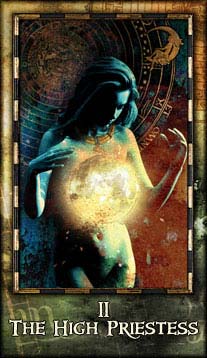
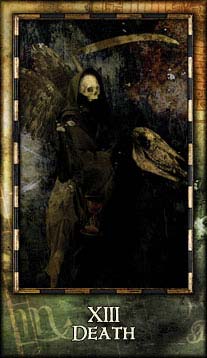
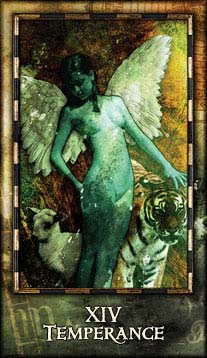
Lantz has created a fully illustrated, standard format tarot deck, with 78 cards and the usual 22 in the Major Arcana. The Fool is first, with Strength as VIII and Justice as XI. The vibrant images vary from recognisably close to traditional, as in The Chariot, Strength, and the Hermit, to uniquely Lantz, as in The High Priestess(see scan on other page), Temperance(see scan), and The World(autumn foliage). The Devil is a wonderfully mischievous Pan figure. The beautiful Moon card, always a "test card" for me, features a full moon, smaller phased moons, two female figures, and two ravens(a number of these fascinating black birds appear on various cards). Despite the absence of towers, pooches, and a crustacean, this is a very evocative image. The Majors include at least 11 cards with moon images(and the Minors 15); not a bad thing to my mind! Suitably enough, Death(see scan) is the very darkest of all these card images.
There are the usual 4 suits of 14 cards, being Cups, Swords, Pentacles, and Wands. The only title change is amongst the Court cards, where we find Herald, Knight, Queen, and King. Dominant colouring amongst the Courts are orange/brown in Cups, grey/rust in Swords, orange/violet in Pentacles, and red/black in Wands. This works out to be more attractive than it may sound.
As far as suit symbols are concerned, in the suit of Cups, every card includes goblets of various types in the appropriate number set within the image. The lone exception is the Ten of Cups, which has 10 Japanese Sake cups. The suits of Swords and Pentacles include essentially identical symbols on each card of the appropriate number, worked into the image. The Swords are swords, but Pentacles are represented by an interesting circular device apparently used in ancient astrology(a "Horologium"?). This also appears as part of the back design. Amongst the Wands there is much more diversity, the Ace being an ancient Egyptian papyrus-working tool, and most of the others are longer, narrower, and pointed; some are even dangerous looking.
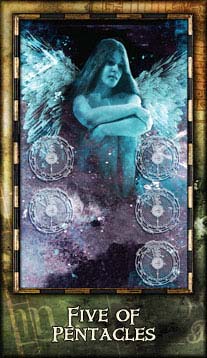
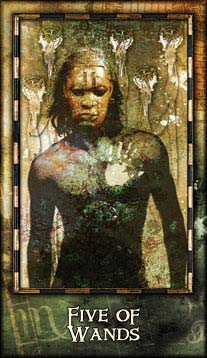
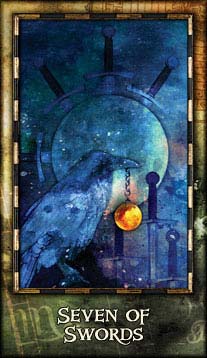
With all the Minors being illustrated, there are again some differences in imagery from a RWS-style deck. The following examples are not exhaustive, but will give a sense of the visual and symbolic changes Lantz has made. None of the Knights has a visible horse, and the Knight of Swords is probably female. The Seven of Cups and the Three of Wands both contain a Pegasus figure(winged horse). Three of the Heralds are female, and the Herald of Pentacles is a somewhat androgynous angel figure. In the suit of Swords, the Two, Six, Eight, and Ten are recognisably close to RWS standard, while the others are perhaps less so. The Seven of Swords(see scan) is a favourite of mine, with a "trickster" raven holding a solar disk, like a gold pocket watch by the chain, and nearly merging with its lunar background. Amongst Pentacles, the Five is a somewhat sombre angel seated and hugging her knees(see scan), while the Ten is an elaborate castle upon a rock overlooking a lava flow. In Wands, the Five is a wild-looking male figure(see scan) marked with a white handprint a la the Uruk-hai from "Lord of the Rings". The Seven is a Japanese pagoda-type building high on a hill at night, and the Ten has that number of human skulls topping each of the "wands" in the foreground. For the suit of Cups, the Three is a dark-haired woman holding a smallish black bird with a huge full moon in the background. The Six is a masked and costumed Carnivale character in the midground with an old manuscript, and the Nine is devoid of living creatures but displays coins and other symbols of material wealth in addition to the nine gold goblets present. There is some nudity in this deck. It has been, as they say, "tastefully handled", but it will not escape notice that there is somewhat more of the female variety than of the male. That said, several women have told me of their very positive reaction to the men depicted on cards such as the Five of Swords, Eight of Pentacles, and Nine of Wands.
Now a few words about the 48 page LWB that comes with the Archeon Tarot. Here Lantz explains too briefly the "Symbolist" approach that undergirds his art, and how the card images are personal to the point of being "windows" into his own "mythology". With some relief then the reader will find individual card significations given that are not a radical departure from standards like the RWS. In other words, in the Archeon Tarot, sometimes very different images have been used to convey basically the "meanings" with which most of us are familiar. There are some Lantz nuances, but the author-artist takes a fairly conservative approach, and there is no need to learn an entirely new tarot system. Only one spread is given; the venerable Celtic Cross. This is one of the more basic but still useful LWBs I've seen.
This is definitely a tarot deck for collectors. I can see how it might be used in meditation. Some interesting storywork could emerge from it. It can certainly be used for divination, perhaps even for tarot beginners with a nocturnal inclination. In a pinch, because of the numbers of suit symbols on each card, one could even play Tarocchi. However, as far as I can determine, this is not a "sophisticated" tarot for pathworking or astrological use. Archeon is a visually attractive set of tarot cards for regular reading, with no perceptible religious bias. It lends itself very well to intuitive reading. And this is no amateur artistic effort. As modern tarot decks go, this one is skilfully made, pleasant to use, and refreshing to the eye and mind!
Read more reviews of these cards at: Amazon.comAmazon.co.ukAmazon.ca
Archeon Tarot Review by Mary Terhune
My personal favorite artist is Odilon Redon, a leader of the late 19th-early 20th-century Symbolist movement. I was put in mind of Redon - both his noir and his color work - by this deck without having so much as cracked open the “little white book”. When I did so, the first things that met my eye were the definitions of Symbolism, and the statement that Timothy Lantz "would like to believe that he would have been a Symbolist". He has the same soft focus and subdued tones to his art, not to mention magical imagery.
The theme throughout is myth, as in the winged Pegasus horse in the 7 of Cups. The figures are ethereal, including the winged female Heralds which replace Pages in the suits. There are a plethora of women to be found here, often (but not always) nude. The Empress is just a face, pensive and thoughtful. The High Priestess is a nude figure who seems to be giving birth on the Mental plane to the Unconscious, in the form of the Moon. There is a running theme, also, of an astrological chart, which is used on the back, and as the coins of the Pentacles suit. This gives the the deck a hint of esoterica; I find such images to have a learned sort of beauty.
That said, I must add that the symbolism is often obscure, at best. Too, it seems to bear little relation to the meanings of the cards. The Rider-Waite-Smith is only fleetingly referred to. This is not in itself so much a stumbling block; however, the interpretation will probably rely much on the LWB (little white booklet) until one is more familiar with Lantz’s noir and Gothic imagery.
It is a dark deck, full of whispers of the Occult. I would even term it an 'art' deck,with the imagery taking place above the individual meanings of the cards. There is a 'Carnivale de Venezia' theme throughout as well, with the appearance of masks repeated throughout, worn and unworn, as on the masked Heirophant, and the Fool with her masks at her feet. This gives a macabre sort of feel, as of the masks that are worn to show certain things to certain people at certain times, however sincere or insincere. It also gives the deck a distinctly theatrical quality. The imagery is also multi-cultural, with the Emperor a Mayan chieftain, and the Oriental woman on the 6 of Wands.
The imagery, again, is dark and macabre, particularly the Hanged Man, which is of a decayed and wasted body. The Tower is a Gothic ruin; the Hermit hard to make out in front of another ruin in the background. The Suits sometimes only show the suit symbols, sometimes they show more ideas in symbolic form. Women, often nude and/or winged, are frequently the only other element in the composition of the cards. The images could be called murky.
Overall, this is not an easy deck to use; intuition is to be heavily relied upon by experienced readers, as, once again, the ideas in the deck are far from obvious. I have been reading for 27 years, and this deck will at times leave me stumped. The LWB has brief, pithy meanings, including reversals which is all to the good. The meanings are original and clearly written.
The layout of the cards includes a border with this montage-style work, with that element, the astrological chart. The titles of the cards are large and clearly framed. In fact, I personally am of the opinion that they could take up a little less of the space that could be devoted to the exceptional artwork.
My recommendation of this deck is to lovers of the obscure and the esoteric, the Goth and the dark, and those who are very experienced readers. Those less so will have, I believe, trouble with this deck - beginners should definitely beware, however and those with medium experience may have difficulty. It is beautiful, but odd. The imagery’s intent is often far from clear. I don’t see it becoming my favorite deck, but I can see growing fond of it over time. I will use it mainly in cases where a very dark mood prevails (I have used it in contact with the departed with good results).
I will use this deck, personally as a standby when I need pips, and therefore can’t use the Giger Baphomet, my darkest deck to date. If you need symbolism that is very clear and extensive, you will probably find this deck troublesome. If you love the Goth and the weird, you will love this deck
Read more reviews of these cards at: Amazon.comAmazon.co.ukAmazon.ca
Archeon Tarot Review by Remi Daily
“The power of Timothy Lantz’s art is awe inspiring. His multi-dimensional imagery draws the individual toward spiritual awakening, stirring the emotional repertoire of the soul. Timothy’s gifted work contributes to a wealth of tarot imagery offered through US Games throughout the world. I am eager to acquire a deck of my own” - Isha Lerner creator of Inner Child Cards
The Archeon Tarot brings to mind the era of post-industrial music. Wikipedia describes post-industrial music as an experimental musical style that draws on transgressive and provocative themes. Some people may not have understood the antics of Marilyn Manson or Trent Reznor of NIN, but no one could escape the rhythmic and wonderfully addictive beats of their songs. If you look beyond the darkness of the façade, one will find two artists who are profoundly intelligent, gifted moneymakers, who have refined interests in the classical arts. These well-known leaders of post-industrial music represent what the Archeon Tarot is to me. The Archeon Tarot is a dark deck that isn’t so dark and beyond the images on the card you will find within the little white book a strong sense of depth entrenched in refined philosophical and artistic tastes.
I personally fell in love with this deck because of Timothy Lantz’s take on the High Priestess card. The High Priestess is personified with a glowing ball of Earth that hovers over the chest and stomach of a woman as she looks within for answers. Eager to get this deck in my hands, I immediately open it up and internally sighed. Fourteen cards that make up the 78-card deck display nude or semi-nude human forms, all female except for one male. Initially, this realization attacked my prudish sensibilities. However, as I was going through the deck I couldn’t keep from humming the refrain from Marilyn Manson’s song “The Beautiful People”. Despite the nudity, the models are aesthetically attractive.
At first I had some difficulties using the deck due to my squeamishness of nude forms but second sight told me to hold onto this deck as I will find something special about it. When working with any deck, if the deck can provide you any insight and accuracy, you tend to look beyond any initial superficial indifference.
There is a transparent feel with these cards being owed to the layers of opaque images superimposed over another. For some readers, this transparent style of layering activates the intuitive nature while a connection is formed between the layering and the reader. The layering provides a message of what is real in conjunction to what is tangible and what lies beyond for each card. This experimental style, which Lantz calls symbolism, is what invokes transgressive and provocative themes that may be brought forth during a specific reading.
The symbols used for some of the cards may not be symbols or images readily accessible to everyone. Such examples would be the appearance of the crow or the few unexpected appearances of a Native American chief and its association with the moon. However, those who are learned in the history of the Tarot will find amusement in the Five of Wands card that features an aboriginal man with a hand imprint on the left side of his chest. The hand imprint on the chest is Lantz’s ingenious way of representing the internal/external conflict or changes one endures within the human form. Lantz also does something with the seven of swords that many contemporary decks have abandoned as he features this card with the image of a magpie holding a gold pocket watch in its mouth. This deck is a perfect balance of integrating the old with the new.
The color choices of the deck may appear dark but is accompanied with pleasing washes of accent colors. The accent colors are in hues of blue, red, yellow, and white. Despite the additional color, the images on these cards lend to an old-world photograph feel, similar to stumbling upon aged yellowed photographs in a time capsule you have just uncovered.
“Consider The Archeon Tarot a window into the mythology of one man’s world, or at least how he imagines his world to be.” would be the best way of summing up the artistic license Lantz has taken in formulating the meanings for the cards. I really do enjoy the LWB for this book as there is a list of word descriptors for each card in its upright and reversed form. For the major arcana, inspiration is a quote from a famous archetype in history or a quote from Lantz himself depicting the energies of the minor arcana. I relish in the quotes provided for Leonardo DaVinci and Eleanor Roosevelt for the Chariot and the Strength card:
“Obstacles cannot crush me. Every obstacle yields to stern resolve. He who is fixed to a star does not change his mind" -Leonardo DaVinci
“We gain strength, and courage, and confidence by each experience in which we really stop to look fear in the face…. We must do that which we think we cannot” - Eleanor Roosevelt
To sum up this deck I would compare it as the Quantum Tarot meets Vertigo Tarot. The Vertigo Tarot seems far darker in its illustrations than the Archeon, but uses the same juxtaposition of images on the cards. The background of The Archeon Tarot is very cosmic, mimicking The Quantum Tarot. Recently I’ve been exploring the world of Edgar Cayce and found a connection between the Cayce’s visions of the pre-mortal world and The Archeon deck. Cayce states that before we come to Earth we sometimes spend time on other planets expanding our thought forms to the qualities of that planet before we inhabit a body on Earth. Each card from The Archeon reminds me of traveling through space and being able to slow down just long enough to find the face of a vibrant Queen of Cups (who is Lantz’s wife) ruling over a particular solar system or an Indian Chief residing over a fiercely red planet called The Emperor.
Read more reviews of these cards at: Amazon.comAmazon.co.ukAmazon.ca
Archeon Tarot Review by Rae Louise
This was the first tarot deck I purchased and undoubtedly remains my favourite. The imagery on the cards is hauntingly beautiful, like an ancient manor house steeped in dark history; only by entering will you uncover its secrets...
That’s very much how I felt upon delving into this deck for the first time, and The High Priestess is a perfect choice for the cover of the box. Being the most spiritual of the cards, she’s shown gazing down into a glowing orb of secret knowledge, and the blue hues to her flesh make her appear otherworldly – alien, even. I have always been a visual person, and the unusual artwork of The Archeon Tarot really digs into the imagination, forcing you to connect with your deepest emotions.
It was Lantz’s intention to create layers of meaning in the card’s symbolism, and on first impression the gloomy colouring might put people off due to the ‘negative’ vibe it creates. Both the Three and Ten of Cups have a dark simplicity to them, despite their celebratory meanings. Traditionally painted with rainbows and happy families, in this deck the Ten of Cups portrays a lone woman reaching towards a stack of cups, with nothing but a skeletal-looking tree in the background and a crow soaring overhead. In the Three of Cups we have another lady huddled up on the ground, her only companion being the little bird cupped in her hand. In both of these cards the moon is present, indicating a night-time theme.
I think a less intuitive person might struggle with this deck; as a newbie I too found them confusing at first, but they were so striking to me that I couldn’t stop looking at them and my creativity soon began to flow. A lot of the characters in these cards appear sombre, their nudity demonstrating the vulnerability of human nature, but this helped me to connect with them almost as if they were real people. Like they were speaking to me, sharing their thoughts and feelings so in turn I was able to tap into mine. There’s raw emotion in their facial expressions and body language that is perhaps lost in more traditional tarot decks.
The Ace of Cups has an orange-brown background, yet this causes the silver goblet to pop from the card, emphasising its beauty and purity and the shiny newness that it stands for. The floating heads or ‘masks’ in the background remind us too of the spiritual nature of the card. The Star is also set against a dark, midnight-blue background, but the contrasting moon illuminates the form of a woman, as if the card’s messages of peace and hope are reflected in the radiance of her body. Lastly, I have to mention The Magician – portrayed as a young man devoid of the usual tools and gadgets that we see scattered around his workbench. This is the card that initially drew me to the deck, admittedly due to the sheer attractiveness of this man! Everything about him oozes confidence, and the globe behind him suggests that he has the whole world in his hands.
Onto the artist and creator of The Archeon Tarot, Timothy Lantz describes his love of symbolism in the handbook, and the random shapes, letters and words that crop up on the cards does give them a ‘thrown together’ sort of feel, but this is purposeful in the fact that it forces us to look beyond the surface and get to the true meaning of the cards. The Three of Pentacles, for example, shows floating spheres above a derelict archway, so again Lantz forces us to use our imaginations – is the structure actually the crumbled remains of something, or is it in the process of being built?
I think the suits of wands and swords in this deck both speak for themselves, with the colours, symbols, shapes and characters capturing the essence of the cards perfectly. There are also many references to mythology, as well as other cultures and time periods, in the varying symbolism. The Ace of Wands and The Chariot both have Ancient Egyptian themes, which was convenient for me seeing as I have an interest in that era of history – sometimes I wonder if this deck actually chose me!
Overall, I would say that the usefulness of this deck largely depends on the personality of an individual and whether or not they can look beyond the nudity and glum undertones. While it may not be the best deck to learn with, once you’re familiar with the divinatory meanings of the cards I feel this deck can take your subconscious to levels you never knew existed. As for the handling of the cards, they are printed onto laminate card and so do tend to slide around while shuffling, but this seems to bring them to life even more. They also come with a border, thus shrinking the imagery rather than using the entire card’s surface, but this doesn’t detract from the realism or attractiveness of them.
Read more reviews of these cards at: Amazon.comAmazon.co.ukAmazon.ca
Complete Details of Archeon Tarot
Creators: Timothy LantzPublisher: US Games 2005
Deck Type: Tarot Deck
Cards: 78
Major Arcana: 22
Minor Arcana: 56
Deck Tradition: Mixed
Minor Arcana Style: Unique Scenes With Suit Symbols
Suits: Cups, Swords, Wands, Pentacles
Court Cards: Herald, Knight, Queen, King
Major Titles: 0 The Fool, I The Magician, II The High Priestess, III The Empress, IV The Emperor, V The Hierophant, VI The Lovers, VII The Chariot, VIII Strength, IX The Hermit, X Wheel of Fortune, XI Justice, XII The Hanged Man, XIII Death, XIV Temperance, XV The Devil, XVI The Tower, XVII The Star, XVIII The Moon, XIX The Sun, XX Judgement, XXI The World
The Fool is 0
Strength is 8
Justice is 11
Card Size: 4.75 x 2.75 in. = 12.06cm x 6.99cm
Card Language: English
Card Back: Reversible
Back Design: Shades of green and black with superimposed gold.
Companion Material: 47 page booklet in English. Keywords provided for both upright and reversed positions for all cards. Quotes provided for all cards. Additional comments provided for major arcana only. Explanation of celtic cross spread provided.
Similar Decks to Archeon Tarot
Theme: Dark & GothicCategory: Available Tarot Decks

< Previous Deck · Back to Top · Next Deck >
Home > Tarot Reviews > Archeon Tarot Review
