
Dame Fortune's Wheel Tarot Deck Review
Publisher: Lo Scarabeo 2009
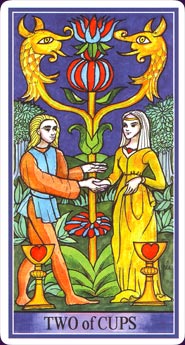
Dame Fortune's Wheel Tarot is a deck of 79 cards - 22 majors, 56 minors and one significator from author, Paul Huson. The cards are based on the Huson's research presented in Mystical Origins of the Tarot, and have Marseilles-inspired majors and Etteilla-inspired, fully illustrated minors. The deck is complete with an instructional booklet and now published by Lo Scarabeo.
Retailers
See Price at Amazon.comSee Price at Amazon.co.uk
See Price at Amazon.ca
Dame Fortune's Wheel Tarot Review by Lillie
Dame Fortune’s Wheel, created by Paul Huson and Published by Lo Scarabeo, is a tarot deck that blends ancient images with Etteilla’s 18th century cartomantic tradition and creates a deck that is enthralling, readable and beautiful. Paul Huson, long known as a writer and scholar of esoteric subjects, has stepped back in time beyond the fin de siecle occultists of the Golden Dawn to explore and illustrate the oldest extant tarot traditions. In doing so he has produced a deck that is a practical example of tarot scholarship at it’s best. Huson has also produced an extended booklet to go with the deck, which goes into some detail about the images, symbols and iconography he chose to use and which can be downloaded free from his web site.
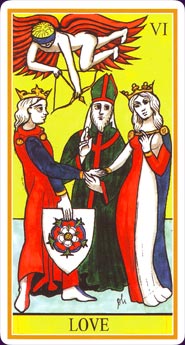
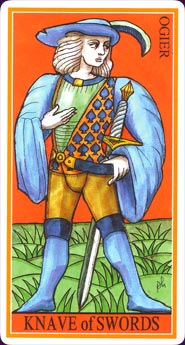
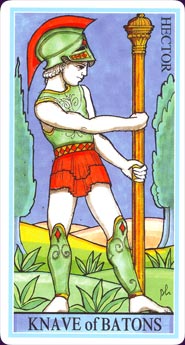
Essentially the deck is arranged in the familiar manner, it has 79 cards, which comprise the usual pack plus the addition of an optional significator card that can be used or ignored according to the readers taste and desire. The 78 cards of the standard deck are structured along traditional lines; Justice is VIII and Fortitude is XI; The Fool is unnumbered and Death unnamed. The trumps are easily distinguished from the suits, and the suits from each other, by a simple but effective system of colour coding where each is given a predominant colouration, particularly in the titles and the backgrounds. The backs are reversible, the minors fully illustrated and the court uses the traditional nomenclature and poses. Kings and Queens are enthroned, Knights on horseback and Knaves are standing; all hold the symbols of their suits. In addition, for all but the knights, the court cards are given names as well as titles. These names, drawn from history and legend, are historically associated with the corresponding figures on French playing cards packs.
The deck is illustrated throughout in a brightly coloured, quasi-medieval style that harks back to the historic inspiration for the cards and which is both enchanting and delightful. The faces of the people depicted portray a sensitivity and grace that is reminiscent of the faces in stained glass windows. The richly coloured clothes and lush surroundings are only enhanced by the deliberate naivety of the images; the disproportionate figures and peculiar perspectives add to the feeling of truth and authenticity that is so clearly a part of these cards.
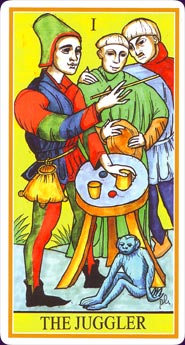
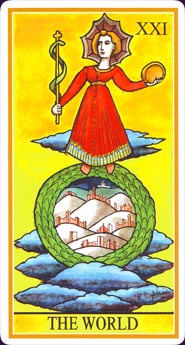
The 22 trumps have a yellow green background and the images chosen for them conform to the traditional images found upon old and antique decks and medieval images. These range from hand painted cards and wood block prints of the 15th century up to the well-known 18th century Conver designs and include the figure of Dame Fortune herself on trump X, turning the wheel of fate upon which we all ride. In keeping with the origin of these images and the ancient inspiration for this deck there is no cabbalistic and few astrological associations on these cards. Instead Huson relates them to medieval mystery plays such as the Dance of Death and to historical and allegorical figures such as pope Joan and Judas Iscariot who would have been familiar to the people of that time. Huson also relates the images to the four cardinal virtues, three of which are clearly named and the fourth, Prudence, which has been variously identified by other tarot scholars, is here linked to trump XXI, The World where it is illustrated with an image based upon the 15th century Este design in which the figure of Prudence stands upon the material world holding her symbolic accoutrements of mirror and snake.
The virtues are also associated with the minors, one being given to each suit, as are the French playing card symbols of Clubs, Hearts, Spades and Diamonds. In his extended booklet Huson mentions the elemental associations of the suits and these appear to be acknowledged in the colour coding. Coins are a deep verdant green, Cups are a dark indigo, Swords are in fiery orange and Batons a pale sky blue. However, other than these thematic colours the elements seem to play little part in the design of the cards; instead the meaning and symbology is given over almost entirely to Etteilla’s neglected and derided interpretations of the minors first published in the late 18th century. Huson has fully illustrated these minors and as with the majors the designs are taken from, or drawn to imitate, medieval illustrations and the suit symbols are clearly shown, generally above or below the illustrative picture.
Just as Pamela Colman Smith famously illustrated A E Waite’s deck and gave the world of tarot the first truly pictorial minors, so has Huson done for Etteilla’s meanings, giving form, substance and readability to these cards. It will not go unnoticed that a few of these designs bear distinct correspondences to the symbols in the RWS images. Most notable amongst these would be the tombs in the 4 of Swords and other examples would include the family with in the gates of their walled home in the 10 of Coins and the man, lost in ennui on the 4 of cups, unable to see the wonder before him. These similarities do not, however, illustrate Huson’s reliance upon the Waite/Smith designs, instead they serve to draw attention to the fact that while Waite had nothing good to say about Etteilla and his works he never the less used his meanings as a basis for his own interpretation of the minors, as had Mathers before him. Because of this lineal descent the modern reader, familiar with the RWS will, in most instances, find it relatively easy to accommodate the images on Huson’s cards within the range of meanings given by Waite, though not necessarily with Colman Smiths drawings.
The majority of these images on these cards bear no relationship to any other deck and appear to be entirely original portrayals of the ideas contained therein. To create them Huson has used an illustrative technique that not only used the scene portrayed to convey the meaning but which also incorporates symbolic allusions which would have been familiar to the medieval mind; symbols such as flowers, objects and allegorical figures that made up the lexicon of the common person in the days before reading and writing became wide spread. That there are more symbols, nuances and subtleties than are apparent at first glance or that are explained in the extended booklet seems to be a likely proposition and whether these are mentioned in Huson’s recent book ‘Mystical Origins of the Tarot’ or whether the reader must discover them for themselves, they make the deck more than worthy of further study and exploration.
Both the symbolism and the use of Etteilla’s meanings may be thought to detract from the readability of these cards, as though they might only be used successfully by someone with a deep grounding in medieval iconography or a knowledge of Etteilla. This is not so, the pictures, the poses, the faces alone speak volumes and intuitive readers should find much in these cards to spark their imagination, while a reader who prefers to work from the interpretations given in books will soon find that the charming and attractive images serve as an aide memoire to the meanings.
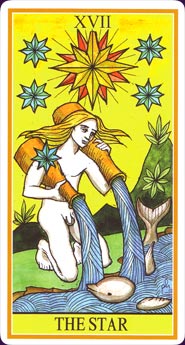
It can be said that a review would not be a review if it did not attempt to give a balanced view of it’s subject; it is therefore necessary to mention whatever flaws may be present in this deck. This is not an easy matter; Huson has created a deck where the majors perfectly capture the chosen iconography of the image, from the crude and clumsy Devil to the enigmatic androgen on the Star; where the courts are filled with people full of character and expression, from the serene confidence of the Queen of Coins to the saturnine Knight of Batons and where the minors are filled with perfect vignettes of life ranging from the doomed lovers in the 5 of Coins to the knight winning honour and acclaim in the 9 of cups. If a flaw can be found in this deck it is that the dark indigo used for the background of the suit of cups makes the names of the King, Queen and Knave difficult to read in certain lights. But it could also be said that the colour is beautiful enough to make it worth such a small inconvenience.
Produced to the high standard enjoyed by all LS Tarots, Dame Fortune’s Wheel is a rare example of a deck that throws light upon a much ignored part of tarot history whilst being exquisitely attractive and easily readable. Indeed it could be said that this is a significantly important tarot deck, it is a bold illustration of serious tarot scholarship. One is given the impression while using it that this could have been the pattern for all modern tarot decks had the Golden Dawn and Waite never stepped forward to exercise their current strangle hold over the Anglo American tarot world. Every tarot reader, especially those who are exclusively familiar with the RWS, should at least look at these cards; both to see where tarot has come from and where it might have gone had things been different. In a sense it is an illustration of the fragility of that which we call tradition. The Etteilla minors, once the corner stone of tarot divination and still popular in Europe, have become almost forgotten in the English-speaking world. Huson and Lo Scarabeo are to be commended for bringing them back to current attention in such an accessible way.
Dame Fortune's Wheel Tarot Review by Le Fanu
Every now and again, a deck comes along which gives even seasoned tarot users a bit of a mental reorientation and makes them rethink the tools they are working with. Dame Fortune’s Wheel Tarot, illustrated by Paul Huson and published by Lo Scarabeo is perhaps one such deck. Whenever a new Lo Scarabeo deck comes onto the market, you can always guarantee that it will have an added twist and, given a chance, will always have something which stretches the reader or pulls them in a direction where they might otherwise not have ventured. We should applaud Lo Scarabeo for consistently taking contemporary tarot into new directions and never letting us get complaisant, and Dame Fortune’s Wheel, given a little time and study should reap rich rewards.
Paul Huson is the author of Mystical Origins of the Tarot, which can be used to enrich understanding of this deck. However, I do not own the book and for this review have taken only the deck, together with the accompanying LWB, and have therefore not considered the book as indispensible for working with the deck. I am sure it would be useful and enlightening to read, but as the deck was not published as part of a kit, I thought it better to assess the deck alone.
What first strikes anyone upon viewing the deck for the first time are the almost “Pop Art” colours. Very strong colours are used throughout and I have found that this can either attract or repel people. The base backgrounds of the Majors are bright, almost fluorescent, green and yellow and I think it is worth quoting Huson himself who, on a thread here at Aeclectic Tarot, said “think Chartres Cathedral stained-glass” which is perhaps the way we should approach them. He sees the colours as a nod towards the fact that so often in history, the visionary experience was described in terms of luminous, bejewelled colours and the deck exploits well this sense of the unreality of such vivid colours, jolting us out of our expectations that tarot cards should be somehow dark, muted and thus mysterious. They can be vivid, jewel-like, vibrant and still retain their mystery. I think this deck is proof of this.
What is important to point out is that Dame Fortune’s Wheel is an attempt to create a historic style deck with scenic pips rather than the usual non-scenic pips we find in historic decks. However, the card meanings are drawn from Etteilla rather than the Rider Waite-Smith system. This is not a Tarot de Marseilles with RWS-illustrated minors. Huson writes in the LWB that the pips “evoke the canonical interpretations of Etteilla with imagery to match the trumps.” Basically, if you are looking for a deck with the Rider Waite-Smith system, you might end up getting frustrated with this one. If you are looking for a historic-style deck to take the first steps towards understanding the Tarot de Marseilles system, then you may also get frustrated with this deck. The idea of having scenic pips to facilitate meaning is, of course, Rider Waite-Smith in origin. The iconography and visual style of the deck is Marseilles inspired, whilst the card meanings are Etteilla in origin, especially in the Minors. Accept these and you should be able to make headway with the deck.
Provided of course you like the artwork. Looking through the cards, they are a mixture of traditional (Nicolas Conver) Tarot de Marseilles imagery (seen in cards such as The Moon and the Pope), Medieval manuscript iconography, with astrological touches (I know very little about astrology and found that there was just enough astrology in this deck to keep me stimulated yet not leave me feeling bogged down.) Other historic decks make their influence felt; The Hanged Man, Death, Justice, and a few others, are derived from the 15th Century Gringoneur deck. The Devil is perhaps the most bizarre card in the pack; the style of drawing here is almost cubist, yet it must be said that the overall effect of so many different images from disparate sources is, however, harmonious and works well. None of the images jar and the deck forms a coherent whole. Having said that, my first impression of the deck was not, I have to admit, entirely favourable, but once I had learnt to love the colours, I found the deck just drew me in. After a short time of reading with this deck, doing short daily draws, it quickly felt like a classic deck to me and I now have a peculiar sense that this deck has always been around. It may not be the deck I consistently use, but I feel that as a reading deck, the system and the artwork click. There are a few occasions where the iconography differs from what might be considered the norm; the Star is a naked man and the Tower does not feature any tumbling figures, but on the whole, the iconography of the majors doesn’t deviate from traditional depictions.
For the minors in Dame Fortune’s Wheel, Huson has reinstated the French playing card tradition of giving names and distinct personalities to the court cards (except the Knights), thus we have Caesar as the King of Batons, Lancelot as the Knave of Coins and Pallas as the Queen of Swords. I also like the fact that the deck comes with a Significator card which means that when you are doing spreads you don’t need to take out the Queen of Wands or King of Swords, thus removing from the deck a card which might want to make its presence felt in a position in the spread! The Significator is a striking card based on a design from a medieval manuscript which depicts man and all the signs of the zodiac. It works as a kind of “everyman” card and, as it features all signs of the zodiac, can represent whoever we want it to represent.
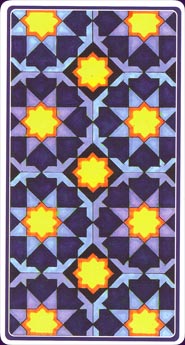
Unlike recent Lo Scarabeo publications, the cards do not have titles in different languages. All the card titles are in English, and it is The Female Pope rather than the RWS High Priestess, Fortitude not Strength (and placed at number XI in the sequencing of the Trumps). There is a thin white border around the image, and the backs are an attractive and colourful design which reminds me of a Moorish mosaic motif. It would be impossible to tell whether a card was reversed or not The card size is standard Lo Scarabeo size, neither too big nor too small and is comfortable to shuffle whatever size your hands. The cardstock is, as always with Lo Scarabeo, excellent quality, lightly laminated, feeling flexible yet durable.
Some users, however, may have issues with the actual card meanings which for many cards, according to the LWB, are a little bit removed from more familiar meanings. Those who associate the 4 of Coins with meanness and miserliness, will find that here it is listed as referring to generosity and donations, and the cornucopia image on the card reflects this. Yet, as already mentioned, the pips “evoke” Etteilla meanings and although his meanings (according to Huson) would have come via the Marseilles/ Besançon pattern, they were very much shaped by his own beliefs. In the LWB, Huson observes that “apart from putting cartomancy on the map as a divination method, Etteilla provided what would henceforth become the “canonical” interpretations of the tarot suit cards in Europe, and it is to these interpretations that Dame Fortune’s Wheel Tarot returns.” Yet it gives them a whole new visual vocabulary. Any reader will, of course, once they get started, put their own layers of meaning and symbolism into how they read the deck, but it is worth bearing in mind where this deck is coming from, and which system it draws upon.
The spread which is included with the LWB is a small three-card spread (one of which is the Significator) which Huson points out is “reputedly a gypsy method”. I thought this was a good spread to see with a deck containing a system which might be relatively new to most people. It is a sufficiently gentle initiation into a deck which will require a certain amount of readjustment. There is no reason why a beginner, or someone who isn’t familiar with any of the three systems referred to in this review, shouldn’t go far with this deck.
The more I look at Dame Fortune’s Wheel Tarot the more I feel it has a lot to say. It is very obvious that here is a deck which has been deeply thought through and executed with great sensitivity. The style of drawing does not slavishly imitate a medieval style. There are contemporary touches to the faces and figure-drawing to prevent them becoming pseudo-historic pastiche, and it would certainly be a waste to transpose traditional Rider Waite-Smith meanings onto a deck like this, as the universe of the cards feels so tangibly different to the Rider Waite-Smith universe. It also feels tangibly different from The Tarot of Marseilles Universe. It is a deck which should be allowed to articulate its own secrets and be taken on its own terms. There is certainly much substance here.
Complete Details of Dame Fortune's Wheel Tarot
Publisher: Lo Scarabeo 2009Deck Type: Tarot Deck
Cards: 79
Major Arcana: 22
Minor Arcana: 56
Deck Tradition: Marseilles
The Fool is 0
Strength is 8
Justice is 11
Card Size: 2.60 x 4.72 in. = 6.60cm x 12.00cm
Card Language: English
Extra Info: Read more about this deck at the artist's website.
Rating: 18/20 or
 stars out of five
Similar Decks to Dame Fortune's Wheel Tarot
Theme: Marseilles-Inspired
< Previous Deck · Back to Top · Next Deck >
Home > Tarot Reviews > Dame Fortune's Wheel Tarot Review
