
Elemental Tarot Deck Review

Creators: Caroline Smith, John Astrop
Published: 2001
The Elemental Tarot fits a system of astrological combinations to the 78 cards of the Tarot, so knowledge of astrology would be helpful when reading with this deck.
Retailers
See Price at Amazon.comSee Price at Amazon.co.uk
See Price at Amazon.ca
Elemental Tarot Review by Cathi Bitzer
I am particularly fond of this deck, because it was the first I ever received. A favorite aunt gave me the cards as a gift, and set me on a path of mystery, magic and joy that I hope to continue throughout the rest of my life. The aunt and I are both mystically-minded individuals, and she knew I would love to learn about the Tarot. I therefore have a particularly emotional connection with the Elemental Tarot, which goes beyond my fondness for image or meaning.
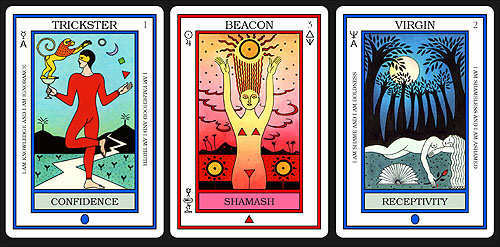
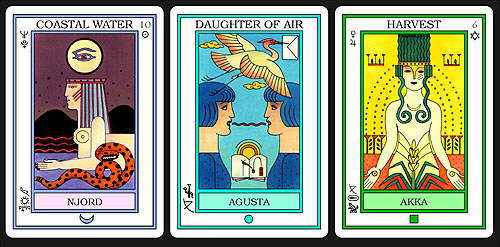
The Elemental Tarot is so named for its use of the four elements, earth, air, fire, water, and then the fifth, holistic Universe element represented by the Major Arcana. For the Minor Arcana, the element earth refers to pentacles, air to swords, fire to wands, and water to cups. The symbols for the elements are at the very bottom of every card. The holistic Element for the Major Arcana is represented by an oval, Water by a half moon turned on its side to take the form of a cup or bowl, Earth by a square, Air by a circle and Fire by a triangle. The cards are also color coded according to each element.
The deck itself is unusual in several ways. Ms. Smith for example includes symbolic references as reminders of each card’s meaning. For the Major Arcana, the name and number of each card appears at the top, with an associated key word at the bottom. On the sides, there are two lines in fairly poetic language, which also relate to the meaning of each card. Some of these are quite cryptic, and a creative mind would most thrive on deciphering them.
Another interesting thing about the Major Arcana is the fact that, while some retain their traditional titles, such as The Sun, The Star and The Fool, others have been renamed to more clearly, according to their creator, suggest their meaning. Instead of the Magician, for example, Card no. 1 is called the Trickster, Card 5 is the Pope instead of High Priest, and Card 21 Aeon instead of the World. These “new” names appear to be more in connection with the modern world and current values, although this is a matter of opinion. Ms. Smith has replaced some archaic terms with more modern ones.
The Minor Arcana are equally interesting. Each card features astrological and mythical Egyptian symbols in the right and left margins. At the top of the card is a word suggesting the meaning of the particular card, while an associated god or goddess name appears at the bottom. The Court cards are renamed to Daughter (page), Son (knight), Mother (Queen), and Father (King) of each suite. This suggests a family rather than the royal relationship of the traditional Tarot.
In general, the artwork of these cards is very abstract, but also in some cases very graphic, especially the Lovers (or Choice, as Ms. Smith names it). I would therefore not recommend it for very young Tarot users or for the “sensitive” viewer who is easily upset by graphic nudity. Nevertheless, the cards are beautifully illustrated: devotees of abstract art are most likely to find the images appealing.
One of the drawbacks of this deck could be the many interpretive elements on each card. This, while intended to clarify, could lead to confusion. Together with the fact that the card titles have changed, such potential confusion makes the deck unsuitable for beginners. I would however highly recommend it to art lovers and the more adventurous Tarot user. The cards are very colorful, and each is striking in its own way.
As for myself, despite my fondness for the deck, I seldom use it. I keep it mostly for sentimental and collector’s reasons. It is difficult to say why. Perhaps the abstract nature of the images do not particularly appeal to me, or perhaps the astrological elements confuse rather than clarify matters for me. This however in no way changes how I feel. The Elemental Tarot is, after all, my first deck.
Read more reviews of these cards at: Amazon.comAmazon.co.ukAmazon.ca
Elemental Tarot Review by Sebastien
The Elemental Tarot was the first major offering from the husband and wife team, John Astrop and Caroline Smith. It was published originally in 1988 by Doubleday and became out of print around 1990. There was a second print done by Connection Books around the mid-nineties, and although essentially the same there were some differences in how the cards were presented, and I feel, quality on the artwork.
John Astrop is an astrologer and writer, and Caroline Smith is a painter who works mainly in occult and astrological fields. She is also an experienced reader. Her artwork has been featured in many magazines, many books and is actually quite remarkable. I believe she studied fashion and design, and this does shine through in her images in how she blends things together. Each image is very evocative and designed with such precision, infusing symbols in clothes, the background and even in borders. There is always so much there.
Smith has designed the cards to follow the basic structure of the commonly accepted Tarot. This means there are 78 cards in total (22 majors, 16 courts and 40 pips). There is an emphasis on progressive reading, led by symbols, and for this reason the authors have decided to omit the traditional symbolism of Wands, Pentacles, Swords and Cups in favour of directly relating to the four elements. In this logic, the Major Arcana has been related to the fifth element, Spirit and can be seen as the child of the four suits when combined together. These are the inner qualities of the person asking for the reading, manifesting in their life.
The Majors follow the ordering of the RWS deck, with Strength at 8 and Justice at 11 (which is my only dislike in the deck). However, some have been renamed to reflect the system used. Rather than the more commonly accepted planetary and zodiac associations, the authors apply a system of each card showing a planet interacting with either the ascendant or midheaven:
Magician is now Trickster (Mercury/Ascendant)
High Priestess is now Virgin (Neptune/Ascendant)
Hierophant is once again Pope (Saturn/Ascendant)
Lovers is now Choice (Venus/Ascendant)
Chariot is now Victory (Mars/Ascendant)
Hermit is now Shaman (Pluto/Ascendant)
Wheel of Fortune is now Fate (Uranus/Ascendant)
Justice is now Law (Saturn/Midheaven)
Temperance is now Peace (Venus/Midheaven)
World is now Aeon (Ascendant/Midheaven)
The Majors have a strong surreal design, which some feel is distinctively Egyptian. For example, on the Choice card we see a naked man and woman standing face to face with each other, their hands held. Their expressions are somewhat pensive, neither knowing what to do. They are both completely white indicating their innocence and naivety. The background is a pinkish hue, emphasising sensual pleasure. Between them is the tree, the trunk rendered like a step ladder which can be both ascended and descended and the branches are laden with many fruits, all of which possible by their union. Lurking behind the tree however is a genderless red figure, its hair standing erect in defiant will. The red is tempting passion, which could influence the choice both positively and negatively.
All of the majors feature quotes from the Gnostic text known as ‘The Thunder, Perfect Mind’. On Choice there is ‘Whatever I will happens to me’. These fit so well with the 22 cards. There is also a key word at the bottom of the card for each major, here: ‘Passion’.
The court cards are Father, Mother, Son and Daughter and correspond to the traditional King, Queen, Knight and Page. Each card has a characteristic denoted by rank, and then a further by element. For example Daughters all relate to water, and Sons to Fire. The authors offer the keyword ‘emotional’ for Daughters and ‘creative’ for Sons, thus meaning the Daughter of Fire is ‘emotional creative’ and the Son of Air is ‘creative intellectual’. This gets you started on what some see as the most difficult cards to learn, and slowly you build up more in-depth personality traits.
All pip cards are titled with an elemental based keyword i.e. ‘Breeze’(Three of Air), ‘Clay’ (Four of Earth). The system in place owes much to Paul Marteau, combining a number interpretation alongside the elemental quality of the suit.
For example, threes are associated with the successful marriage of a two bearing fruit while tens indicate the passing of perfection, bringing it back down to one. The suits are numbered solely 1-10 with no ‘aces’, as this went with all other pseudonyms.
Astrology figures very much throughout the minors. Each card shows a facet of two planets combining e.g. Four of Earth is Sun/Saturn and the Ten of Water Venus/Pluto. All these mergers do not require an in-depth knowledge of how planets interact, but as time goes on you do see a deeper knowledge growing and as with all decks the more you know and study the better you get.
As said, when it was re-printed there were some changes. The editors replace the original font with something a little more fancy, but the images became somewhat diluted in colour. Both Astrop and Smith commented on this and I think there were plans for a further edition to address this. It is noticeable when comparing both editions but you can still see the detail in the card designs.
Neither Astrop nor Smith use reversals and offer their take in the book. However, the book is designed solely to ‘get you going’ and reading with these cards is intuitive. The meanings they offer in the book are deliberately cryptic to force you to go with what you feel based on the system. For this reading, I do use reversals even with this deck.
I’ve loved this deck ever since getting it. The card quality is excellent and they have held up since I had it (aged 10), and I still use it now. It’s my main deck (Hudes second). I notice new things time after time, and because so much is offered in the image you can see so much at varying degrees in reading after reading. I understand why people don’t recommend it as a first deck, but it really could be used. The book is actually very good despite it being slim.
Caroline Smith and John Astrop went on to design the Oracle of the Radiant Sun, Moon Oracle and the Runic Tarot. All decks I own and are equally stunning and useable. Smith also did the artwork for the Mystic Tarot, which is a deck I like and used as my second deck for some time. It was an elemental twist on the Marseille style, but really wouldn’t be a wise choice for first time readers – more because it is let down by the book. However there is nothing in the Elemental Tarot to stop it being a first time deck.
Read more reviews of these cards at: Amazon.comAmazon.co.ukAmazon.ca
Complete Details of Elemental Tarot
Creators: Caroline Smith, John AstropPublisher: St Martins Press 2001
Deck Type: Tarot Deck
Cards: 78
Major Arcana: 22
Minor Arcana: 56
Deck Tradition: Astrological
Minor Arcana Style: Unique Scenes Without Suit Symbols
Suits: Water, Earth, Air, Fire
Court Cards: Daughter, Son, Mother, Father
The Fool is 0
Strength is 8
Justice is 11
Card Size: 3.50 x 5.17 in. = 8.89cm x 13.14cm
Card Language: English
Card Back: Unknown
Similar Decks to Elemental Tarot
Theme: AstrologyCreator: Moon Oracle, Oracle of the Radiant Sun, Runic Tarot by John Astrop Moon Oracle, Mystic Meg Tarot, Oracle of the Radiant Sun, Runic Tarot by Caroline Smith

< Previous Deck · Back to Top · Next Deck >
Home > Tarot Reviews > Elemental Tarot Review
