
Robin Wood Tarot Deck Review
Creators: Robin Wood
Published: 1991
Easy for beginners and tarot newcomers to use with its Rider-Waite foundation, Robin Wood's self-titled Tarot deck is also rich in Pagan symbolism. The illustrations in this popular deck are attractive, and brightly but not harshly coloured.
Retailers
See Price at Amazon.comSee Price at Amazon.co.uk
See Price at Amazon.ca (Set)
Robin Wood Tarot Review by Tom LeBlanc, CTC
For many years, Robin Wood has earned a well-deserved reputation as one of the most beloved illustrators of fantasy literature and Pagan art. As such, the Robin Wood Tarot was an inevitable favorite among readers with an eye toward Pagan symbolism.
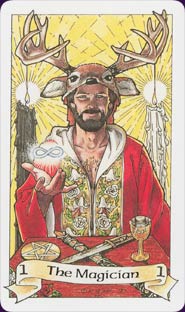
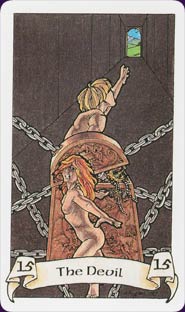
In this deck, she appears to attempt a complex meld of modern images, Pagan symbolism, and the well-known Rider-Waite-Smith orientation to create a very unique deck. However, Wood seems to accomplish this without alienating non-Pagans or violating the sensibilities of those who enjoy the RWS system. Many of the adaptations include quite subtle changes. For example, close examination of the battlers on the Five of Wands will reveal that the combatants’ staves form a pentacle, and the Ace of Wands contains a DNA strand, possibly indicating this cards’ propensity for representing creation and synthesis. Other changes, however, are more obvious. The Magician, now wearing an antlered headdress, somewhat resembles a shamanistic priest. The Devil is noticeably absent in the card by that name, and is replaced by a pair of slaves to materialism, each vainly trying to pull a treasure hoard to their own end of a dark tunnel. For those who find the absence of a goat-headed Baphomet in this card to be remiss, Wood makes a concession in the form of an inverted pentacle created from the chains that bind the treasure to its spot.
Printed on strong, plastic-coated board, this deck is approximately the same size as most standard Tarot decks, which facilitate shuffling for those who are accustomed to the “slightly longer than playing cards” size. Naturally, Wood’s artwork is quite vivid in color, rich in detail and—most obviously—quite dynamic in movement. Her use of color and texture also highlights the traditional elemental associations with the suits. For example each of the wands appears “fiery,” while the pentacles exude a very terrestrial quality.
The accompanying little white book (LWB) is adequate in that it provides a basic interpretation of each card and offers a fifteen, ten, and five card spread description.
In sum, it is quite obvious why the Robin Wood
Tarot is a first-choice for Pagan and non-Pagan readers
alike. The scenes in each card are quite lively and rich
in interpretive potential. Both beginning and
seasoned readers are likely to find considerable benefit
from this deck.
Robin Wood Tarot Review by Kim Huggens
The Robin Wood deck is my main reading deck. I bought it after a desperate search for a deck in which the Minors were as well-drawn and thought out as the Majors, and I wasn't disappointed! This deck is the culmination of nearly 10 years of work by the Wiccan artist and writer, Robin Wood, and as such, there is quite a lot of Pagan undertones, although these can be easily left out by non-Pagans. The scenes themselves are not overtly Pagan, and indeed, they stick mainly to the traditional Rider Waite images, but in the subtle symbolism and detail, Wood incorporates teachings from her tradition of Wicca, helping to convey meaning.The deck being largely traditional, there is not much I can say about it. There are only a few cards where the image is changed, such as the Judgement card, where instead of the familiar Christian Judgement Day scene, Wood depicts a naked woman rising from a cauldron of Rebirth. This leads me to one of my only problems with this deck: the obvious bias against Christianity and formal religions inherent in the deck. Wood admits in the book that she later wrote to accompany the deck, that when she was creating the deck she did include her views of Christianity in certain cards, such as the Heirophant, where the priest is depicted as a very stern, even constipated, ugly man. This can be seen as merely another re-drawing of the Heirophant, but it can also be taken as a picture inclusive of Wood's views.
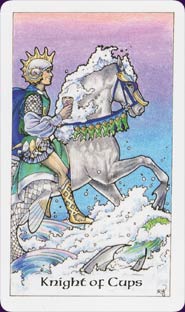
Wood's views and experiences are quite inherent in the cards actually, but this would not be noticed unless the accompanying book is read, so such things do not affect the readbility of this deck. Wood admits that she began this deck largely as a private project, drawing it for herself solely, so the Pages have mnemonic devices to help her, and the users of this deck, remember what they stand for, eg- A pallette of paints for the Page of Cups, a book for the Page of Pentacles. I found this to be a great help when reading the Pages, as Court Cards are not my forté, and indeed, they are not usually anybody's! The other Court Cards in this deck are beautifully rendered, and the characters almost come alive in a reading. Their facial expressions and stances help the reader identify with them, and convey the meaning and significance of the Courts in a reading.
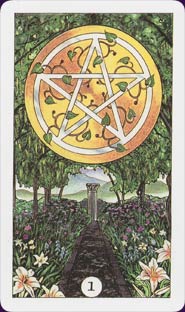
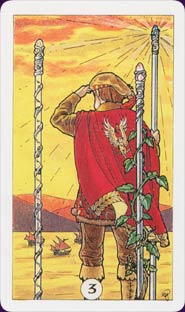
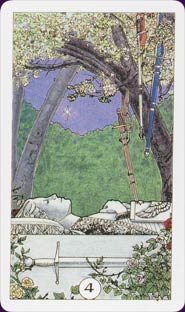
The Minor Arcana, instead of bearing their full titles eg- 5 of Swords, only bear the number of their suit, in a simple small white circle, which is a very good idea to me, because it does not detract from the images on the cards. The Major's titles remain the same, and are to be found on the bottom of each card, again, not detracting from the images.
The artwork itself I cannot but praise! It is sumptuous, colourful, bold, yet realistic. All the cards were drawn in Prismacolor pencils, and thus they take on a simple, welcoming feel. This type of artwork is attractive to quite a few people, regardless of age, (Children would like this deck as well) although it has been accused of being too 'Barbie and Ken'-like for some people. I can see where this comes from, as there is not really a character in the cards of this deck which is not beautiful, thin, and healthy. (Other than the man on the 5 of Pentacles, with only one leg!) But for those who find such characters appealing (I certainly do), then this deck would definitely appeal.
There is some nudity is the cards, although since the artwork is quite cartoon-like the impact of nudity on those sensitive to it is somewhat lessened, and it does not seem offensive at all. Such nudity is used sparingly (It only appears in 5 cards) and only where it serves a symbolic purpose, or where the Rider Waite tradition dictates is use.
Overall, this deck is easy to use, evocative, and can be used by anybody, regardless of their experience with the Tarot. I often find that this deck is particularly useful for those who read intuitively, as the images are detailed, clear, and always show scenes which depict meaning. Each card is full of symbolism, and there is no item in the cards which does not have symbolic meaning. I have never met a querent who does not like the Robin Wood Tarot, and for those who also use Gestalt methods of reading, this deck would be extremely useful for querents who know very little of Tarot. It is also not necessary to get the book writen for the deck, because most of the symbols in the cards are self-explanatory, althoug the book is a very nice addition, and explains why Wood included certain things, and how she got the ideas for each card.
I would recommend this deck to all beginners,
no matter what their age or religious persuasion.
This deck is a universal one, and is certainly one of
the treasures which are beautiful as well as readable.
It is not often one sees the Rider Waite deck cloned
in such a sumptuous and evocative manner. As such,
this deck never leaves my side, and is fast becoming a
bit tattered and worn through all the successful
readings I have performed with it!
Robin Wood Tarot Review by StarShine
I was introduced to this deck by a friend. I was using the Rider-Waite deck and I commented that I could relate to the illustrations, but not the artwork. I just did not find it to be a eye-pleasing deck.
That is when she pulled out her Robin Wood Deck. We were in the metaphysical shop where she works and I was so taken with this deck, I had her special order these cards for me on the spot and even paid for them in advance. When I received them, they were more beautiful than I had remembered. Just carrying this deck home from the store made me feel beautiful, mysterious and enlightened. I don't know what it is about this deck but I receive incredible vibrations from it. These vibes are so powerful for me, just holding the deck in my hands after a stressful day calms me and makes me feel better.
I still use the Rider-Waite to read for others. Part of the reason for that is that the RW deck is most recognized and people tend to feel more comfortable with familiarity. The other part of the reason is that I still use the Robin Wood deck for my own personal readings and right now, I just don't feel like sharing my special deck. Eventually I do plan on using my Robin Wood Deck for other's readings. The illustrations are close enough to the RW to recognize, but much softer and much more pleasing to the eye. Much less ominous than other decks that I have seen.
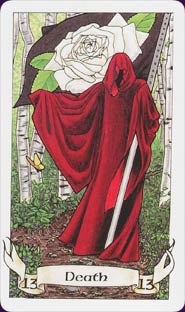
Another plus, for me, is the pagan flavor to these cards. The artwork definitely portrays the true beauty and harmony of the Pagan Path. Even the death card is non-threatening and cloaked in beauty.
This deck is a must have for beginners, experts,
dabblers, and collectors alike.
Robin Wood Tarot Review by Helen Morrison
If I could have only one tarot deck, this is it. In fact, I bought two copies! By destiny or chance, I had my Robin Wood deck with me when I spotted her signing autographs at a convention. Robin signed the Magician card for me, now framed and hanging on my wall. I was, and still am, thrilled to have the signed card, but had long lost the blank extra card that came with the deck, leaving it short one card. I realized how much I missed using this deck, and bought my second copy.
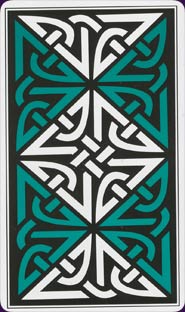
It might be easy to dismiss this deck as just another Rider clone, as it sits quietly on the shelf in a small, simple dark green box. But that would be a mistake. Even the sturdy box is special; it opens from the front, like a book. The cards are typical weight and size, about 4.5” x 2.75”. They sport a slick, but not shiny, finish. The back is a repeating Celtic knot pattern in black, white and green, with a white border. It looks the same both right side up and upside down.
Robin uses the traditional trumps, numbering and court cards. Art, Imagery and Symbolism So what makes this deck stand out from the pack (pun intended)? The beautiful art work on each and every card, rich with updated images and symbolism. The images are filled with life and movement. Traditional Christian iconography is replaced with secular or Pagan symbols. The symbolism speaks clearly. Newbie readers and seekers alike relate easily to the images, yet each card still carries all the meaning (and sometimes more) of traditional Rider tarot. The deep but clear symbolism in gorgeous art makes this deck ideal for beginners and experienced readers alike.
The cards have a white border, beginners sometimes write short notes there to help them learn. The trumps are identified with a banner at the bottom. Pip cards have only their number in a white circle at the bottom, but it’s easy to distinguish the suit.
The image content on some cards are nearly identical to the corresponding Rider cards, but with enhanced detail, textured backgrounds and complex colors from pastel to dark. In Trumps, for example, the Wood version of the Moon features a realistic beagle, wolf, and stone pillars, framed below and above by navy blue water and sky with a white full moon. The Sun features a chubby cherub on a realistic white horse with a flowing red banner and bright yellow sun filling the sky with yellow and white rays of light you can almost feel.
In Pip cards, the Wood two of Swords and Rider two of sword share nearly identical image content, a blindfolded woman in a robe sitting in front of water. But the Wood version is lusher and darker, you can almost feel the cold wind whipping over pounding surf. The Wood eight of Wands depicts 8 wands, as does the Rider deck, but the wands on the Wood card fly across a dark sky, in outer space, with planets behind and below and flames spewing from them like rockets.
Other Wood cards share elements with their corresponding Rider card, but the images are different. The Wood Lovers, for example, depicts a fairly realistic naked man and woman arm in arm. The woman holds the moon in her other hand, the man holds the sun. The traditional Christian god above the couple on the Rider card is replaced by the Tree of Life behind the couple on the Wood card. The Wood Devil card lacks the typical Devilish figure from Christian mythology. The naked man and woman from the Rider deck are still chained to the trunk, which is far larger than they, and the trunk itself is chained to the sides of a long, dark tunnel. But, there is still hope, an entrance, a light at the end.
Some cards, particularly the Trumps, are dramatically different from the classic Rider trumps. The Wood High Priestess is portrayed from the waist up, against a dark night sky and full moon, with flowing hair and robe, holding an open book and a crystal ball. Death is a figured shrouded in a deep red robe, in a birch forest with a white rose over his shoulder. Judgment is a single, naked woman leaping from a fiery cauldron, framed by a rising phoenix with golden wings. The Magician is a smiling, bearded fellow, his tools of magic on the table before him, twin candles of black and white at his sides, antlers on his head and holding infinity in his hand.
These layers of rich symbolism convey the traditional archetypical images along with new insight for people of any religion, Christian, Pagan or other. Eliminating the classic Devil image from the Devil card helps the seeker and the reader understand that we often create our own problems or “devils”. Instead of the Rider deck image of small, passive people and the static figure of an evil boogey man ruling with an iron fist, we see the man and woman actively struggling with their personal “devils” of greed, grief, anger, jealousy. It also presents the concept of self-imprisonment. The woman on the card refuses to turn around and “see the light” or way out, the man could easily escape to the opening if he would let go of the trunk. The “devil” is the temptations hidden inside the trunk. This concept is displayed in secular imagery but can still support the Christian philosophy that paints the Devil as constantly tempting us.
The LWB includes a brief introduction of the deck and each Arcana. The meaning of every card, both upright and reverse, is listed. The pip cards (excluding court cards) also include a brief description, such as “Thief” for seven of Swords, or “I just can’t” for the eight of swords.
The LWB includes three
layouts, a 15 card general spread, a traditional 10 card
spread, and a 5 card spread for a specific answer to a
specific question. This spread packs a lot into five cards,
I like how the first card sharply defines the
question. This focus on definition frames the answer
presented in the last card.
There is a 50+ page book
available for this deck. The book and deck are available as
a set or separately. I bought just the deck (both
times). I confess I’ve never read the full book, just the
LWB.
Complete Details of Robin Wood Tarot
Creators: Robin WoodPublisher: Llewellyn 1991
Deck Type: Tarot Deck
Cards: 78
Major Arcana: 22
Minor Arcana: 56
Deck Tradition: Rider-Waite-Smith
Minor Arcana Style: RWS-Based Scenes
Suits: Cups, Swords, Wands, Pentacles
Court Cards: Page, Knight, Queen, King
Major Titles: 0 - The Fool, 1 - The Magician, 2 - The High Priestess, 3 - The Empress, 4- The Emperor, 5- The Hierophant, 6 - The Lovers, 7 - The Chariot, 8 - Strength, 9 - The Hermit, 10 - Wheel of Fortune, 11 - Justice, 12 - The Hanged Man, 13 - Death, 14 - Temperance, 15 - The Devil, 16 - The Tower, 17 - The Star, 18 - The Moon, 19 - The Sun, 20 - Judgement, 21 - The World
The Fool is 00
Strength is 8
Justice is 11
Card Size: 2.76 x 4.61 in. = 7.00cm x 11.70cm
Card Language: English
Card Back: Reversible
Back Design: Celtic knotwork design in green, white and black.
Companion Material: The cards themselves are acompanied by a little white book. A companion book is also available separately, entitled "The Book" by Robin Wood.
Rating: 18/20 or
 stars out of five
Similar Decks to Robin Wood Tarot
Theme: Beginner, Pagan & WiccanCategory: Available Tarot Decks

< Previous Deck · Back to Top · Next Deck >
Home > Tarot Reviews > Robin Wood Tarot Review
