
Victorian Romantic Tarot Deck Review
Creators: Alex Ukolov, Karen Mahony
Publisher: Magic Realist Press 2006
The Victorian Romantic Tarot is based on original engravings from 19th century artists, perfectly collaged to create fully-illustrated, Rider-Waite-based Tarot scenes. It's available for order in gold and standard editions.
Retailers
See Price at Amazon.comVictorian Romantic Tarot Review by Sheila Hamilton
Earlier this year, I had the privilege of writing the companion book to the Victorian Flower Oracle designed by the formidable team who are the Magic Realist Press, namely Karen Mahony and Alex Ukolov. These two have now brought out this new Tarot deck, their fifth, which I come to purely as a reader. I have had no input into this project-but I would have been immensely proud if I had.
This is a Tarot deck in the Rider-Waite tradition, and as far a from being a clone as is possible. It contains the usual 78 cards, of which 22 are Major Arcana and 56 are Minor Arcana, the latter divided up into the suits of Swords, Wands, Cups and Pentacles. But the Major Arcana are not actually numbered, so it's entirely up to you whether you perceive Strength and Justice as 8 and 11 respectively or the other way round. The Major Arcana have the usual names.
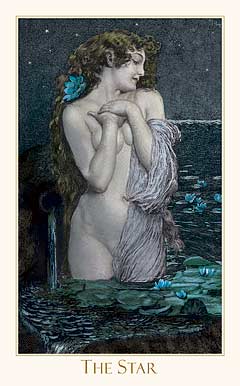
Each card is printed on good-quality cardstock, neither flimsy nor rigid, and has an intricately-designed back which could be used in a reading that involves reversals. The colour printing can only be described as exceptional ; there is nothing gaudy or harsh on the eyes but the colours are too vibrant to be described as muted. The whole range of colour is used, my own favourites being the superb turquoise (Ace of Cups, The Chariot, The Star), and the fresh leafy green (The Empress, The World). As author of the companion book to the Victorian Flower Oracle, I am pleased but not surprised to see beautiful flowers on many of the cards, the roses tumbling out of the huge basket on The World card, for starters.
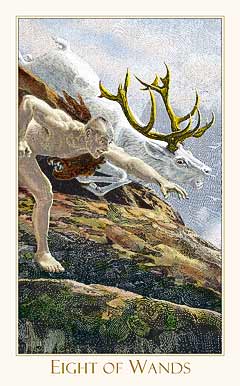
And what of the artwork ? Many Victorian passions and obsessions are here. There is medievalism , one example being The Lovers, who are Dante and Beatrice. There is also orientalism, the love of the exotic, especailly anything Egyptian; the Emperor is an Egyptian pharoah. The Classical world appears on several cards; my favourite of these is the Eight of Wands, a marvellously dynamic image of Hercules racing the Ceryneian Deer. And no self-respecting Victorian deck could be without its nymphs and fairies; this one has quite a few. The Judgement card is most unusual in this respect, showing not an angel with a trumpet but Oberon and Titania with their diminutive cohorts. Then there are a great number of genre pictures depicting, among other things, children, circuses, a tragedy at sea, the pathos of the poor. There are dramatic scenes and tranquil scenes, historical scenes and domestic ones. There is sorrow and drama, playfulness and humour.
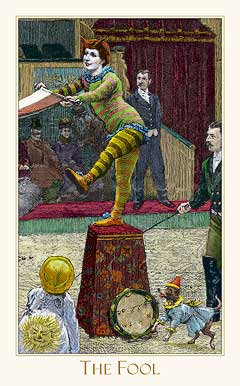
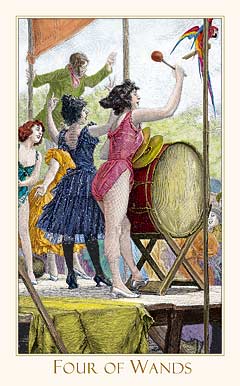
As Karen points out, the depiction of women throughout the deck varies enormously. There is the elegant Queen of Wands and the woman in the Ace of Cups who is really a fae. There are several women from the poor sections of society, some eeking out a living as best they can and some doing rather better than that-the whiteface on The Fool card, for example, and the circus troupe on the Four of Wands. There is a Russian princess and there is a lion-trainer. In short, any stereotyped picture we have of Victorian women is challenged ; there aren't many prim and proper ladies here and there is only one passive woman, the slave-girl in the Eight of Swords, included because her passivity is essential to the card's meaning.
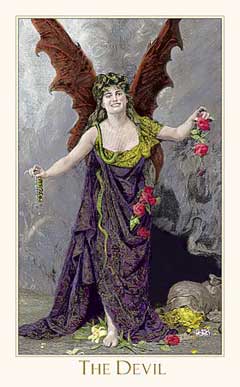
At this point, I'd like to focus on some specific cards. Whilst deriving inspiration from Rider-Waite, the creators of this deck have not been slavish to that tradition. The Magician is very old, a venerable-looking man with a long white beard. We read that he is Faust, the seventeenth-century magician reputed to have sold his soul to the Devil in exchange for magical skill. The Hierophant is one of the few Hierophants I am able to relate to ; gone is the stern Pope-figure, and instead we see an Islamic teacher, pupils at his feet. We are presented with a sombre, hardworking environment that is very much at ease with itself, watched over by a clearly benevolent man. One of the decks' most powerful cards, appropriately, is Strength. We are used to the image of woman with lion but here is a woman surrounded by both lions and lionesses ! The woman is a lion-trainer : brave, skilled, totally calm. Tellingly, she is not subduing the beasts, nor is she being intimidated by them. She is working with them in a spirit of total respect and, consequently, reaping the rewards. The image works as a striking piece of art-adapted from an engraving that shows Daniel in the Lions' Den-and it works as Tarot. This marriage of Victorian art and Tarot meaning is one of the strongest aspects of this deck. Though there are many very attractive images, and some pretty ones ( such as Six of Cups showing young children entranced by the first snowfall of winter), no image is just here as eye-candy.
I hope it has become obvious that these cards are a joy to read with, containing enough that is traditional whilst offering images that are well-chosen, deep and multi-layered. There are several spreads given in the companion book ; I found "Looking Back, Looking Forward" particularly insightful. But I've also found meditating with these cards to be an interesting and rewarding experience. As artwork, they provide much enjoyment and are deepening my love of , and appreciation for, Victorian things in general. And I can see all sorts of opportunities here for creative writing-selecting a card at random, for example, and then running with the image as image, not worrying too much about the usual interpretation and possibly diverging from it in all sorts of weird and wonderful ways. Another creative exercise would be to select five or six, say, cards, line them up and then just launch into a narrative. This could be either written or spoken ; I sense the latter could be particularly effective with a group of children.
Could a
beginner use this deck ? I think so. It's traditional
enough to give a grounding in Tarot, specifically
Rider-Waite, while being much more aesthetically pleasing (no
offence to Pamela Coleman-Smith). I suspect
the many
Victoriana freaks out there would snap this up, Tarot
knowledge or not.
Note : For lovers of Limited
Editions, there is a Gold version, still available at the
time of writing (late October 2006).
The images
are the same, except that there is an extra Lovers
card-more physical and obviously erotic than the
Dante
and Beatrice- and the gold has been added very subtly,
not in the form of gold foil but in the form of gold
ink. In short, an edition best appreciated by
candlelight. Whilst the Standard Victorian Romantic can be
purchased
in many places, the Gold Edition is only
available from Karen and Alex's studio in Prague.
Victorian Romantic Tarot Review by Kate Hill
“Seventy-eight lavishly illustrated cards capture the romance of the Victorian era. The images are based on gorgeous antique engravings, many of which are now rare. This enchanting tarot is full of beauty, inspiration, and the power of story-telling.” – From the book.
The Prague-based Tarot artists and designers at Magic Realist Press, Alex Ukolov and Karen Mahony, continue their rapid production of quality Tarot and oracle decks with their sixth deck, the Victorian Romantic Tarot. The 78 cards are based on original Victorian art engravings and combine contemporary scenes of Victorian life and times with popular historical scenes interpreted through their eyes – Classical Greek, Medieval, Biblical, Gothic, Ancient Egyptian and more.
Finding a book of art engravings from nineteenth century Germany was Karen and Alex’s spark of inspiration for this deck. Intrigued, they began searching for more books with engravings from the same period, images that “not only spoke, they sang, laughed and cried.” And here, adapted to Tarot cards, they do. There is such an expressiveness in the faces and the body language; a range of emotion and human experience that jumps out of the cards. There are people of all ages and stations, in homely surroundings or rich and luxurious, but all with such human feeling.
Those original Victorian engravings were skillfully modified to become Tarot scenes with a Rider-Waite foundation, but are by no means clones. The final images, as well being elegant scenes that work beautifully for Tarot uses, are snapshots of the social history and changes of Victorian times. As Karen mentions in the book, the rise of industrialism and the resulting rural romanticism, the beginnings of psychoanalysis with Freud, the fascination and idealisation of history, and changes to attitudes between men and woman, are all also visible in the cards.
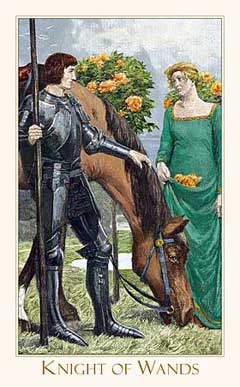
On looking through the deck, there were plenty of cards that stood out for me. The light in the Four of Swords is visually amazing – the way the shaft of light falls through the window and onto the face of the person lying asleep. The feeling of rapid motion in the Eight of Wands, where an antlered deer and naked man hurtle headlong down a hill, running alongside one another. Temperance, which is a little different from the standard symbolism: the angel is holding the rudder of a small boat - an embodiment of ‘steering a middle path’ and ‘not rocking the boat’. The court cards have also received equal attention to the other cards: Knights are courtly, the Pages androgynous, the Queens are distinct in costume, posture and background, and the Kings, like, well, story-book kings.
The faces of the cards have white borders and have the title in English but are not individually numbered. The backs of the cards have an extremely ornate, decorative design and are reversible. The card size is typical for Magic Realist Press decks, and is of dimensions that are large enough to show off the images but still small enough to handle easily.
The companion book, The Victorian Romantic Tarot, included along with the cards in the Standard Edition has basic primer information to help if this is your first deck: a short history of tarot, learning the tarot, reading styles and spread styles, and sample spreads. The section with the card meanings offer upright and reversed keywords and talks about the imagery, traditional meanings and nuances of the cards, comparing and contrasting with each other. The meanings are also a little ambiguous, rather than definitive, as the book isn’t meant to be the only, definitive way to use the cards, but rather a beginning to your own journey with them. Along with the card explanations, Karen has provided some interesting information on the image sources. There is info on the original artist, relevant quotes to the theme, and often, a picture of the original engravings, showing the inspiration for the tarot card and how the original image was adapted.
Magic Realist Press has again managed with the Victorian Romantic Tarot to bring something new and beautiful to a crowded market of decks. The cards have gorgeous, expressive artwork completely in the feeling and look of the Victorian era, and work perfectly to convey the Tarot meaning. It’s a five-star deck that I’d recommend highly for any Tarot reader or enthusiast.
* I reviewed the standard mass-market edition of the Victorian Romantic Tarot, a kit with the cards and 132-page book in the usual Magic Realist Press box (a thinnish outer cardboard case and a sturdy inner box to the safely hold the cards and book). There is also a limited edition of 500 signed decks available only from Magic Realist Press, with an extra Lovers card, a Tarot journal, and a small companion leaflet instead of the full book.
Victorian Romantic Tarot Review by Lynda Cowles
Despite only being released in the Autumn of 2006, the Victorian Romantic Tarot was voted the best tarot deck of 2006 by Aeclectic members. That’s quite an honour when you consider how many new decks – both mass-produced and self-published – are released over the course of a year. With that in mind, I was keen to get my hands on this review copy. Alas, for me, the Victorian Romantic Tarot failed to live up to the hype.
What first struck me were the deck’s physical attributes. The cardstock is thin and the finish feels very dry, which seemed to cause the cards to grip to one another. Coupled with the large-ish size of the cards, this made handling and looking through the deck a little tricky – not impossible, but enough to put me off. That aside, the print quality is good and the cards attractively designed: the fronts have white borders with titles in an elegant gold-coloured font, whilst the backs feature a reversible intricate gold pattern.
Fortunately, many of the cards are very beautiful and this compensated somewhat for my initial disappointment. The Queen of Cups, with her faraway gaze and discarded cherub, seems to sum up the romantic imagination of the time, along with The Moon card, which depicts a wistful maiden beneath a velveteen-blue sky. And it’s not all swooning women: the tempestuous image of The Tower card – picturing two half-drowned men tied to a broken mast – is both breathtaking and effective at conveying the card’s powerful message.
The deck was created using intricate collages of art engravings published in Germany in the late nineteenth century. As with previous Magic Realist Press creations, the card images are created using a painstaking process which involves selecting the most suitable picture or pictures, then cutting and assembling the pieces into intricate collages. The variety of source materials used has resulted in a deck that lacks the coherence you’d find in a deck illustrated by a single artist. Here you can find graceful Pre-Raphaelite figures rubbing shoulders with coarse-engraved street performers and greetings card ladies with lace gloves. This mix of styles can be a little jarring, to the point where some cards look they don’t really belong in the same deck.
The collage work is extremely well done and near enough undetectable in the majority of cards. There are a handful of cases where the individual pieces don’t make a convincing whole but these seem to have a certain charm of their own. My favourite is the Six of Pentacles, where it seems any minute now the immaculately turned-out lady will open her eyes to find herself transported far away from the handsome suitor who was about to kiss her in another picture.
The LWB that accompanies the deck is very thorough, giving an introduction to learning and reading tarot and two original spreads designed specifically to be used with the Victorian Romantic. The meanings given for each card are much more informative than the usual LWB fare and indeed, all Magic Realist decks have so far been created with beginners in mind.
Nonetheless, I had to question some of the card descriptions given and their relation to the cards themselves. For example, we are told the Magician card stands for, “Brilliance, wizardry. A spark of inspiration. A flash of creativity.” The card however, shows a bearded man slouched in a study lit only by a single lamp. He seems old and world-weary. Whilst it’s not inconceivable that – were his quiet study to be suddenly invaded by pesky dragons – he could summon the energy to perform some brilliant feat of wizardry involving sparks and flashes, that isn’t what the card shows. To me, the Victorian Romantic Magician looks more like a Hermit. In fact, place the Magician and Hermit cards next to each other and there’s not much to choose between them.
The majority of cards, however, do a good job of conveying their meanings and are close enough to the familiar RWS scenes to make this an easily pick-up-able deck. The question is, how difficult is it to put down? Judging by the glowing reviews it’s had, very, and its popularity looks set to continue. But overall it has failed to impress me and it won’t be long before my copy is winging its way to a new home.
Complete Details of Victorian Romantic Tarot
Creators: Alex Ukolov, Karen MahonyPublisher: Magic Realist Press 2006
Deck Type: Tarot Deck
Cards: 78
Major Arcana: 22
Minor Arcana: 56
Deck Tradition: Rider-Waite-Smith
Minor Arcana Style: RWS-Based Scenes
The Fool is 0
Strength is 11
Justice is 8
Card Size: 3.07 x 5.04 in. = 7.80cm x 12.80cm
Card Language: English
Card Back: Reversible
Rating: 20/20 or
 stars out of five
Similar Decks to Victorian Romantic Tarot
Theme: Historical, Victorian EraCreator: Baroque Bohemian Cats' Tarot, Bohemian Gothic Tarot, Fairytale Tarot, Fantastic Menagerie Tarot, Tarot of Prague, Victorian Flower Oracle by Karen Mahony Baroque Bohemian Cats' Tarot, Bohemian Gothic Tarot, Fairytale Tarot, Fantastic Menagerie Tarot, Tarot of Prague, Victorian Flower Oracle by Alex Ukolov

< Previous Deck · Back to Top · Next Deck >
Home > Tarot Reviews > Victorian Romantic Tarot Review
