
Cary-Yale Visconti Tarot Deck Review
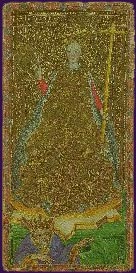
The Cary-Yale Visconti Tarot is a faithful reproduction of an original Italian fifteenth century tarot deck. The deck has the 67 cards that are still in existence in Yale University's Cary Collection of Playing Cards, plus recreations for 19 missing cards. This Visconti deck is also unusual because it has male and female Knights and Pages in the court cards.
Deck Type: Tarot Deck Cards: 86
Publisher: US Games
Retailers
See Price at Amazon.comSee Price at Amazon.co.uk
Cary-Yale Visconti Tarot Review by James Mathis
When I first acquired this deck I was so impressed by its art. The cards are rich with gold. The pictures have a distinct fabric texture. The deck consists of 86 cards. There the 22 majors and 64 minors. The additional cards come from male and female knights and pages. The Popess (Priestess) is replaced by Charity; the Pope (Hierophant) is replaced by Faith; and the Star is Hope. Thus the three virtues are present for the readings. The suits are swords, staves (wands), cups, and coins (pentacles).
The LWB provides a history and keys to both upright and reversed positions. The author, Stuart R. Kaplan, demonstrates his understanding of the history and uses of this deck. He also states that there is no direct evidence that the deck was used for divination. He further asserts that the people of the Renaissance were fascinated with the occult and that these cards may have been used for this purpose.
I hesitated to do a spread because of the different structure and the absence of numbers or names (this may complicate a reading for those who are not accustomed to examining the art of the cards) but I did a 10 card spread as suggested by the book. First, I relied on the book for help in the meanings. The virtues provide a different depth for a reading. The pip cards were not difficult since my first deck was of the Marsailles group. The meanings were similar. The male and female pages and knights provided a broader reading. The court cards have facial expressions which are similar to art of this period. At the personal level, they communicate the richness of the Renaissance.
This deck is a beautiful addition to the historical tarot collection. When used for readings, it may causes the beginner problems due to the lack of numbers and structure of the court cards. The extra large size of the cards may make shuffling difficult. Overall, I find this deck valuable for the history and the use in readings.
Cary-Yale Visconti Tarot Review by Bonnie Cehovet
Suits: Staves, Cups, Swords, Coins. Court cards: King, Queen, Male Knight, Female Knight, Male Page, Female Page. Major Arcana: Charity (Popess/High Priestess), Faith (Pope/Hierophant), Hope (Sun). Order: Justice VIII, Strength XI.
This is the first time that I have held in my hands a reproduction of one of the earliest Tarot decks, and I was fascinated by it. The colors tend to be dark, and the details not easily discerned, but I found it exciting to work with - trying in my mind to place myself back in the times that the original of this deck was in use.
In his notation on the provenance of the "Cary Yale Visconti Tarocchi", Stuart Kaplan indicates that the original deck may have totaled 86 cards - 22 Major Arcana and 64 Minor Arcana. Sixty-seven original tarocchi cards were reproduced from the Cary Collection of Playing Cards, with an additional nineteen cards recreated in 1983 (by artist Luigi Scapini) to replace the cards presumed missing from the original deck.
In introduction to the LWB (Little White Book) that accompanies the deck, Kaplan presents a brief history of the Tarot, and defines the major divisions of Major Arcana and Minor Arcana. An added bonus is a section on the history of the "Visconti" and "Visconti-Sforza" decks, breaking these fifteenth century Milanese decks down into fifteen distinct groups, with a brief definition for each group. Kaplan also addresses the artist attributions, and dating of the decks, as these are areas where, generally speaking, there are no definitive answers.
The "Cary-Yale Visconti Tarocchi" does carry some rather distinctive features of its own, one of which would be the addition of the three theological virtues: Charity (Popess/High Priestess), Faith (Pope/Hierophant), and Hope (Star). The four cardinal virtues (Fortitude, Justice, Prudence, and Temperance) are believed to be associated with Strength, Justice, the Hanged Man (or the Hermit), and Temperance. Thus all seven virtues are contained in the "Cary-Yale Visconti Tarocchi" major arcana.
Another distinctive feature resides in the Court Cards: in addition to the King and Queen, each suit contains a male and female Knight, and a male and female Page. The symbol used for Staves in this deck is that of an arrow.
The gold background decoration for the Major Arcana and the Court Cards consists of repeating suns with sixteen rays each: eight wavy, alternated with eight straight. The decorative border is that of a flower design consisting of ten dots in a circle, with a dot at the center, connected by a continuing stem.
Kaplan notes that the appearance of Visconti and Sforza heraldic devices on hand painted fifteenth century tarocchi cards does confirm the involvement of these two families in certain decks. He goes on to say that the lack of Sforza heraldic devices in the "Cary-Yale Visconti" deck would indicate that the deck was not commissioned by a member of the Sforza family, and thus probably predates Fillipo Visconti's death in 1447.
Kaplan presents graphic showing the heraldic devices, along with a text description of them. These include a coiled, crowned viper; a radiant dove; the motto "A bon droyt"; a crown pierced by branches or tree fronds; a sunburst; the imperial eagle of the Holy Roman Empire; a pomegranate; a wreath draped with a scarf.
The cards are presented with a black and white scan, a description of the card, divinitory meaning, and reversed meanings. Separate meanings are given for the male and female Knights and Pages. From the LWB:
"Male Page of Swords: The male Page of Swords stands in full armor. He wears the same type of hat, with a spreading peacock feather brim, worn by the Knight. A helmet is in his left hand, and a sword is in his right hand.
Divinatory Meanings: A person adept at perceiving, discerning and uncovering the unknown or that which is less than obvious. The quality of insight. Vigilance. Agility. Spying. A discrete person. An active youth. A lithe figure alert and awake to unknown dangers. A versatile and adept person capable of adjusting to changing conditions.
Reverse Meanings: An impostor revealed. Unforeseen events which may come to pass in the near future. Illness is also possible. Powerlessness in the face of stronger forces. Lack of preparation."
"Female Page of Swords: The female Page of Swords wears a long robe, also decorated with pomegranates. Her cape is lined in red and she holds the sign of her suit, a sword.
Divinatory Meanings: Empathic person. Insight. Ability to extract confidences. A nervous, alert personality. Assistant to scholar.
Reversed Meanings: Emotional and intellectual dullness. Inability to concentrate. Sluggishness."
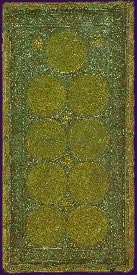
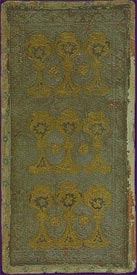
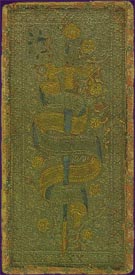
The cards themselves are large - 3 7/8" by 7 1/2", of good quality, glossy card stock. The backs are a solid, pale yellow. The face of the cards shows a 1/4" pale green border, followed by a 1/2" decorated gold border. There are no titles or text of any kind on the cards, and the Minor Arcana pips are not illustrated. The nineteen cards added to the deck by Luigi Scapini follow the same structure, but show figures in much more intense color. This does act as a slight distraction with this deck.
At the end of the LWB, the traditional ten card Celtic Cross spread is presented.
I like this deck for its historic content, but the size does make it awkward to use in a reading. A student of the Tarot would find this deck well worth working with, especially for meditative, ritual or ceremonial purposes. It would also be a good pick for someone looking for a representative deck from this period for their collection.
© Bonnie Cehovet
Cary-Yale Visconti Tarot Review by Nisaba Merrieweather
The Cary-Yale Visconti Tarocchi Deck (U.S. Games, Inc) illustrated originally probably by Bonifacio Bembo, with repair-jobs and missing cards supplied by Luigi Scapini, has been on my wish-list for a couple of years, because due to a *ahem* quirk of taste of mine, I've been collecting Scapini decks, so this was a natural to add to my basket of Tarot. I originally decided that I couldn't really justify this one given my recent spending spree on Tarots and associated articles like bags and silks, so I acquired the cheaper Lo Scarabeo miniature version, which was very much cleaned up by A. A. Atanassov with all of the age-damage removed. I fell in love with it, but my eyes at 48 aren't what they were at 38, and reading it, especially in its miniature format, was uncomfortable at best. So out came the plastic again, and I trotted blythely off to my Friendly Neighbourhood Tarot Dealer without so much as a backward look at the balance of my account.
When the deck arrived and before I even opened the outer packaging, I was struck by the size of the parcel. Oh well, I thought, she probably gave me lots of bubble-wrap to add to my growing collection, and I was pleased with that spontaneous display of generosity. Ripping away the outer layers to receive the Inner Mysteries, though, I realised that all of the depth of this magickal package was in the inner realms, discovering a box 19x10x3cms. Huge!
Then came the first disappointment. The elegant glossy black cardboard box with its details described in feminist red and white, opened at a touch, having been origami-ed closed. I kid you not, folks, they saved money on the very glue (also, on slightly flimsy cardstock). Not being an origami artist I have not one word of a clue how to reassemble the box which has Odd Bits everywhere, so I was very glad I had recently been given an enormous satin-lined velvet drawstring bag, by my estimate suitable for two or three "normal-sized" decks, a few crystals, a candle, a spread-cloth, an largish eagle and probably a good couple of adult wombats as well. I carefully slid the deck and LWB (or more accurately, the EWB for Enormous White Book) carefully into it - it only just fitted. My advice: if you go out and buy this deck make sure you have a VERY BIG bag or wrap for it before you open it - unless you are a Japanese traditionalist, you will never be able to re-use the box.
That was the first disappointment: the first joy was the EWB (see above) itself. They didn't just increase the font-size to fill the extra paper: the EWB was as thin as your average LWB but because it was so wide and tall and because the font size was still achingly small, Stuart Kaplan managed to squeeze a lot of stuff into it. We had a brief discusion of the history of the families whose union was celebrated in creating this deck, a discussion of academic interest about the original artist, a wider discussion about the different Visconti-Sforza decks, an explanation of the dating of this particular one to some time before Filippo Visconti's death in 1447 and so forth. If the deck had been printed to the normal US Games size, we would never have garnered such a richness of information from the publisher.
I'm getting to be okay with unillustrated pips. I've been using Tarot for so long that I only have to see the name of a card, and its meaning, energy and even nuances come over me, so blank or decorated pips are starting to be okay with me, where twenty years ago I found them very challenging in my first TdM and Bologna decks. If you find unillustrated pips difficult, then this deck will be awkward for you to read with. And in fact its enormous size makes it awkward to read with anyway: today I lunched with a dear friend who is also a Tarotista (hello, Ambrosia!) and while she was ooing and ahing over it, like me she found it really difficult to handle despite the larger decks we've both used in the past. A hint: if you don't like unillustrated pips, don't cut it down to a Majors-only deck. Keep the Aces and the Court Cards - this will leave you with a much enhanced majors-only deck.
Okay, so now would probably be a good time to discuss the Court Cards. We like to think of our own time as an enlightened time re our treatment of women in society and in Tarot, but I'm telling you, it just isn't. This deck is much, much, much more feminist and woman-friendly than nearly all later decks, including, shamefully, most 20th and 21st century decks that I've seen except for a couple that labour the whole feminist point so much that they err the other way. We have in each suit a King and Queen, a male page and a female page (or maid), a male knight and a female knight (or warrior-woman). I can really see that - I like it.
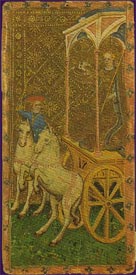
In addition, cards in the Major Arcana that we normally think of as archetypically male such as the Chariot, is actually rather feminine-dominated: we have a large and dignified feminine Charioteer moving towards the left side of the card, the female side, with two bucking horses, and a smaller (to indicate lower status) male either walking with the horses to guide them, or walking beside the Chariot as an escort for this important lady. And Bembo couldn't have predicted this (unless he was using an unusually good Tarot deck!) but the Chariot itself in this card reminds me strongly in its appearance and proportions of the vehicle in Australia known colloquially as "The Pope-Mobile" that the last few His Holinesses have used as their personal transport when in my country. Go, the Women of the Visconti - I love you all!
Talking of the women of the Visconti, I was chatting to someone on the net about the Popess or Papess card, which we now know as the High Priestess, and a whisper came to me of a woman called Manfreda Visconti, the distant ancestor of the house of Visconti that these series of decks were designed for. Wiki backed up what I heard, which was that she lived approximately 150 years before the deck was painted, and was a member of a Catholic sect that believed that as women had equal the capacity for thought and arguably a greater capacity for nurturing then men, and as nurturing is an important part of the duties of the Clergy, women would be better suited to high office in the Church than men. There were about eighty or a hundred of them in this sect, I think, and in anticipation of the incumbent Pope's death, they elected Manfreda Visconti, a wife and mother, as the next pope-elect. The incumbent reigning in the Vatican got wind of this, and did the inevitable gruesome public burning of her on New Year's Day, 1300, as a warning to any and all other upstart women who might believe they are equal to men. This card was supposedly painted not for a mythical Pope Joan, but for a very real Pope-Elect Manfreda Visconti, whose descendants commissioned the deck. I am actually much more comfortable with, and happy about, this legend relating to the Papess card than I ever was with the Pope Joan one - it just feels so much better. From now on, every time I revisit a deck with a Papess instead of a High Priestess, I will carry Manfreda into my relationship with the card, and it will make the whole relationship a lot more positive for me.
One thing I liked very much about certain cards in the deck was that, where time had created cracks and fissures in the cards, US Games chose to keep them whilst in the Lo Scarabeo version they prettied them up and removed all traces of damage. This deck has a much more authentically old feel to it because you *can* see damage on many of the cards; both Ambrosia and I enjoyed connecting with the ancientness of the cards over our lunch, even though we were both aware they were fresh off the printing press.
I have read other reviews of this deck, and a couple of them mentioned Scapini's reconstructed cards, one where he "repaired" the bottom-third of an image, others which had gone missing from the deck which he recreated in a consistent style, as a bit of a problem, with him using colours that were richer than the palette of the rest of the deck and other colours like traces of pink etc that simply didn't occur elsewhere in the deck at all. Now, thumbing from card to card through the deck, it is quite possible to tell the reconstructs from the originals. But at the same time, it isn't a problem, at least, not for me.
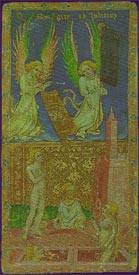
Take, for instance, Scapini's Tower. It is blasted by a Mediaeval-looking Sun, not a more modern lightning-bolt. The falling figures are richly robed, harking back to my comments in other places about this card often representing the fall of poor government. The Tower itself has pinks in its masonry, which other reviewers have criticised, but it frankly works for me, as does the mysterious arched entranceway and spiral stairs disappearing up and into the tower. Instead of them going deeper into darkness as modern painting techniques would demand, they are rising inwardly into mysteriously lighter and lighter shades of paint - light, enlightenment and inner reality having something said about them there. The Tower is pictured as planted solidly on a rock rising out of a grassy field. In the bottom right-hand corner of the card, a part of that rock itself peels up like a blanket, to show us a bearded, crowned figure in Royal Purple, a king or emperor or other person of political and military might in the underworld, in Hell. The stone doesn't really curl up to allow him access - that is a Mediaeval artistic conceit to show you him dwelling deep below the bedrock. The obvious message of that detail is the old chestnut about camels and needlework ...
I love this deck. I find it far more woman-friendly and empowering than most 20th century decks, and even some blatantly feminist-biassed ones like the Motherpeace or the Shining Tribe because they are so self-conscious and bend over backwards to go too far the other way. This is a deck of its time - even the reconstructed cards - and it captures a sense of living and thinking in another completely different cultural matrix quite naturally without having to force or explain itself. As to Scapini's work, I quite like it. I have several of his decks now, and one thing I like about him is that he has enormous technical skill, but he doesn't seem to have a personal style, a personal fingerprint, that marks all of his work. His Mediaeval, his Stained Glass and his Lukumi are just so different - I showed all three of them to a person with an eye for artistic style last year, and as a trick question asked them to pick the "two" decks by the same artist - he grinned and told me I was lying - they were obviously by different artists. And just as those decks were executed in completely different ways, this one was executed pretty much in the style of its older surviving cards. I've been happy with Scapini as deck-creator, as deck-illustrator for other people's ideas and now I'm also happy with him as deck-repairer.
Enjoy this deck - it's worth it.
Complete Details of Cary-Yale Visconti Tarot
Publisher: US GamesDeck Type: Tarot Deck
Cards: 86
Rating: 18/20 or
 stars out of five
Similar Decks to Cary-Yale Visconti Tarot
Theme: Historical Reproduction, Visconti
< Previous Deck · Back to Top · Next Deck >
Home > Tarot Reviews > Cary-Yale Visconti Tarot Review