|
The Gilded Tarot is a digitally drawn and visually sumptous Rider-Waite style tarot from the talented Ciro Marchetti. The 78 card deck is available from Llewellyn as well as in a handmade edition.
See card images of the Gilded Tarot
By
Ciro Marchetti
Tarot Deck - 78 Cards - Published by Llewellyn 2004
|
|
Review by Jason M. Kays
I am privileged to be in receipt of Ciro
Marchetti's "Gilded Tarot," deck number twenty-two, in a
limited production series of two-hundred. The deck
arrived carefully packaged and housed in a flattering
wooden presentation chest. The deck is a precursor to a
general production run to be published by Llewellyn.
Mr. Marchetti is
an internationally recognized artist with multiple
awards in digital graphics; discussion of his work and
technique has appeared in feature articles in numerous
publications. His thirty plus years of work in the genres of
digital graphics and pen-and-ink art has been influenced,
in part, by artists such as Arthur Rackham, James
Christenson, and Michael Parkes. Mr. Marchetti's artistic voice
has a singular and unique expressive tonality and
timbre that earmarks his artistry in all of its
manisfestations. The images, while often representational,
incorporate a Rube Goldberg fanciful quality that visually
delights while providing contextual juxtaposition, lending
subtle connotation to the otherwise denotative
symbolism.
Perhaps as remarkable as the complexity and
contrast in imagery and composition is Mr. Marchetti's
color palette. Upon first examination of the
seventy-eight card "Gilded Tarot" deck under natural light, one
is immediately and profoundly struck by the tactile
quality of the highly detailed artistry; the remarkable
chiaroscuro present--typically reserved for criticism of oil
paintings; and, most notably, the sheer richness of color and
hue that evokes the stained glasswork of Chartres or
John La Farge's stained glass artistry gracing Boston's
Trinity Episcopal Church.
Whether practitioner or
discerning collector, the "Gilded Tarot" is a rare find and
distinguishes itself as a masterwork in the realm of Tarot deck
artwork.
© Jason M. Kays
(Note: There exists no professional association between Ciro Marchetti and myself, nor
was I given a discounted price on the Gilded Tarot or any other economic incentive to write this review.)
|
Review by Christopher Butler
This deck is not due for commercial publication
for over a year but a high quality, limited edition
run of 200 decks are available on application from the
artist via his website. As of this morning I am now the
proud owner of deck no 34 of 200 and all of my very
highest expectations have been exceeded.
Firstly from a
personal point of view. Over the years and latterly whilst
researching to design my own tarot, I have built up a
collection of over seventy decks. Some are purely for
research, some I enjoy for their artistic value and the best
are for my readings. This new deck surpasses anything
I have encountered before. On a personal level this
is the perfect deck that everyone seeks but never
expects to find. Although designing my own cards, they
could never be my perfect deck. As an artist you are too
close to your own work to be objective about it. For it
to work, it has to be for other people. My greatest
hope would be that someone would see my work and have
the same reaction to it as I have to this deck - Then
I'd know I'd got it right!
The presentation of the
deck is stunning. It is housed in an octagonal wooden
box bound luxuriously in black leather and lined with
black velour. The box contains the deck, complete with
personalised dedication card and a certificate of authenticity,
carefully rolled up and tied with gold ribbon. The contents
of the box are wrapped and cushioned in swathes of
delicate gold foil. The effect is breathtaking when you
open the box and reinforces the fact that you have in
your hands something of great value.
The cards
themselves are manufactured to the highest of standards.
Archival standard, museum quality inks are used for the
printing on fine art print stock. Each card is the
approximate thickness of a beer mat and is laminated on both
sides with fine, matt finish laminating film. The
resulting deck is three times the thickness of a
conventional deck but remarkably easy to shuffle although
unconventional shuffling techniques may be required. The
vividness of the colour reproduction and the overall print
quality are something to be marvelled at.
Artistically
speaking, this deck has no rival. Ciro Marchetti is a rare
talent and his work has garnered numerous awards over the
years. He has a fantastical imagination coupled with a
high level of technical accomplishment in his chosen
media. His is computer art in the finest sense. His work
shows all the benefits of working digitally but has none
of the spliced or synthetic qualities apparent in the
work of other computer artists. The sense of everything
being too precise to be true is completely absent here.
Rather, there is a natural spontanious quality,
particularly in the human figures which makes you feel that
they really do live and breathe. The deck follows the
basic Rider - Waite format but not slavishly. Each card
is fresh and original and there are many innovative
touches. The Star and Moon cards are among my favourites.
Each celestial body is seen through a giant mechanised
magnifying glass. Also very striking is the design for the
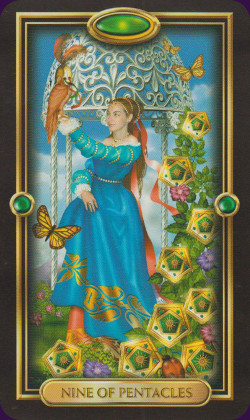
suit of pentacles - golden, enamel embossed and
pentagonal rather than disk shaped. The back design is as
beautiful as anything else on the front of the cards.
Each
of these decks is manufactured to order and one of
the best features is the fact that each one is totally
unique. There are two reasons for this. The first I have
already mentioned. It is a 79th card which contains your
name as a dedication, the edition number of your deck
and a quote of your choice. Your name and edition
number also appear on the certificate of authenticity.
The second reason is even more fascinating. Each of
these 200 decks will contain minor variations and
differences, both from each other and from the commercially
published version when it appears. I have not had time to
compare each card with the images as they appear on the
artist's website so I don't yet know how many variations
there are. One of my Major Arcana cards however is
significantly altered in comparison to the version on the
website. This makes my deck totally special and unique.
Which card is it? That's a secret between myself, the
artist and anyone who spots the difference when they come
to me for a reading!!
If you are tempted to invest
in one of these decks, be warned - It doesn't come
cheap!! Prices are published on the website. I'm sure
there are many who will question the expense but seeing
the quality of the finished product I know full well
that the expense is justified. This is not just a
personal opinion - As an artist I appreciate that this is
not just a tarot deck but a set of 79 limited edition
fine art prints produced to the highest archival
standards. The materials used in production are of optimum
quality as is the print process. This will account largely
for the cost of the deck . The commercial issue when
it arrives, with all due respect to the publisher
will not begin to match the quality seen here nor could
it realistically begin to do so within the price
constraints of commercial printing. When you also consider the
money spent on packaging and presentation, let alone the
man hours spent in manufacturing each card
individually you begin to understand the cost.
I do not
begrudge one penny of what I've spent. The artwork alone
justifies this for me personally. Also, I know that as a fine
art limited edition by a reputable artist, the set
will only increase in value over the years,
particularly when the deck becomes available commercially. It
is likely to become a bestseller, not only because of
its unusual high standard but also because it is the
first Rider style deck to employ high quality digital
artwork.
Will I ever be tempted to part with edition no 34/200?
I really don't think so!
Review © Christopher Butler
Chris Butler discovered the Tarot in his teens
whilst watching a James Bond movie. Now, almost thirty
years later, he has illustrated three oracle decks and
five Tarot decks. He is the illustrator for the Quantum Tarot, published by Kunati Books.
|
Review by Roger J. Katz
Review of the Special Edition Gilded Tarot
I - PREFATORY NOTE AND A QUALIFICATION
I wish to make three
points clear at the outset. First, I wish to point out
that, while the purport behind this review was certainly
inspired by my obvious appreciation for the artistry and
technical precision that I find inherent in the Special
Edition Gilded Tarot deck, the idea for writing a review
at all was solely my own it did not come from the
creator of the deck, Mr. Marchetti, either by assertion or
innuendo. Second, I wish to point out that while Mr.
Marchetti did graciously extend his valuable time to
explain to me certain technical features of and aspects
pertaining to production of the Special Edition Gilded
Tarot deck upon my specific query, which I have related
here and which I clearly ascribe to Mr. Marchetti, my
critique of the deck from an artistic viewpoint is solely
my own and any failing that may exist in this review
of the Gilded Tarot must, accordingly, be blamed on
me and not attributed either to Mr. Marchetti or to
Mr. Marchetti's creation. And, three, I wish to point
out that I have received no monetary benefit from Mr.
Marchetti for writing this review and submitting it to the
Aeclectic Tarot; nor have I received anything else of value,
whatsoever, from Mr. Marchetti; nor was any monetary benefit
or item of value promised; nor is any monetary
benefit or item of value expected. In that regard, I have
recently purchased and paid full retail price for the
Gilded Tarot (Special Edition) tarot deck. I have also
recently purchased and paid full retail price for several
prints that Mr. Marchetti has also produced. Both the
tarot deck and prints that I purchased are available to
anyone, for purchase, on Mr. Marchetti's web site.
II - INTRODUCTION
The
Special Edition Gilded Tarot deck, created by Ciro
Marchetti, is one of the finest tarot decks I have ever seen,
if not the finest. Highly original in conception and
exquisite in detail and in execution, it is the
quintessential tarot deck for the twenty first century. As a
serious collector of tarot decks I own several dozen I
was immediately impressed by the singular beauty of
the imagery and the technical proficiency of the
artist in producing such carefully crafted images. I
recommend the deck to all serious collectors, without
reservation.
III - TECHNICAL FEATURES OF THE SPECIAL EDITION GILDED TAROT
DECK
When I first happened upon this particular tarot deck,
while perusing the Aeclectic Tarot web site, as I often
do, I thought that the images in the Gilded Tarot
were created by air brush, for they had a soft radiant
look, and at one and the same time, seeming
paradoxically, a crisp, sharp, precise look that I find to be
typical of the finest air brush creations. In fact, I had
thought, albeit erroneously, that the images had been
originally painted on metal or Plexiglas through the use of
air brush and that the artist had then, somehow,
transferred the images to card stock. I have since learned
that the artist had created the images digitally, on
computer, through use of Adobe Photoshop software, which,
today, I understand, as the artist pointed out to me, is
the standard in the graphics industry. However, as the
artist also made clear to me, upon specific query, it is
very important to understand what a digitally created
tarot deck means in the context of the creation of the
Special Edition Gilded Tarot. The tarot card images in
this deck are not computer generated images in the
sense, as one often understands the expression, however
wrongly, of suggesting that the computer itself generates
the images. That is to say the creation of the Gilded
Tarot was not a cut and paste exercise, where an image
is first created by a computer as a pre-existent
software option and then digitally altered by inputting
information into a computer. This may be the way that some
artists work, who utilize computer technology in
generating images, but this is not the way that this
particular artist works. Mr. Marchetti uses the computer as a
medium in the same way that a conventional canvas and
brush is used by many (non-graphic media) artists. Where
the typical artist would use a brush to apply enamel
or acrylic or water color to a canvas, Mr. Marchetti
uses a digital pen, and the digital pen is used in much
the same way that a conventional brush is used for
painting on canvas. Mr. Marchetti's canvas happens to be a
computer/monitor screen. That Mr. Marchetti should be able to
employ such a technique in the creation of the Gilded
Tarot so expertly, should not be surprising, for he
began his work many years ago as an illustrator, using
the conventional tools of the trade at that time,
namely pen, pencil and brush. The Special Edition Gilded
Tarot deck is, then, in every sense of the expression, a
free form creation. Thus, preparation of the Special
Edition Gilded Tarot deck required no less skill in
execution on the part of Mr. Marchetti as that skill
exhibited in the creative, artistic triumphs of such
surrealists as Salvador Dali, Rene Magritte, Joan Miro and Max
Ernst, to name a few, from whom it is clear that Mr.
Marchetti's art clearly alludes.
What is surprising to see in
a digitally created work of art, however, is the
extensive range of colors, which is clearly in evidence from
a perusal of Mr. Marchetti's Gilded Tarot
creation. Mr. Marchetti explained to me that he personally
prints each Special Edition Gilded Tarot deck. The
paper that he uses is a special premium luster coated
stock, produced by the same manufacturer as the ink jet
printer that Mr. Marchetti also uses. The inks are
archival quality, guaranteed to not fade for 100 plus
years. Moreover, in the production of the Special
Edition Gilded Tarot deck, Mr. Marchetti uses seven
colors as opposed to the normal four used by standard
commercial printing. This translates to a wider color gamut
and richer colors than one would normally see in
standard tarot decks, or in other commercial print
material. I also noticed immediately, upon viewing my
Special Edition Gilded Tarot deck, that the cards are
quite thick. Apart from the quality of the card stock,
the thickness is clearly due, at least in part, to the
fact that each card is really two cards glued together.
As Mr. Marchetti explained to me, he prints the front
and backs separately and then he glues them together.
This requires the artist to line up the fronts and
backs very carefully. The 78 cards, plus a special 79th
card, included in each of the Special Edition Gilded
Tarot decks, is two and one-half inches thick
substantially thicker indeed, over twice as thick as the
typical tarot deck, which is, normally, approximately, one
inch thick.
Once the front and back cards have been
glued together, Mr. Marchetti sends them to a supplier
who covers the cards with a laminate sheet. Mr.
Marchetti instructs the supplier to use a very thin satin
finish. Mr. Marchetti prefers using a satin finish to a
thick gloss, as the satin finish gives the cards a much
more elegant, refined look. Mr. Marchetti receives the
laminated sheets, which contain 10 cards per sheet, and then
hand trims them. The corners are snipped, which gives
the cards a unique, slight octagonal appearance as
opposed to the standard deck which, I understand, will
have the normal rounded corners. Lastly, the edges are
smoothed with a fine cosmetic sanding block.
My Special
Edition Gilded Tarot deck came to me in a very
impressive, handsome brown leather-wrapped box that had the
appearance of a treasure chest. The interior of the box was
felt lined and the cards were wrapped in gold foil. The
chest included a Certificate of Authenticity.
At $350.00
the price of the Special Edition Gilded Tarot deck
obviously is not inexpensive. But, given the quality of
materials used and the artistic and labor intensive
manufacturing process employed each Special Edition Gilded
Tarot deck is handmade by the artist and his staff
the cost of producing a Gilded Tarot deck is itself
exorbitant and any significant reduction in price of the
Special Edition Gilded Tarot deck would likely make
production of the deck cost prohibitive.
In terms of quality
of materials used as well as in the careful
articulation of and delineation of images appearing in the
various cards, I believe it safe to say that the Special
Edition Gilded Tarot deck is unsurpassed by any other
tarot deck currently on the market.
IV - CATEGORIZATION
OF THE SPECIAL EDITION GILDED TAROT DECK
The
Special Edition Gilded Tarot deck (as with the mass
marketed Gilded Tarot deck that is being manufactured by
the publishing house Llewellyn, and which, I
understand, will be available from Llewellyn at the end of
2004 if not sooner) is a true tarot deck in the
traditional sense. It is not a variant form of a tarot deck or
a deviant fortune telling deck that typically has
uncommon images that is to say images that do not fit
the standard archetypal images of the Major Arcana as
seen in traditional tarot decks. Non-tarot deviant
fortune telling decks, which I generally do not collect,
often consist of either more cards or fewer cards
(usually fewer cards) than those contained in the standard,
traditional tarot deck. Both the Special Edition Gilded
Tarot deck and the mass marketed version of the Gilded
Tarot deck that will be available shortly, from
Llewellyn, consist of the typical 78 cards of which 56 cards
comprise the Minor Arcana and 22 cards comprise the Major
Arcana (exclusive of a 79th personal dedication card,
available in the Special Edition Gilded Tarot deck only,
which is not so much a tarot card as a book cover for
the tarot deck). Moreover, the Gilded Tarot deck is
not a so-called novelty tarot deck, which I refer to
as a bubble gum deck (alluding to the manner in
which baseball cards were sold, with a flat stick of
bubble gum, in the dim past the 1950s).
It is
abundantly clear that the artist drew heavily on the
Rider-Waite/Pamela Coleman-Smith tarot deck for inspiration in
creating the Trumps Minor. From that standpoint alone the
Gilded Tarot deck may reasonably be categorized as a
variant of the Rider-Waite/Pamela Coleman-Smith tarot deck
to the extent that the Minor Arcana follows, at all,
the basic images as designed by Pamela Coleman-Smith,
who must be given credit for the original designs.
And, there are, today, a plethora of versions of the
original Rider Waite/Pamela Coleman-Smith tarot deck, and
many more are continuously being produced. But, whereas
the images of the original Rider Waite/Pamela
Colman-Smith deck, which was first published in 1909, have a
rather rough, unfinished look to them as do numerous more
recent versions of that deck (many of which are virtual
clones of the original deck), Mr. Marchetti's rendition
of the Minor Arcana is polished and carefully
articulated. The images, in fact, could almost be taken for
photographs, given the precision in the execution of those
designs.
V - AN ANALYSIS OF THE TAROT
IMAGES
AN OVERVIEW
The drawings are luxurious. The artist uses a rich
palette of colors, tints and hues. Each scene of each card
is framed with a gold rectangular border, suggestive
of a painting that might be hung in a gallery or
suggestive more whimsically, perhaps, of a scrying
mirror. Gemstones are illustrated on each frame of each
card, which also convey luxuriousness and grand
opulence: black onyx for the Trumps Major, and, for the
Trumps Minor, ruby for the suit of wands, carnelian for
the suit of cups, sapphire for the suit of swords and
emerald for the suit of pentacles. On the reverse side of
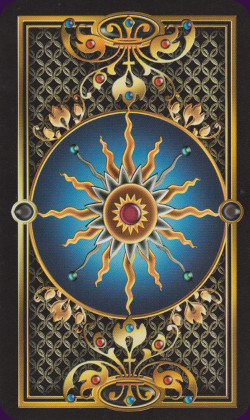
each card the artist has utilized a gold sun medallion
motif an image resplendent with gold hued rays, set
within a glistening sapphire blue circle. Above and below
the gold sun medallion motif the artist has drawn an
ornate gold and gem encrusted filigree that appears as if
emblazoned on a silver lattice structure. The outer borders
of each card, front and reverse, are black. The
extravagance of the images of the deck allude to valuable
mineral wealth, as if one were holding the crown jewels of
some undefined royalty.
The drawings are
extraordinarily evocative. Close scrutiny of the cards tends to
draw the perceiver into them. The artist has designed
the cards as he says for the reader as well as
for the collector. Clearly, they may also be used for
serious meditative work. To do a proper analysis of this
deck one lengthy chapter could easily be devoted to
each card.
I wish to point out that, apart from the
Special Edition Gilded Tarot, deck the artist has created
several prints, which are also available for purchase on
the artists website. The artists website may be
accessed from a link on the Aeclectic Tarot site. Two of
Mr. Marchetti's prints, one titled, Reading the
Gilded Tarot, and a second, titled, Gilded Tarot, Major
Arcana, were obviously designed after or concurrently with
the design of the Special Edition Gilded Tarot deck,
and they include many of the images, exactly as
depicted on various cards of the actual deck. But, other
prints, which may have been completed prior to the
manufacture of the Special Edition Gilded Tarot deck, are
curious insofar as they appear to be tarot images in their
own right perhaps alternate images that might have
been employed by the artist in creating the images
appearing on some of the cards, particularly those of the
Major Arcana. In particular the Divine Fool and the
High Priestess of the Major Arcana are recurring
images (motifs) in the artists prints, and a detailed
comparison between the prints that are offered for sale on
Mr. Marchetti's website and the images as depicted on
the cards of the Gilded Tarot deck illustrate
curious similarities, which demand close scrutiny.
I have found that, through a juxtaposition of various
images that appear both on the cards and in the prints,
the artist leaves clues as to the import of various
tarot images from his perspective. This offers, for the
student of the Tarot, several avenues through which
serious analysis of artistic motifs and archetypal nuances
might be undertaken.
THE TRUMPS MINOR: A
SYNOPSIS
As previously stated, the Trumps Minor are fully
illustrated and follow, fairly closely, the original designs
of Pamela Coleman-Smith, except for the Aces, which
do not fit as neatly into the typical Pamela
Coleman-Smith designs. The style of dress of the actors and
general theme is, I believe, that of the Middle Ages or,
perhaps, early Renaissance. The male actors are dressed in
hose and tunics and the knights, as one would expect,
are in armor. The female actors are dressed in gowns,
which, in the case of the court cards of the Minor Arcana
and in the cards of the Major Arcana are quite elegant
and elaborate.
The cards of the Minor Arcana are
referred to by their usual names wands, cups,
swords and pentacles and the emblems of the four
suits of the Trumps Minor are also quite elaborate
indeed ostentatious and this was obviously clearly by
design to suggest the pomp of a royal banquet or,
perhaps, the lavishness of a royal pageant.
The emblems
of the four suits deserve more than a cursory glance.
While the manner in which the emblem of the Sword, in
the Suit of Swords, and the emblem of the Cup in the
Suit of Cups, remain constant in the manner of their
appearance from one card to the next in each of the two
suits, the emblem of the Wand as used in the suit of
Wands, and the emblem of the Pentacle, as used in the
suit of Pentacles, go through various transformations
as seen in the various cards of the respective suits.
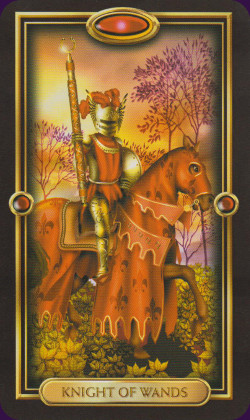
Thus, the Wand appears variously as scepter,
fighting staff, walking staff, column and knights lance
subject to the whim of the artist but clearly
appropriate to the meaning of the particular card. Yet, for
all that, there is a curious, temporal discontinuity
to the images of the wands as correlated with
medieval scenes; for, the wands, threaded as they are, top
and bottom in many of the cards, suggest a part for a
machine perhaps a connecting rod something that
clearly belongs to the industrial age and not to the
feudal age. This curious anachronistic feature intrinsic
to the Suit of Wands of the Gilded Tarot, suggests,
to me, a novel by Mark Twain A Connecticut Yankee
in King Arthurs Court. Yet, for all this
strangeness undoubtedly specifically because of it the
cards of the Suit of Wands exude a mystery a surreal
or hyper-real state of affairs that transcends the
mundane world and draws one to more ethereal realms.
Another rendition of the Wand appears in Mr. Marchetti's
print, titled Toccata. The Wands, there, appear in
the form of Pipes, comprising a beautiful complex
Pipe Organ.
Similarly, the Pentacle in the suit of
Pentacles is, at once, Knights shield, a structural part of
a Kings throne, a treasure chest of coins and
various other constructs some whose meaning is not
readily obvious. In whatever guise the pentacles appear,
though, the Pentacle motif is five-sided, which, for all
its obviousness has, curiously enough, never been
envisioned before in any other tarot deck that I have come
across.
The Swords and Cups motifs, as I have stated earlier,
do not undergo the various, curious transformations
of the Wands and Pentacles but there is, nonetheless,
in those suits, as well, a curious unreality to all
the emblems or, perhaps, a hyper-reality that
engages the mind as it focuses on emblems and characters
and scenes from one card to another. And, I find this
extremely alluring.
THE TRUMPS MAJOR: A SYNOPSIS
Mr.
Marchetti's vision for the Trumps Major is wholly original.
What I mean by this is that, although the images of
each of the Trumps Major are clearly typical archetypes
of traditional tarot decks, the artists renditions
of those archetypes are unique. Below, I provide a
brief synopsis of my impressions of a few of the Cards
of the Major Arcana.
I often find that the depiction
of the Divine Fool in any particular deck often
heralds for me, for good or ill, whether I will find the
other Trumps Major aesthetically pleasing or not. The
Divine Fool, as it appears in the Special Edition
Gilded Tarot does not disappoint me. I find it
particularly compelling, both from the standpoint of the
obvious beauty and perfection of the image, from an
artistic and technical standpoint, as conceived and
executed by the artist and from the standpoint of the
manner in which the image affects me emotionally. This
Fool is neither buffoon nor innocent child. Rather, the
artist clearly views the Divine Fool as Trickster,
suggestive of a god Loki or Hermes perhaps. Mr. Marchetti's
Trickster easily conceives and creates all manner of things
and manipulates matter and energy as he wills. The
artists Magician seen as a powerful wizard as he is
nonetheless, for all that, is still a man. The Magicians
mastery of magick although considerable is but the
constructs of a child to the Trickster. Thus, I find an
intriguing discordance between Magician and Divine Fool
in the Gilded Tarot deck, as it is the Divine Fool
who is Master of the Universe here, not the Magician,
although, had Mr. Marchetti, portrayed the Divine Fool,
differently in the usual mode of innocent soul who is
unaware of the dangers lurking in front of him the
transition to Magician would have struck me as normal
albeit, not nearly as interesting. I might add that the
Hanged Man appears to allude to the Divine Fool in the
Gilded Tarot. The goldenrayed sun motif also appears
prominently in the Hanged Man card. The Divine Fool
archetype recurs in one of the artists prints, titled the
Tower, which is not to be confused with the artists
rendition of the tarot card that is commonly referred to as
the Tower. And the tarot card titled the Hanged Man
appears in the print titled, Strings Attached. A study
of both Mr. Marchetti's prints and the Cards of the
Gilded Tarot deck I find insightful and useful in
obtaining a sense of the artists view of the various
archetypes that come into play in the Special Edition Gilded
Tarot deck.
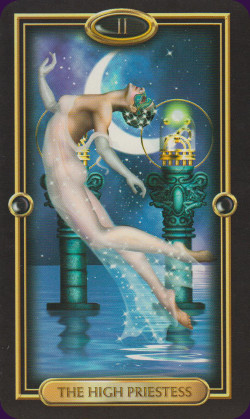
The artists tarot trump card, commonly
referred to as the High Priestess, clearly alludes to the
Anima. In the Gilded Tarot deck the High Priestess is
a card that bears close scrutiny, as this particular
archetype recurs in the twenty-first card, The World, and,
of all the motifs, the High Priestess figures the
most prominently in the artists collection of prints.
One finds the High Priestess in the prints titled:
The Astrobat, Golden Gazebos, Balancing Act, a
Touch of Color and Fly the Light. A study of these
prints, I find, has assisted me in understanding the
import behind the artists rendition of the High
Priestess. It may also be instructive and certainly
interesting to compare the High Priestess as she appears
in the Gilded Tarot deck with the Art Deco images
of women portrayed in Amerigo Folchis Erte Tarot
deck.
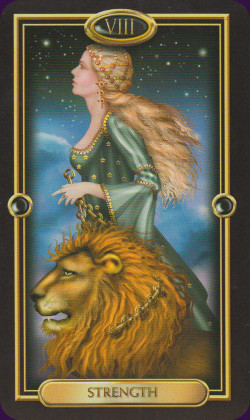
Another card of the Major Arcana of the Gilded
Tarot that I find particularly interesting is the card
titled, Strength. In most, if not all, traditional tarot
decks at least those that I have come across the
power of the lion perhaps representing the baser
aspects of ones self must be overcome by force and
the image of force is in fact used for the card
Strength in the majority of decks that I have viewed.
However, in Mr. Marchetti's Special Edition Gilded Tarot
deck, what is illustrated is not only the defeat of the
baser aspects of the self, but the absolute taming of
the baser aspects of the self as symbolized
ingeniously by the Lion on a leash which the actor has
taken out for a stroll as if it were, simply, a
harmless lovable pet.
It is a curious thing that I happen
to find the archetypes, as they appear in Mr.
Marchetti's Special Edition Gilded Tarot deck, at their
noblest. The Lovers Card conveys the idea of perfection
in carnal love as represented by the God of War,
Mars, and the Goddess of Love, Venus. Even the Devil
suggests nobility and the idea that one may immerse ones
self in raw passions, cravings and desires and, yet,
still retain control and, indeed, mastery over
them.
Many of the images exude sensuousness an eroticism
that appears intricately tied to the particular
archetype.
There are as well motifs that appear from one card of
the Trumps Major to the next. These include the
golden-rayed sun motif that is seen in various semblances in
the Chariot, the Hanged Man, the Wheel of
Fortune, Justice and the Sun. The artists interest in
and fascination with astrology is also clearly
manifest in the Cards of the Trumps Major.
Lastly, the use
of surreal machine-like astrological devices
(astrolabes?) or intriguing clock mechanisms also appear
prominently in both the Special Edition Gilded Tarot and in
the artists prints. This rhapsodic machine device
motif appears in the Wheel of Fortune, the Star, the
Moon, and the Sun. In Mr. Marchetti's prints, the use
of whimsical machines appear in such prints as
Evening Commute, Cosmic Clock, Time Machine Past and
Viewing Machine, and others.
VI - BRIEF RECAP
The
Special Edition Guilded Tarot deck is a cornucopia of
archetypal symbolism. Motifs occur and recur in fascinating
kaleidoscopic array. The artwork is of the highest order and the
materials used in the construction of the Special Edition
Gilded Tarot are the best available. The images as set
forth in this tarot deck are extraordinarily provocative
and evocative. The Special Edition Gilded Tarot deck
should be of value to the tarot practitioner, to the
serious collector of tarot decks or to the connoisseur of
fine objets dart. The Special Edition Gilded Tarot
deck is a singular and significant artistic achievement
and I feel fortunate to be able to include it in my
collection.
Review © Roger J. Katz, 2004
|
Review by Christopher Butler
Review of the Commercial Edition Published by Llewellyn
After a long wait, the commercial edition of the Gilded Tarot has now been published by Llewellyn. My copy arrived this morning and I thought it appropriate to review it, as a postscript to my original article on the limited edition.
As I stated in the earlier review, a commercial printing would not be able to match the quality and luminescence of the limited edition, mainly because of the more elaborate seven colour printing technique employed by the artist. This is certainly the case but I have to say that Llewellyn have done a marvellous job despite this. No, the colour is not as rich but yes, the eye soon adjusts and if you don't have anything to compare to you will be as thrilled opening this as I was the day I unpacked my limited edition. Why, because what you will hold in your hands is streets ahead of anything else on the market. If you enjoy reading with Rider based decks you will find no finer one than this.
If you are familiar with the Aeclectic Tarot Forum then you will know just what kind of excited admiration this deck has caused. Look at any thread. A good one can often have fifteen or sixteen pages of postings. Now look at a Gilded Tarot thread - very often thirty pages or more! Not bad considering that until the beginning of August 2004 there were only a maximum of 200 copies in print!
In presentation terms, Llewellyn have done the deck proud. The package contains the deck ( printed on excellent quality cardstock ), a wonderful book by Barbara Moore, a plain white box if you choose to use it and a very attractive black organdy tarot bag. The outer box is as beautifully designed as the deck.
The book contains detailed descriptions of the cards, accompanied by the elementary principles of tarot divination. There are blank journalling pages included in the Major Arcana section for your own observations.
This is not just a beautiful deck. It's both highly detailed and a well thought out reworking of the Rider format. I've no doubt it will become a classic and justifiably so. It should have a place in any serious collection.
© Christopher Butler, August 2004
Chris Butler discovered the Tarot in his teens
whilst watching a James Bond movie. Now, almost thirty
years later, he has illustrated three oracle decks and
five Tarot decks. He is the illustrator for the Quantum Tarot, published by Kunati Books.
|
Review by Solandia
Review of the 2004 Llewellyn edition of the Gilded Tarot
Welcome to the Gilded Tarot world of fantasy, magic and enchantment. Its release as a mass-produced and widely available deck has been awaited with anticipation by those of us not able to afford one of the luxurious limited edition, hand-made copies direct from the artist, Ciro Marchetti.
There are few decks with artwork that I’ve found quite this attractive. Ciro’s art is a sophisticated blend of digital paintings drawn by hand on a graphics tablet, and some pasted elements (mostly faces). The vibrancy and choice of the colours is fantastic: the backgrounds of blue skies, sunrises, night skies, twilight, stars and comets in many cards are so luminous they almost appear to glow, as do the strong, saturated blues, greens, purples and reds of the medieval-style costumes.
In symbolism, the Gilded Tarot is fundamentally Rider-Waite but it is not a clone or even a re-drawing of Pamela Colman-Smith’s very familiar art. Rather than simply copying, Ciro has used its imagery as a jumping off point for his imagination and inspiration. The Gilded Tarot isn’t one to use for its comparative historical symbolism or occult and esoteric depth, but the card images are unique and beautiful, feeling more like a beautiful fantasy or the inhabiting of a hyper-real dream-world than the Rider-Waite ever did.
The major arcana cards are traditionally named (bar the Hanged Man, who is here the Hanging Man). In most major cards the art has been stripped down to the main human figure, losing some of the familiar symbolism and detaching them somewhat from their environment. (The High Priestess, the Hanging Man, Temperance and the Fool – who looks interestingly but coincidentally like George W. Bush - literally float, weightlessly, in the air.)
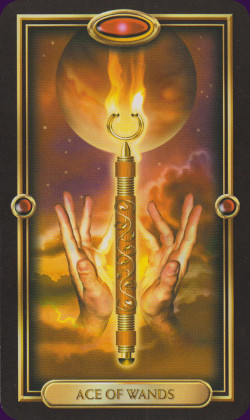
The minor suits are Cups, Wands, Swords and Pentacles. The chosen suit symbols are fairly standard, though the Wands are unusual. Rather than magical or living wands, the Gilded Tarot has a unique baton that appears more like a fountain pen with a metal ring attached to one end. The deck has a few other mechanistic touches, especially noticeable in the Wheel, the Sun, Star and Moon, which is slightly at odds with the non-technological fantasy landscapes.
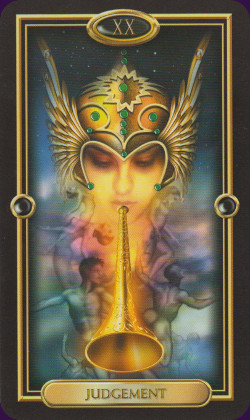
While the most of each card scene in the Gilded Tarot is a digital illustration, the human faces are not. Photographs rather than drawings of faces with the appropriate expression and angle have been used instead. I like this effect; my eye is drawn first to the human face in a card and I find it off-putting if a face is drawn clumsily or out of proportion (not an uncommon occurrence in many decks). The faces of the Gilded Tarot’s medieval characters have a distinct reality of expression, which has been matched to the mood of the card. Overall, my favourite cards of the deck are the Hierophant (not usually one of my favourites, but the combination of the stained glass and robe colouring is stunning); Judgement, which seems to glow; the natural meadow scene with the moon in the Ace of Pentacles; the lighting, sky and colours of the Two of Wands and Page of Wands; the blue and purple sky colours in the Knight of Swords. (All of the Knights and the Kings are on my favourite list, actually, the composition of these cards is gorgeous.)
The Gilded Tarot cards are packaged in a front-opened cardboard box, along with a black organdie bag and a 168 page book. (I like these sets from Llewellyn, but there is usually a large amount of empty space in the box, and this means the packaging is almost always crushed in transit and arrives with torn corners and sunken panels.)
The book, 'The Gilded Tarot Companion' is a nice looking but extremely basic tarot manual. It does contain artist notes - a background on the deck, the inspiration and the motivations for its creation - but unfortunately nothing else written by Ciro. The rest of the book is a workbook written by Llewellyn’s Barbara Moore divided into Basics, Major Arcana, Minor Arcana, The Court Cards, and Spreads. The Basics section covers learning the cards, significators, reversals, divination, performing a reading, plus a number of exercises. The card meanings offer two paragraphs describing the image and its possible meaning, alongside plenty of space for notes, while the back of the book contains five common but useful tarot spreads. Together, the book and card set is suitable for beginners. More experienced readers will find little of novelty in the book or deeper insight into the images -- a separate cards-only edition could be a good idea.
I also would have liked to have seen this deck in a larger size with bigger pictures for easier viewing of the wealth of gorgeous detail and colour, but the Gilded Tarot is a still a deck to be admired. It is suitable for beginners; has wide appeal to querents with its attractive images and lack of nudity or frightening cards; and it is eminently worth collecting for the pleasure of the artwork.
|
Review by Bonnie Cehovet
The Gilded Tarot is a Rider-Waite based deck, with updated imagery that students of today can easily connect with. It is a wonderful representation of the work done by graphic designer Ciro Marchetti - bright with color, and a wonderful use of the imagination.
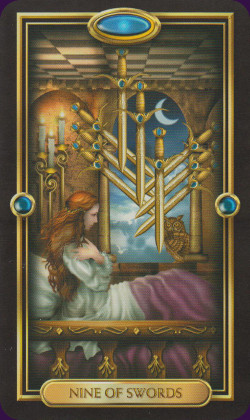
Some of the imagery and symbolism is traditional, some of it has a mythical, faery tale quality to it. It is one of those decks that each time you use it, you see something new and different. One of the things that Marchetti talks about in his artist notes is the use of animals: be aware that they are not always there in their mythical form - sometimes they are there simply to observe the action within the card, and to draw your attention to said action. If you don't realize this, you could read more than was intended into some of these cards. For instance, the Owl in the Nine of Swords is there to make you ask questions, as well as (according to Marchetti) reinforce the idea that the scene is a night scene. The deer in the Two of Wands are there to point out that a decision is being made - in the Ten of Wands they appear to be observers. Death shows a Unicorn featured on a shield; the Ten of Cups features a cat; the Lovers shows leaping Dolphins; the Four of Wands shows rabbits; the Eight of Wands features sheep; the Four of Cups shows a squirrel and a mouse; the Six of Cups shows a cat peeking from the grasses; the Seven of Cups shows a Dove; the Eight of Cups shows a sleeping mole (to indicate blindness); a frog watches in the Six of Swords; in the Seven of Swords a cats watches curiously; in the Nine of Swords an Owl peeks in the window; in the Ten of Swords a deer looks on; in the Ace of Pentacles we have a weasel looking on;in the Seven of Pentacles we see sheep in the field; a mouse looks on, while a spider spins its web in the Eight of Pentacles; in the Ten of Pentacles a ferret peers into the wooden chest; in the Knight of Pentacles a rabbit peers through the greenery; a Peacock graces the Queen of Pentacles.
There is a Special Edition of this deck on Marchetti's site, at a hefty price, but the regular edition deck, through Llewellyn Worldwide, is at a much more affordable price, making this deck available on a much larger scale.
The presentation of the deck is along the lines of other recently published Llewellyn decks: the deck and book come in a box that opens from the top, with the deck and book inside, along with a white box in which to store the cards, and a black mesh bag (I know it is a cost consideration, but I truly wish that nice velvet bags were included with all decks). I did note something this time that I have not seen before - although it may have been there all along - and that is a set of instructions that go with the Little White Box (Little White Box - Little White Book: do we see a trend here!). Entitled "Caring for Your Cards", it includes such suggestions as embellishing the white box with protective or empowering symbols; wrapping the cards in a protective cloth or placing them in a bag; smudging the cards to clear their energy; and storing the cards with crystals or other stones. All very good suggestions - although some in the Tarot world may feel a bit uneasy about embellishing the white box with any kind of symbols.
Marchetti did a great deal of research before starting this deck, with one of the main reasons being that he did not want his work to be regarded in the "novelty" category. He has succeeded in creating a masterful deck along very traditional lines - a deck that could certainly serve as a beginners deck if a student so choose.
The artwork itself comes from the digital art venue - and is absolutely stunning! There is great attention to detail, and a very "otherworldly" feel to many of the cards. Marchetti notes that one of the recurring themes in his personal work is that of mechanical devices, devices that act as a bridge between the worlds of science and magic. We see this in cards such as the Wheel of Fortune, which has a mechanical base moving the Wheel; and in the Star, where we see a mechanical base upholding a globe of the world.
The cards are approximately 2 3/4" by 4 1/2", which make for an excellent size for small hands to work with. They are of good quality, glossy cardstock. The backs have a black background, with an inner 1/4" gold frame surrounding a jewel-toned inner setting, with the four corners marked off and a middle "flame" on a blue background. It would not be possible to tell whether the cards had been dealt upright or reversed.
The faces have a black background, with the same gold border acting as a frame (approximately 1/4" in from the edge of the card). (I believe that I get to say here that I prefer the decks that take the picture to the edge - I feel more like a participant than an observer.) Centered at the top of the deck the is a gold framed oval. With the Major Arcana, this oval is black, bearing the Roman Numeral for the card. With the Minor Arcana, the oval is colored, to represent each individual suit: Red for Wands, Orange for Cups, Blue for Swords, and Green for Pentacles. The Blue for Swords I can see - the color of communications, but I am at a loss for Orange for Cups! In the middle of the gold frame on each side of the card we see a blue-toned circle. At the bottom we have a gold plaque, with the card Title in black (for the Major Arcana), the number and suit in black (for the Minor Arcana), and the title and suit in black (for the court cards).
All of the cards in this deck are outstanding, but I have chosen a few to examine more closely that really drew me to them. The first card would be the literal "first" card of the deck - The Fool. Marchetti has depicted the Fool as a court jester, rather in what we might consider the "Carnivale" mode. This is also the first card in which we see one of the dominant themes in this deck - Astrology. The Fool is juggling the twelve signs of the zodiac, with the moon behind him. He dances with one foot in a gold hoop, and appears to have just stepped over a gold wand with colored ribbons on one end. I am definitely uneasy with this card - too much of the Trickster aspect here for me. From the book:
0 -The Fool
The Fool is at the beginning of his journey. All possibilities and seeming contradictions exist in this moment. The signs of the zodiac that he so carefully juggles indicate both the science of the heavens and the vastness of human imagination. These symbols represent all types of personality traits. Which one will he end up with? Will he make this important choice or will the choice be made for him by chance? Is he playing when he should be serious, or is his play filled with wisdom? Speaking of playing, is that gold hoop at his feet something he should be paying attention to, or is it a possible distraction? The Fool does not know, nor doe he much care. He lives in the moment, filled with wonder and curiosity, not worried about where the journey will end.
The Fool's message is one of unconventional choices. Take a leap of faith. Adopt a playful attitude in a serious situation. You are at a crossroads, and you have no way of knowing where each road will end. Pick one that strikes your fancy and set out with courage and a light heart. Prepare to meet all challenges with confidence.
Be aware of carelessness and folly. There is a difference between taking a risk and plowing headfirst into danger. reckless behavior can lead to a long path of unhappiness.
The High Priestess is shown between two pillars, with a quarter moon in the background. The pillars stand in water, and the female figure is shown wearing a transparent gown, arched back over the waters of the unconscious with nine glowing orbs (representing the nine planets) hovering around her head.
The Hanging Man (Hanged Man) is shown suspended by chains from what appears to be the Wheel of Fortune. To me, he appears to be flailing, as his hands are free and out at his sides - one arm hanging down, the other bent up at the elbow.
Death has to be one of the most stunning cards in this deck. In the middle of the card we see a blue/gray mask. A banner featuring a white pentacle (with a white flower superimposed on it) flies to the right hand side of the card, while under the mask is a shield with a Unicorn on it.
The Ace of Cups shows a large gold Cup, with a blue eye centered over it, pouring down light. Arranged in an arc over the Cup are the six phases of the moon.
The Ten of Cups shows the typical family scene - but only the mother and daughter, and family cat, are shown sitting in front of the family home. Instead of a rainbow, ten cups are arched over the house. Marchetti mentions that this would be the view of the head of the household coming home to his wife and child. I find this approach a bit disconcerting - as if part of the family has been left out.
The Queen of Swords is my favorite Queen in this deck - and I generally do not like Swords in any deck! Her costume is medieval in nature, as are all of the court card costumes. This Queen stands, in her blue and purple gown, with her sword upraised - not in intimidation, but in readiness should she need to defend herself. Light glints off both the sword and her crown, to show the relationship between truth (the light of the Sun), her thoughts (the crown) and her actions (the sword).
The book that accompanies the deck is well written, with an introduction to the suits, the meaning of the numbers, the sequence of the Major Arcana, how to pose a question, how to choose a significator and such. My feeling here is that the information was very basic - perhaps too basic, and I did not see the need for imbedded references to other Llewellyn published books as references. This could have well been presented, if needed, at the end of the book.
Very basic (read incomplete) black and white scans accompany the presentation for the Major Arcana, and there are no scans for the Minor Arcana or the court cards. The text that is presented for each card to me is lacking in depth, and the description of the card itself very minimal. In a deck that is pushing the boundaries for imagery, a more in depth approach, such as the one that Rachel Pollack used for the Haindl Tarot, would have been more appropriate.
There are several useful spreads presented at the end of the book, including various versions of the Three Card spread (Past/Present/Future, Body/Mind/Spirit, and Choices); the Celtic Cross spread and a spread by Katie Vyvyan entitled the daily spread, which I found intriguing. (The positions in this spread are defined as Works (whatever you are accomplishing throughout the day, either at work or at home), Home (the people and activities surrounding the home), Unexpected (literally, the unexpected things that happen during the day), Your Role (your moods, actions and reactions), and Outcome (the outcome of the day, and the spiritual lesson(s) learned).
There are two extra cards with this deck: one shows the layout and position definitions for the Celtic Cross spread, the other shows the layout and position definitions for the daily spread. Nice inclusion - I like this!
The Gilded Tarot is a wonderful example of traditional structure with non-traditional imagery. It is a deck that anyone and everyone can use for any purpose that they wish. There is some nudity in this deck, so it may or may not be appropriate for use with children. IMHO, the "fact" of the nudity is overcome by the mythical/nagical setting in which it is presented. All levels of Tarot students/readers will find joy in working with the Gilded Tarot.
© October 2004
Bonnie Cehovet is Certified Tarot Grand Master, a professional Tarot reader with over ten years experience, a Reiki Master/Teacher and a writer. Bonnie has served in various capacities with the American Tarot Association, is co-founder of the World Tarot Network, and Vice President (as well as Director of Certification) for the American Board For Tarot Certification. She has had articles appear in the 2004 and 2005 Llewellyn Tarot Reader.
|
Review by Kristi Capron
The Gilded Tarot has certainly earned the rave reviews above. It is visually lush, wonderfully vibrant. As a Neo-Gnostic, I truly appreciate that the Strength and Empress cards both hold true to the Magdalen's description and display colors that are always attributed to her in Renaissance/Religious artwork, as the Emperor Card maintains Jesus' indigenous artistic colors.
However, I don't think the esoterism holds true. One example is the application of the color gold to the suit of Cups. I find this disconcerting, as any esoteric deck would ascribe the color blue to this suit; however in this deck, blue is attributed to swords. I can uncerstand the reasoning behind this...blue is likened to sky, therefore air. Gold represents the actual color of the chalice. This is a glaring misconception as far as I am concerned (esoterically speaking) as the element for cups is and always will be water. The only esoteric deck I have found to deviate from this successfully is the Knapp-Hall deck. In this deck, cups are red. The Gnostic Christian implications of this are clear. The color attributed to swords in an esoteric deck is usually a pale yellow representing air, so Marchetti has in fact switched these two suit colors. It goes against the esoteric rules, so to speak. That leaves me uncomfortable with this artistically stunning deck.
My Tarot collection is quickly approaching 100 decks, many of which are collectors items and out of print. I purchased this deck not to utilize, but to add to my collection as a work of art which it certainly is. But, the fact that the color blue is so obviously missing from the suit of cups (a suit of supreme importance to Neo Gnostics. We believe the tarot's origin is gnostic/hermetic/Templaric in nature, therefore to deviate from this renders the deck non-esoteric) and replaced the suit's primary color with gold and swords are replete with blue. That makes me a little uncomfortable with this gorgeous deck.
Tarot Historian and Reader, Essene Christian
minister, member Unitarian Universalist Church, HOGD and
BOTA.
|
Review by Brian Carles
In The Gilded Tarot Ciro
Marchetti pays homage to the Rider-Waite deck, while adding
his own personal touch. You can see Marchetti’s art
reflected in this tarot deck in that it features the signs
of the zodiac, mechanical devices, and parts of
nature; as are shown in his other works.
At first glance the Gilded Tarot
may seem like any other Rider-Waite clone, but that is
not necessarily the case. Structurally The Gilded
Tarot is a normal tarot deck with the 22 cards of the
major arcana having the usual names and numbering. The
minor arcana include the usual suits of wands, cups,
swords, and pentacles. However, one significant difference this
deck has from normal tarot decks is that the background
of the minor arcana isn’t reflective of the element
represented by the suit but rather scenes of nature with the
occasional planet or moon and stars.
While this deck does
incorporate symbolism from the Rider-Waite deck in the major
arcana, Marchetti also incorporates some of his own ideas.
This can be seen in the Fool card, which strays from
the traditional format completely in that the fool has
opened his bag of tricks and is employing what he knows
as he is juggling the zodiac signs. Other differences
are minor, such as the magician holding the symbols of
the minor arcana with magic rather than merely looking
over them. Another card that strikes interest is the
Lovers, which strays from tradition in that the lovers are
intertwined rather than just standing side by side. Strength
does the same in that the woman has the lion as a pet
rather than wrestling with it. The Devil is along the
same lines in that it removes the chained man and
woman, as well as changing the devil into a man in a
mask. Here he may be making a comment as to that the
devil being a creation of man? Marchetti takes a new
approach to the Wheel Of Fortune in that the animals that
are usually around the wheel are missing and the wheel
has become a wheel of the zodiac.
The minor arcana
includes the usual 56 cards, only slightly changed. The minor
arcana includes the usual suits and court cards with one
slight difference. The pages are female, or at least very
feminine. This can also be seen in the Witches Tarot, and
other decks that try to balance out the court cards. The
minor arcana embraces Rider-Waite symbolism more than
the major arcana, with a few differences. In the Eight Of Wands the
wands are flying upward rather than downward, giving the
card a more positive meaning than that of the same card
in the Rider-Waite deck. In the Six of Swords, instead
of the boy on a raft with the six swords it’s a woman
in a small boat. Has Marchetti changed the card to
make it a symbol of the lady of the lake on her return
to Avalon? Of course there are new illustrations as
well such as the chest of pentacles in the Ten Of
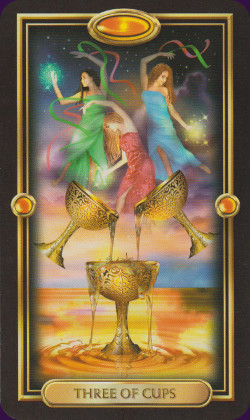
Pentacles, or the three women dancing in the sky over three
cups in the Three Of Cups.
Marchetti being a card
collector himself may have made this deck for tarot
collectors. This deck may not be a good one for many tarot
readers, for they prefer not to mix divining with
technology. If you don’t mind bending tradition though, this
deck may be for you. This deck may also be good for
those who like the symbolism of the Rider-Waite deck, or
those interested in Rider-Waite clones. Those who are
into astrology, technology, and nature would like this
deck, as well as those that enjoy Marchetti’s
artwork.
This deck is a tribute to the Rider-Waite tarot deck
and it shows that. This deck is a mix of astrology,
technology and nature with Rider-Waite symbolism. Marchetti
adapts Rider-Waite to fit his own beliefs in this deck
and did a good job at it seeing that this was his
first tarot deck. Some of the cards change only slightly
from the Rider-Waite deck, and others go far from
tradition. This deck has great art work
and comes with a 150 page companion book by Barbara
Moore. Should it be so taboo to mix technology with
divination?
|
Write a review of the Gilded Tarot for Aeclectic Tarot.
See the card images of Gilded Tarot or find out the details.
|  |