Herbal Tarot Deck Review
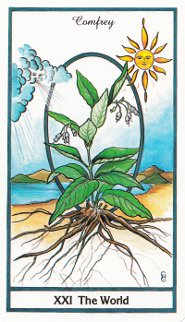
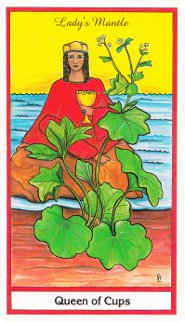
The Herbal Tarot is another Rider-Waite style deck, except it pictures a different herb that corresponds with each card, such as garlic for the Tower, and a lotus in the Ace of Cups. Some herbal knowledge (or the companion book) would be necessary to read with this deck.
Deck Type: Tarot Deck Cards: 78
Creators: Candice Cantin, Michael Tieris
Publisher: US Games 1978
Retailers
See Price at Amazon.comSee Price at Amazon.co.uk
See Price at Amazon.ca
Herbal Tarot Review by Maiden
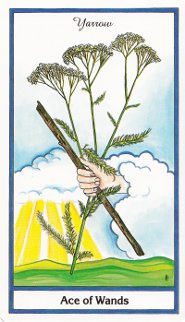
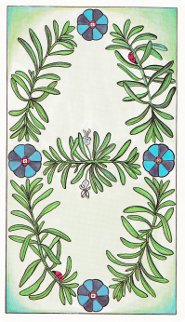
When I began reading Tarot cards I used the good ol’ Rider-Waite deck. For a beginner, I believe this was/is the best place to start. However, as I got deeper into the meanings of the cards and their meaning to me, I started to look around at different styles. I found that the illustration of some cards did not "feel" as connected to me as others. In my search I never found exactly what I was looking for. That is, until my mom cleaned out her chest and handed down one of her older decks to me. This "new" deck came to me wrapped in a black, cotton piece of cloth--no box, no author or publisher name, just the sweet, earthy smell of sandalwood. Immediately, I could tell this was "my" deck. I held them in my hands and got goosebumps that accompanied a rush of energy. Perhaps I was just excited to get a very special heirloom from my mom, or maybe they were just meant to be mine. In magick it is hard to tell the difference, and I really hate to try and separate. The Herbal deck, aside from being well used, is beautifully illustrated. For example, the back of the cards have a sea-green background with a rosemary border. As if marking elemental corners, there are four eight-petal flowers in blue, as well as two red ladybugs and two white flowers. The illustration of the cards themselves are done with the traditional meaning attributed, but also with the herb/plant/flower which attunes to the card. I find this to be even more helpful in understanding the meaning of particular cards. For instance, a person may not "get" the feeling for the Ten of Cups right away, but with the background of the herb marijuana/hemp it becomes a little clearer. In addition, the Tower is represented with garlic, Knight of Wands by aconite, Four of Swords by mullein, Ace of Wands by yarrow. Each of these adds an additional "feel" to the cards that I find are not present in traditional decks. I would recommend that anyone who is interested in both the Tarot and herbs to seek out this deck.Herbal Tarot Review by Sally Ann
The Herbal Tarot set has 78 cards, along with a LWB and companion book. It is another deck that begins as a variation on the traditional Rider-Waite theme, but this deck has sort of a holistic approach, which could be handy when dealing with clients that are in poor health or depressed. (Caution is advise to the reader, remember your not a doctor, proper medical attention is important in any health situation.)
The Herbal deck is beautifully illustrated, the backs of the cards have a sea green background with a rosemary border, which there are four eight petal flowers in blue, as well as two red ladybugs and two white flowers a pleasant design. The cards are the perfect size and shape for shuffling, they are printed on good quality card stock which will stand up to repeated use.
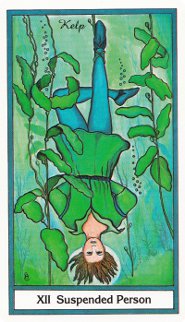
Many of the Major Arcana cards are beautiful in design, while the Minors tend toward the traditional suits of Cups, Wands, Swords and Pentacles. Knowing the Rider-Waite symbolism is a plus when using the deck. Within the Major Arcana there are several renaming of the cards: The Hierophant is called the High Priest, The Wheel of Fortune is now the Medicine Wheel, the Hanged Man is the Suspended One and the Devil has be renamed as Pan.
The court cards are simple figures sitting or standing in a plain but nicely colored landscape. Each card is assigned a herb. The LWB says; As above, so below, as within, so without applies to the order of nature. The illustration of the cards are done with the traditional meaning but also with the herb/plant/flower which attunes to each card. It is helpful in understanding the meaning of a card. For instance take the Ten of Cups, the card of happiness, has the background of the herb marijuana/hemp making this card clearer. The Ace of Wands has yarrow, the Knight of Wands has aconite and the Four of Swords has mullein. Each of these herbs add an additional feel to the cards.
Michael Tierra wrote The Herbal Tarot with more specific text:
The Fool is assigned Ginseng for cosmic energy
The High Priestess is assigned Peony for intuition
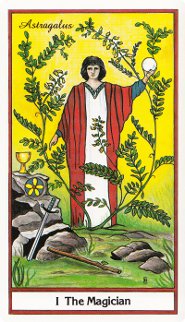
The Magician is assigned Astragalus for creativity
The Empress is assigned Dong Quai for women's tonic
The High Priest is assigned Sage for purification
The Lovers is assigned Parsley for aphrodisiac
The Emperor is assigned Atractylodes for Digestion
The Hermit is assigned Licorice for clam
The Chariot is assigned Cyperus for direction from within
Strength is assigned Cayenne for circulation
Death is assigned Elder flower for protection
The Medicine Wheel is assigned Slippery Elm for soothing
Justice is assigned Plantain for adjustment
Suspended Person is assigned Kelp for softening
Temperance is assigned Echinacea for antibiotic
The World is assigned Comfrey for healing
The Sun is assigned Angelica for stimulant
The Tower is assigned Garlic for breakthroughs
The Star is assigned Skullcap for relaxation
Pan is assigned Lobelia for playfulness
The Moon is assigned Lemon Balm for nervine
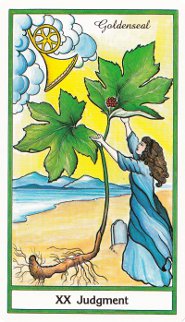
Judgement is assigned Goldenseal for cleansing
The book is written to accompany this set it is a wealth of herbal lore and a wonderful tool for physical, mental and spiritual healing. It cover the meaning of the card and addresses the meaning of the herb assigned to the card. This is one deck that should not be purchased without its associated book for much of its value would be lost. It is a good reference book and essential for doing a reading but you can use it anytime when you want to know a herb.
Even though at first appearances this deck seems to be limited to health-oriented readings, they work surprisingly well for daily and general reading. Reading this deck you will find that the book is essential, you can look up what the authors have to say about it, with gives new insights to the general meaning and how it approaches ones overall health, mind, body and spirit.
I recommend this deck to anyone who has in interest in herbs, or one who wants a new approach to spiritual, physical and mental health. A deck that a collector will want for their collection of Tarot.
Herbal Tarot Review by Helen Morrison
The Herbal Tarot was one of my first tarot decks. I saw the Herbal Tarot as a way to learn two things at once; the power of herbs and the wisdom of the tarot. Every time I used this deck I would be exploring both tarot and herbs.
It’s inspired by Rider-Waite, but too different to be another clone. The non-traditional interpretation of some of the minor arcana can be confusing; it’s necessary to realize the deck creator takes a non-traditional approach to the progression through the suits. I used this deck when I was still just a beginner myself. It was challenging at times. It was not my very first deck. I could not recommend this deck as a very first deck. It’s a fine choice for anyone who is interested in herbs, or who finds the non-traditional views appealing, or who would like to branch out a bit (but not too far) from the standard Rider deck.
The sturdy cards are typical tarot size, about 2.5” x 4.75”. The Magician card appears on one side of the box. (My box did not hold up well, the top and bottom flaps vanished after a couple of years.) The back of the cards features a lovely oval leafy pattern in mostly green shades. Touches of blue flowers and bright red ladybugs liven it up, and a white border frames the card. It appears the same both right side up and upside down. Each card is labeled at the bottom. Trumps and court cards are labeled in capital letters on a grey background, pip cards are labeled in upper and lower case on a white background. All cards have a white border. The common name of the herb that is used on the card appears in script at the top of the card. When the background is dark, the script is light, when the background is a light color, the script is black.
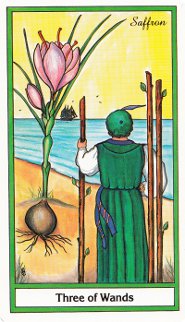
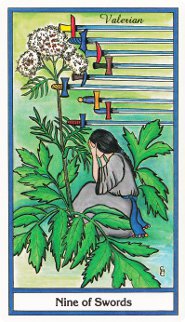
The cards are drawn in soft tones, with a watery quality. An herb is predominantly featured on every card. On some cards, the herb is nearly the whole image. For example, the Medicine Wheel (X) features an elegant slippery elm tree surrounded by a circle of small grey boulders, a rather minimalist image for a major arcana card. Pip cards are fully illustrated, a few have more complex illustrations than some of the trumps. On the Four of Wands, the four wands are clumped together at the left side of the frame. A large, airy stem of fennel dominates the scene, and two winged women, maybe fairies, flutter about. The overwhelming feeling is relaxation, matching the deck designers vision for this card; “Agreement, relief”. According to the LWB, the herbs were selected for the cards based on “astrological correspondences of the cards, symbolic aspects of traditional herbal uses, and sometimes an herb’s folklore or biological action”.
Each suit is associated with a body system. Swords correspond to air and emotions, so all the herbs used in the suit of swords are herbs that affect the respiratory or nervous systems. Wands correspond to fire, energy and blood, herbs used in the suit of wands affect the heart and circulatory system. Cups are water, the herbs on cup cards affect the urinary and reproductive system, including aphrodisiacs. Pentacles represent earth, pentacle herbs affect the digestive system.
One odd thing about this deck is the creators interpretation of the progression through the suits in the minor arcana. Traditionally, the ace is the root or beginning. Ten is completion, the end of the cycle. According to the LWB, in this deck, ten is the lowest point (hitting rock bottom, so to speak), and the beginning. Aces are the cards of enlightened fulfillment.
The choice of herb on some cards can seem a little weird, but this non-traditional view of the suit cards explains things. For example, the Ten of Cups is represented by marijuana. The traditional Rider interpretation of this card is usually something like “perfect state of contentment”, which makes the association with marijuana seem a bit baffling at first glance. The “contentment” one may (or may not) get from smoking marijuana is just a temporary drug induced high, and doesn’t qualify as “perfect state” of anything. But in the Herbal deck the assigned divinatory interpretation is “pie in the sky dreams, illusions”. The description of the medicinal properties of marijuana in the LWB says it “lowers inhibitions and allows for free expression of sexual instincts”. In other words, it’s classified as an aphrodisiac. Herbs used on cup cards include aphrodisiacs, so marijuana fits that requirement. Smoking marijuana makes people a little bit stoned, and that state of mind fits the cards divinatory meaning in this deck. So it all fits nicely within the system. It’s necessary to read and refer to the LWB until you become familiar with how this deck works.
The trumps stick closer to the traditional archetypical divinatory interpretations, even when the name is changed. Trump X for example, is the Wheel of Fortune in the Rider deck and the Medicine Wheel in the Herbal Deck, but the LWB says the interpretation of Medicine Wheel is “Wheel of Fortune”. The Hierophant was renamed High Priest, but his meaning stayed the same. Likewise, the divinatory meaning for XII Suspended Person sticks close to the typical Rider meaning, even though gender was stripped from the name and even the image on the card is somewhat androgynous. Is it a boy or a girl? After years of pondering I still cannot decide. But with Trump XV, where the Devil is substituted for Pan, much of the negativity traditionally associated with this card is gone. Instead, the divinatory meaning is lighter, almost frivolous.
I was a little disappointed when I opened the LWB. I was interested in the symbolic powers of herbs, but the LWB discusses these only for the major arcana. The medicinal properties of the herbs are included for all the cards. The psychic powers of the herbs are implied by their correspondence to the cards of the tarot. However, it is still essential reading.
The LWB describes the creator’s perception of progression through a suit, the correspondences of herbs to suits, information, including the scientific name, of the herbs that appear on the cards, the medicinal properties of the herbs, the divinatory meanings of the cards in both upright and reversed positions, an introduction to tarot in general, a section on how to use the herbs in conjunction with the tarot, and a classic 10 card layout. That’s a lot of stuff packed into 39 pages.
The scientific name is essential information for anyone interested in obtaining and using an herb. Many plants may share the same common name, and some plants have many common names. “Maywort” could be Sweet Woodruff, an edible herb sometimes used to flavor wine or bakery. Or it could be May Apple, which is poisonous. But each plant has one and only one unique scientific name, in Latin. Using the scientific name eliminates any potentially dangerous confusion over which “Maywort” we are talking about.
The LWB starts out with an introduction to tarot in general. The next section, called “Herbs and the Tarot”, discusses the holistic use of herbs and how the tarot is integrated into the herbal system. It also includes suggestions on how to use the herbal associations beyond tarot, for example, burning or burying the herb associated with a problematic card.
The section on Major Arcana starts out with a brief introductory paragraph, then lists each trump 0 to XXI with a description. The associated herb and both common and scientific names are listed, the herbs medicinal properties and symbolic uses are described, and the divinatory and reversed meaning of the card are given.
The section on Minor Arcana begins with a brief paragraph about the significance of the suit of swords. It’s followed by a list of sword cards, starting with King of Swords. The description for each card includes the associated herb, common and scientific names, medicinal properties and the divinatory and reversed meaning of the card. The second suit covered is the suit of wands. I assume the deck creator had a special affinity for this suit, because the introduction is over a page long. Here is where the unique progression through the suit is finally explained, using wand cards as examples. The suit of cups comes next, with a single sentence introduction. The suit of pentacles is covered last, and includes a two paragraph discussion of wealth and spirituality.
The LWB closes with a diagram and explanation of a 10 card spread.
I enjoyed this deck and used it often. As my skills and knowledge grew and my tarot card library expanded, the Herbal Tarot gradually slid to one side. But, unlike dozens of other decks that quickly landed on the hard-to-reach (and therefore, much less used) shelf, this one always stayed in an easily-reached place and never slipped completely out of use.
A warning - if a seeker is suffering from a physical
malady, encourage them to seek appropriate medical advice.
Do not attempt to prescribe an herbal remedy from
this tarot, even if the seeker requests it. Herbs can
be deadly, such as belladonna, or illegal, like
marijuana. Only licensed practitioners can legally prescribe
herbal or chemical medications. Offering medical advice
based on a tarot card reading is foolish at best, and
could land you in seriously hot water. Could you deal
with the guilt if someone became gravely ill because
they took an herb prescribed by your tarot reading
instead of getting medical help? I know I could not.
Complete Details of Herbal Tarot
Creators: Candice Cantin, Michael TierisPublisher: US Games 1978
Deck Type: Tarot Deck
Cards: 78
Major Arcana: 22
Minor Arcana: 56
Deck Tradition: Rider-Waite-Smith
Minor Arcana Style: RWS-Based Scenes
Suits: Cups, Swords, Wands, Pentacles
Court Cards: Page, Knight, Queen, King
The Fool is 0
Strength is 8
Justice is 11
Card Size: 2.76 x 4.72 in. = 7.00cm x 12.00cm
Card Language: English
Card Back: Reversible
Rating: 14/20 or
 stars out of five
Similar Decks to Herbal Tarot
Theme: Herb & Plant, Rider-Waite-InspiredCategory: Available Tarot Decks, Tarot Decks from the 1970s
< Previous Deck · Back to Top · Next Deck >
Home > Tarot Reviews > Herbal Tarot Review