
Light and Shadow Tarot Deck Review
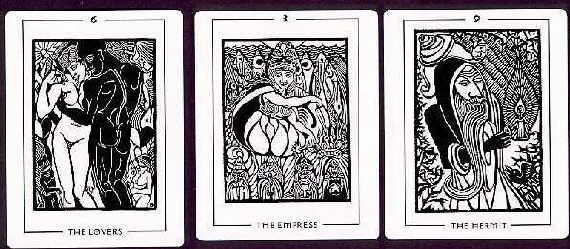
The Light and Shadow Tarot is a black and white deck symbolising contrast and balance, and inspired by a number of spiritual traditions, including Native American, African, East Indian and Medieval European.
Deck Type: Tarot Deck Cards: 78
Creators: Brian Williams, Michael Gopford
Publisher: Inner Traditions 1997
Retailers
See Price at Amazon.comSee Price at Amazon.co.uk
See Price at Amazon.ca
Light and Shadow Tarot Review by Bonnie Cehovet
The history of this deck and book are as amazing as the deck and book themselves. Purely by chance (if there is such a thing), Brian WIlliams saw the "Light and Shadow" Tarot images at the Bay Area Tarot Symposium (BATS). He was so impressed by Michael Goepferd's linoleum block cuts that he felt that the deck "had" to be published. Brian approached Michael about writing a book to go with the deck, as there was a much greater chance of the deck being accepted for publication if there was a book to accompany it. The result of this coming together is a book and deck that are cohesive in nature, as well as strong in spirit, focus and intent.
Brian wote the book as a collaboration with Michael - feeling that the words should reflect Michael, and not himself. The words are gentle, yet strong. They flow freely, and they never waver. We see here two gentlemen that have honed their craft well, and gifted the Tarot world with a marvelous tool.
The "Light and Shadow" Tarot carries with it many levels of energy and understanding. The first level would be related to physical presentation. The very manner of creating linoleum block prints is such that areas that are to appear white are cut away, and that which remains will show as black. Without color to "distract", the energy of the concept or thought that the card represents comes through with a major impact.
The second level of understanding is very connected to this use of white and black, or positive and negative space. The Tarot in and of itself it a spiritual journey, a tool to be used for personal exploration. In setting foot on this journey, we are putting forth an implicit agreement to work with the "shadow" sides of ourselves. These shadows are the corners ofo ur lives that we refuse to bring into the light, for fear of what we will see. They weigh us down - they are our "baggage". We empower ourselves by searching our out baggage - by shining light into the recesses of our souls. In my opinion, the "Light and Shadow" Tarot is an excellent deck for this purpose.
The cards in this deck are large - 4 1/4" by 5 1/2", which is something that I would normally complain about, as I have small hands. For whatever reason, I found this deck easy to handle - and well worth the effort! The backs of the cards have a white border, with a narrow black border forming a frame around four hands - each hand holding a representation of one of the elements. I found t hat this gave power to the deck.
The face of the deck has a white outer border, a narrow black inner border, then a second white border that frames the picture. For the major arcana, the numbers are on the top of the card, with the title on the bottom. The pips show the number across the top and the name of the suit across the bottom. The court cards show the card title and suit across the bottom.
Each of the cards starts with a short poem from the work "Incantations", written by Mark Hannon. There follows a discussion of the card, and a section on its divinitory meaning. For the most part, this deck follows very traditional Tarot lines of interpretation. Where it departs is that the females represented in this deck are strong - a good balance for the male energy, which is something that is not seen in all decks.
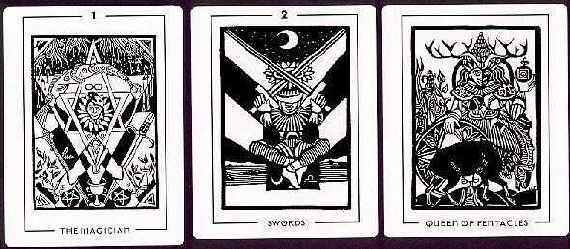
These are also the kind of cards that one needs to look at - and then look at again! There are layers upon layers of symbolism here. For example, the Four of Swords shows a figure seated in front of four swords that are placed so that their tips touch. That is a first impression. Look again, and you will see that the hands of the seated figure are held together, palms facing each othe, and pointed downward, to the center where all four swords meet. Man has become the catalyst for his own understanding.
The Magician is a story within a story, within a story. There is immense detail within this card - and remember, this is a block print, not an etching or a painting. In the middle we see the smiling face of the Magician - who looks very Jester like. Surrounding him we have two triangels - one pointed up, one pointed down. Over the Magicians head we see the symbol of Luminescence. Above the Magician we see an array of fish, to the right we see a sword, to the left a Wand, underneath we see a Cup. All tools of manifestation. Between the Cup and the face of the Magician we see a small figure, seated, with knees drawn up and what appears to be rays surrounding the head.
Each card is drawn in this manner - relaying the meaning of the card at first glance, deepening the meaning each time one returns to it.
I would
recommend this deck to anyone doing Shadow or Shamanic work,
or to anyone who simply has a deep appreciation of
art. It is easy to work with, and true to Tarot
tradition.
Complete Details of Light and Shadow Tarot
Creators: Brian Williams, Michael GopfordPublisher: Inner Traditions 1997
Deck Type: Tarot Deck
Cards: 78
Major Arcana: 22
Minor Arcana: 56
Deck Tradition: Rider-Waite-Smith
Minor Arcana Style: RWS-Based Scenes
Suits: Cups, Swords, Wands, Pentacles
Court Cards: Princess, Prince, Queen, King
Major Titles: Fool, Magician, High Priestess, Empress, Emperor, Hierophant, Lovers, Chariot, Strength, Hermit, Wheel of Fortune, Justice, Hanged Man, Endless Dance of Death, Temperance, Devil, Tower, Star, Moon, Sun, Judgment, World
The Fool is 0
Strength is 11
Justice is 8
Card Size: 4.50 x 8.50 in. = 11.43cm x 21.59cm
Card Language: English
Card Back: Non-reversible
Back Design: Within a wide white border, a black block print of four hands, each holding a suit sign
Companion Material: Substantial 194-page illustrated book packaged with the cards in a sturdy two-piece cardboard box
Rating: 14/20 or
 stars out of five
Similar Decks to Light and Shadow Tarot
Theme: MulticulturalCategory: Black and White Tarot Decks
Creator: Minchiate Tarot, PoMo Tarot, Renaissance Tarot, Ship of Fools Tarot by Brian Williams

< Previous Deck · Back to Top · Next Deck >
Home > Tarot Reviews > Light and Shadow Tarot Review