
Medieval Enchantment: Nigel Jackson Tarot Deck Review
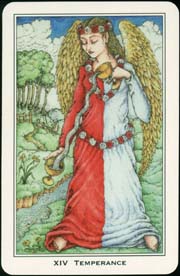
Based on Medieval/Renaissance symbolism and Pythagorean numerology, the Nigel Jackson Tarot looks polished and authentic. Bear in mind it associates Swords with Fire and Wands with Air, but it's a deck worth adding to any tarot collection. Reprinted by Llewellyn in 2004 as the Medieval Enchantment: Nigel Jackson Tarot.
Deck Type: Tarot Deck Cards: 78
Creators: Nigel Jackson
Publisher: Llewellyn 2004
Retailers
See Price at Amazon.comSee Price at Amazon.co.uk
See Price at Amazon.ca
Medieval Enchantment: Nigel Jackson Tarot Review by Tom LeBlanc, CTC
A well-known esoteric/symbolic artist, Nigel Jackson appears to utilize much of the Rider-Waite-Smith (RWS) system in juxtaposition with "Classic" tarot imagery. That is, the Minor Arcana symbols remain consistent with the RWS decks, yet many of the Major Arcana cards are labeled in a fashion consistent with the Classic style. For example, The Magician becomes the Juggler and the Hierophant is once again the Pope.
Indeed, Jackson's reputation as a symbolic artist is well earned. The artwork of the cards is engaging and ideal for readers who wish to capture a "Renaissance" feel. Printed on high-quality, plastic-coated cardstock, this deck is quite durable and the colors appear soft without becoming overly subdued.
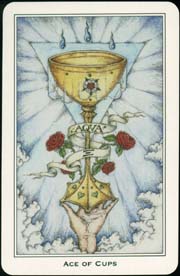
Although Jackson certainly promotes a specific philosophy regarding Tarot reading, he does not permeate the cards with symbols to the point of inflexibility. As such, although Jackson purports a Pythagorean approach to Tarot, he does not overwhelm the reader with geometric numerical notations on the cards. The elements associated with each suit of the Minor Arcana are well-represented symbolically (the Swords represent fire and the Staves represent air in this system), and the aces of each suit have the elements indicated in Latin upon a scroll.
Though not requisite for the effective use of this deck, the 143-page mini book that accompanies this deck is a relatively valuable find. Jackson's viewpoints regarding Pythagorean theory as it relates to Tarot, for example, is thought-provoking and well worth the time invested in reading. Jackson also provides his viewpoints regarding the history of Tarot and card meanings. Rather than utilizing the standard "Celtic Cross" 10-card spread, Jackson provides an outline for more unique spreads compatible with his Pythagorean philosophy (e.g., the Key of Hermes, the Pythagorean Method, the Eastern Cross).
However, the Nigel Jackson Tarot takes on dimensions that are rather idiosyncratic to the typical tarot deck in that it is slightly wider than most (5-1/8" x 3-3/8"). Thus, even seasoned readers may find moderate difficulty acclimating to shuffling this deck.
Although the unique size
of the cards may make shuffling a bit challenging for
some individuals, acclimating to these cards should not
be a significant problem. Further, although many may
feel that the system of reading promoted by Jackson may
be a bit farfetched or incompatible with their own
style, this deck appears to be adaptable to other systems
of interpretation. However, the Nigel Jackson Tarot
makes sufficient deviations from both the RWS and
Classic systems so that novice readers (or those who
prefer not to deviate from either system) may find this
deck somewhat challenging to interpret. As such, this
beautifully illustrated deck may be considered slightly more
appropriate for more seasoned readers than those just
beginning.
Medieval Enchantment: Nigel Jackson Tarot Review by Kate Hill
If Nigel Jackson's artwork looks familiar, it is because he created the Witches Rune cards together with Silver Ravenwolf. This deck, however, offers a much better opportunity to showcase Jackson's art as well as his historical studies, with its solely produced seventy-eight tarot cards.
The fine artwork of the Nigel Jackson tarot is late medieval/Renaissance in symbol, dress and landscape, and appears historically authentic to a casual eye. The cards are finely drawn in black ink and coloured with soft watercolours. Overall, the colours are muted and feature plenty of pale blues and greens. Some sky scenes are beautiful blends of yellow, pink and blue hues.
The uniformity and quality of the illustrated tarot scenes in the Nigel Jackson deck make it suitable for tarot readers with almost any level of skill, though scholars and academics may benefit from the deck's deeper occult meanings. Each card looks polished, as though it had many hours spent on it during its creation, and none deviate from the style and theme. The Nigel Jackson Tarot keeps the essential tarot meanings, but recasts them into a subtle and elegant Renaissance mould.
Physically, the cards are large and rectangular, and a little harder to shuffle for those with smaller hands. The scene is set into a medium white border, with the card title printed at the base. The backs of the cards are stunning - coloured deep blue and white with gold highlights, a design with the infinity symbol is in the centre and stars bordered around the outside.
The packaging of this tarot deck is excellent. The cards have their own sturdy, individual box, and both it and the 150 page explanatory book fit inside the hardcover jacket. (I can't tell you how much I prefer this method of packaging to the usual large Llewellyn boxed set, with a large book and cards only wrapped in plastic.)
Nigel Jackson has weaved together occult symbolism from classical Greek and medieval cultures as well as Pythagorean numerology to create the Nigel Jackson Tarot. This combination can make the deck artwork far more complex than it appears on the surface, if you prefer it that way. The accessory book is complicated, with very limited divinatory meanings, and mostly helpful to those interested in Pythagorean numerology. I feel these high quality tarot cards could be more easily used with a generic tarot book.
Medieval Enchantment: Nigel Jackson Tarot Review by Bonnie Cehovet
The cover of the box that this deck, with its accompanying 143 page book, come in aptly tells the story of what is inside. The midnight blue background and white stars lend a feeling of softness, perhaps even "other worldliness" to the atmosphere, while the depiction of the Ace of Cups shows the depth of esoteric imagery involved. Nigel Jackson is an extraordinary artist, as well as historian (a la the late Brian WIlliams).
The Nigel Jackson Tarot reflects artwork done in the medieval/Renaissance mode through the use of black ink drawings that are colored in with soft, pastel watercolors. Greens, purples and blues predominate, with some of the sky's reflect a brighter orange/red coloring. The quality of the work in uniform throughout this deck, with esoteric symbolism blending into the illustrations, rather than calling undue attention to itself.
The 143 page, 3 1/2" by 5 1/2" book that accompanies the deck is somewhere between a standard LWB (Little White Book) and an expanded book. The book and deck, along with a black organdy bag, fit nicely into their storage box, which opens the long way (and is currently my favorite type of box for the deck/book kits). Jackson does a credible job of developing the history of Tarot from the 15th century on, hitting on the high points of Court de Gebelin's theories to pre-Christian Celtic origins and the woodcuts of the 18th and 19th centuries.
From here Jackson goes into the background of Tarot symbolism and origins. He makes these times sound so wonderful that it makes one yearn to be part of them! Jackson posits that Tarot as we recognize it today is based on the "so called" Venetian-Piedmontese Tarocchi, as well as influences from Gnosticism and Hermeticism.
In this vein, Jackson places great import on numerology as influencing the Major Arcana, vis a vie the Pythagorean theory. There is a more than adequate discussion along these lines, leading into a description/explanation of the ancient Pythagorean Tetraktys symbol that Jackson calls the "Key to the Tarot". For those interested in numerology, there is a section on the Pythagorean Dekad, representing the first ten cards of the Major Arcana. Cards XI through XX (Fool = 0/22) represent the doubling of the Dekad, the cosmic cycles of outgoing evolution and ingoing return represented by the Lemnescate sign of infinity. Part of this section includes the magical meanings of the Major Arcana. From the book:
0 - The Fool
The Fool is the unnumbered card of the Greater Trumps and can be equally well placed at the beginning or the end, as it represents Zero, the Divine Void, the radiant Emptiness at the heart of Reality. The Fool walking along a high precipice in the early morning brilliance with his cat at his heels, bearing a staff twined about with the vine and grapes of ecstasy and an air filled bladder on a stick can be interpreted as the youthful Dionysus-Zagreus with his panther and thyrsus-wand, as "Green George" the mediaeval Woodwoose or Wildman (representing unfallen, innocent humanity in ecclesiastical symbolism) and even as the mysterious "Green Wanderer" of Arab lore, Al Khidir, whose mythos seeped into Europe after the Crusades. He is the Pure Spirit in the "Age of Gold," the transcendent paradaisal Aeon of Saturnas, which is the abundance of Divine Mind, the boundless Pleroma of the Gnostics. As Pure Spirit, the Fool is poised prior to his "fall" into the realm of experience. The Fool symbolizes the invisible, limitless, divine "breath" (Pneuma), the "Human of Spirit" (Pneumatikos), and corresponds with the "Air of the Wise".
Jackson presents the sequence of the Major Arcana as the unfolding of the Gnostic myth of the journey of the Spirit from innocence through evolving states of consciousness (traditionally referred to as the Fool's Journey). The accompanying book presents a black and white scan for each card, along with upright and reversed meanings. From the book (and also acting as a comparison to the magical meaning above):
0 - The Fool
The inexplicable factor; the spiritual wanderer and seeker of experience; anarchic freedom from conventional standards; enthusiasm; intoxication and "divine madness"; numinous wisdom and genius which is a "law unto itself"; the incalculable, transcendent element that challenges "conventional wisdom" and eludes worldly strictures; childlike spontaneity; ecstasy.
(Reversed: Stupidity; folly; unwise behavior; lack of self-restraint; irresponsible excess.)
At the end of the book, Jackson presents five spreads: the five card Key of Hermes spread, the ten card Pythagorean Method (which I have seen presented elsewhere as the Tetrakytes Spread), the eleven card Method of the Seventh Card, the twelve card Royal Road spread, and the twelve card Eastern Cross spread. These are relatively in-depth spreads, which need to be done in a very exacting manner. The book can be set aside here, and these gorgeous cards used with any spread (but please do remember the elemental assignment - Swords = Fire, Staves=Air.
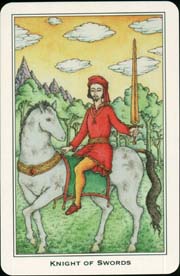
The cards themselves are rather large - 3 1/4" by 5 1/4", making shuffling difficult for smaller hands (but never impossible!). They are on high quality, glossy cardstock, that will hold up well with continued usage. The backs have a blue border with white stars, surrounding a blue and white "wave" pattern with a circle in the middle of it, containing a central Lemnescate. The faces contain 1/4" white borders surrounding the illustration. For the Major Arcana, the number and title are across the bottom of the card. For the Pips, the number and suit are across the bottom of the card, and for the court cards, the title and suit are across the bottom of the deck.
Jackson brings together, with a great deal of authority, symbolism from medieval cultures combined with a hefty dose of Pythagorean numerology. This is both a simple and a complex deck - it follows traditional lines, so can be used by any level of reader, yet the symbolism, which is there if one looks, adds incredible depth to the interpretation. Also in the back of the book are sections on card combinations and exercises dealing with magical meditation.
I was impressed with all of the cards in this deck - but I only get to talk about a few. One of the most interesting is the Popess (High Priestess). In the background, we see a well done combination of quarter and full moon. The Popess is seated, wearing a blue gown with a lavender cape. Behind here are green curtains (veils), with a red curtain (veil) showing behind her head. She is shown wearing a triple crown, and holding a book (of knowledge) in her lap, with a pheasant at her feet.
Death is an incredible cool card - a dancing skeleton, shown drumming a red drum, with a red sky as background. Oh, yes - he is in a cemetery, dancing beside an open grave, with his scythe and a crown at his feet.
The Ace of Swords is representative of all Aces - a hand coming out of the clouds, holding an upward turned sword with its Latin title swirling around it and a crown at its tip. (Notice the triangle also - I love the way the esoteric symbols are so much a part of the picture that you have to look for them!)
The Queen of Cups shown a female, seated, wearing a red dress with a white collar, a blue head covering, and holding an upright cup in her hand. Behind her we see a green screen, with three seashells adorning it. In the background of the picture we see green grass and waterfalls.
The Three of Staves is another interesting illustration because of its complexity. At a glance, we see a masted ship at sea, with three stave above it, wound around with a white banner. Look closely, and you will also see three fish swimming in the water, three white masts on the ship and three yellow banners streaming from them.
The Nigel Jackson Tarot is a deck that can be used by any level of student, for multiple purposes. For beginning students, I highly recommend using other sources to help define the cards, coming back to the book with an eye to more advanced studies.
© Bonnie Cehovet
Complete Details of Medieval Enchantment: Nigel Jackson Tarot
Also known as Nigel Jackson Tarot
Creators: Nigel JacksonPublisher: Llewellyn 2004
Deck Type: Tarot Deck
Cards: 78
Major Arcana: 22
Minor Arcana: 56
Deck Tradition: Mixed
Minor Arcana Style: Unique Scenes With Suit Symbols
Suits: Cups, Swords, Staves, Coins
Court Cards: Page, Knight, Queen, King
The Fool is 0
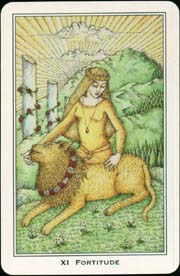
Strength is 11
Justice is 8
Card Size: 3.35 x 5.12 in. = 8.50cm x 13.00cm
Card Language: English
Card Back: Unknown
Rating: 16/20 or
 stars out of five
Similar Decks to Medieval Enchantment: Nigel Jackson Tarot
Theme: Medieval & RenaissanceCategory: Decks With Changed Suit/Element Associations
Creator: Fortuna's Wheel Tarot, Rumi Tarot, Witches Runes by Nigel Jackson

< Previous Deck · Back to Top · Next Deck >
Home > Tarot Reviews > Medieval Enchantment: Nigel Jackson Tarot Review