
Pagan Tarot Deck Review
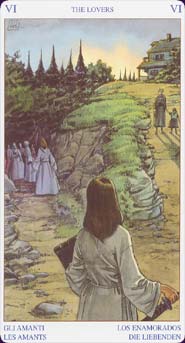
The Pagan Tarot, from Gina M. Pace (known as Wicce on the Internet), combines the joys and problems of everyday life with Wiccan and Pagan spirituality. The art shows Pagan scenes and is also very modern and ultra-realistic: computers feature in several cards.
Deck Type: Tarot Deck Cards: 78
Creators: Gina M. Pace
Publisher: Lo Scarabeo 2005
Retailers
See Price at Amazon.com (Set)See Price at Amazon.co.uk
See Price at Amazon.ca
Pagan Tarot Review by Kate Hill
The Pagan Tarot is the brainchild of Tarot reader and webmaster Gina M. Pace, also known online as Wicce. Different from most other Pagan or Wiccan themed decks, her 78-card Tarot depicts “the life of a witch whose spirituality and daily life flow in harmony” through ultra-real and modern illustrations.
My first impressions of this deck were to think it fluffy and light: an older but not wiser sister to the adolescent Witchy Tarot. But that’s not the case - the Pagan Tarot, instead, is firmly grounded in reality. Flipping through cards feels like we’re flicking through snapshots of a twenty-something American Pagan girl - a modern girl with modern accoutrements: cards, computers, even a laptop - taken at regular intervals in her daily life. It comes across to me as a Tarot of the everyday; very prosaic and oriented towards the physical and material aspects of life. (Minutiae outweighs the spectacular in most lives, and it adds an extra touch of realism that it does so in this deck as well!)
As mentioned, the card imagery is very modern, but the symbolism will be familiar to the regular Tarot reader. This is the kind of intuitive Tarot that supplies very human, very plausible scenes of human interaction and leaves you to make your own interpretation. There are no keywords to confine the meaning, either on the cards or in the booklet. Instead, you must look at the scene, and think about what is happening, and why, and how the people involved feel about it.
The court cards have been modified to fit the Pagan theme, and are now Elemental, Novice, Initiate, and Elder. They are evenly divided into men (Swords and Wands) and women (Chalices and Pentacles): all willowy and elegant but differing in age, hair colour and appearance. The art style is true-to-life but is let down somewhat by the colouring, which is a little cold and heavy (there is no red in these cards) and gives the girl’s life a dull veneer. The variations between cards can also be quite marked. Some like the Four of Pentacles and Five of Pentacles are in browns and greys, leached of almost all colour and sparkle, while the Four of Chalices seems over saturated with their artificial greens and lurid apricot skin tones.
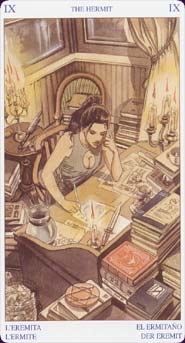
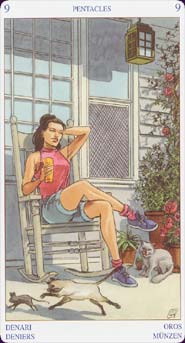
In most cases, this deck works, and some cards I very much liked. The Hermit holed up in her study, writing furiously, while surrounded by a pile of books. The Nine of Cups, which assumes three dimensions in the Pagan Tarot and shows the girl shopping in an old-fashioned store attended by the storekeeper. In the Two of Wands, she is a backpacker, one torch extinguished behind her while the one she holds lights the way. And the Nine of Pentacles, where the elements of the card are the same as the Rider-Waite’s – lone woman – house – animals – garden – but updated for the modern Pagan theme. (I like the way she is resting but not lazing, she still looks poised for action.)
Others missed the mark, like The Chariot (which appears to have broken down, and the girl stares into space while two Good Samaritans approach) and The Wheel, my least favourite card. I normally see it as card of destiny or fate, the unseen hand of the universe, but in this deck, the woman sits at her computer and dispassionately looks at a pie chart on screen - it doesn’t have the same sense for me at all. And Temperance, again on the computer, a card which just as easily could have been stood in for the Magician.
On the whole, the Pagan Tarot is a workable divinatory and meditative deck for anyone with minimal Tarot knowledge and an affinity for the Pagan and Wiccan perspectives. There is no need here to interpret obscure medieval or esoteric symbolism; these cards are very real, and the contemporary items and familiar backdrops make it very easy to apply to real-life situations.
Pagan Tarot Review by nexy jo
The Pagan Tarot brings a fresh and unique approach to the tarot in general, and specifically to many of the individual cards. While based on the Rider-Waite-Smith template as far as structure is concerned, that’s where the similarity ends. The imagery is totally new and often features scenes of modern daily life, yet is rich with symbolism and interpretive potential. The trump cards bear little resemblance to the historical counterparts, bringing a contemporary vision that I found curiously enticing. The court cards are renamed from pages, knights, queens, and kings to elementals, novices, initiates, and elders; another change I found that offers new insight into arguably the most difficult cards to interpret. The suits are named in a traditional fashion as pentacles, swords, wands, and chalices, corresponding respectively to earth (physical), air (mental), fire (spiritual), and water (emotional), but again with distinctively inventive scenes, familiar yet suggestive of a deeper meaning, beyond the conventional.
As its name suggests, much of the symbolism and imagery is pagan in nature, with scenes ranging from traditional Wiccan ritual to shopping at ones favorite metaphysical boutique. There is little nudity however, and I would feel comfortable using this deck to read for all but the most prudish. The religiously conservative may also find exception to a variety of the scenes, but for most typical tarot readings, this deck would suit both querent and reader quite well, regardless of background.
The standard-sized 78 card deck features a thin, white border on which the card name, number and/or suit appear at the top in English, and in Italian, French, Spanish, and German at the bottom, leaving the greater part of the card for the illustration. And illustrated they are, with sometimes totally new perspectives, or familiar symbols in different surroundings or situations.
On the familiar side, the three of swords depicts the traditional heart in which three swords are inserted. Yet below, a woman is seated at the foot of a couch on a hard, polished and tiled floor, arms wrapped around bended knees, head bowed and eyes looking down. A clear picture of an ending, a cycle’s completion in this case causing the pictured woman some amount of thoughtful introspection.
Somewhat less familiar is the Empress, depicting a child, a young woman, and an older woman all casually attired, apparently working in a home garden, planting the seeds of fruition. Maiden, Mother, and Crone, working in concert, bringing to pass the fruits of their labor. A refreshing and meaningful change from the traditional “queen” figure, seated in a throne.
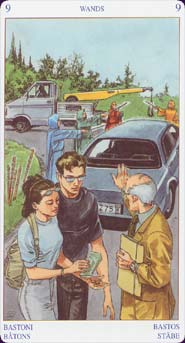
Totally new is the nine of wands, depicting a scene in which a tow truck prepares to tow what would appear to be a disabled car, with the apparent owners, a young couple, paying the tow-truck driver. Quite a change from the traditional “man behind cell block nine” scene.
For me, the most unique aspect of this deck is the clear recognition of the blend of elemental energies in all of the cards. The six of swords with fire in the background, the thick gray smoke churning up through the air, as the canoe is paddled quickly and quietly through the waters. A cleansing indeed, as the couple lets go of the past, and heads into the future. Or the eight of wands, where a woman is seated at the foot of her couch, bills stacked about her, cash in hand, wands in front, books in back, all on a blue carpet. Or the nine of chalices, where a woman is shopping, looking at the chalices neatly displayed behind the clerk, with swords, wands, and jars of liquid in the foreground, shadowed yet evident.
At first, I though the accompanying “lwb” (little white book) was somewhat sparse. It crams 5 languages of meaning into 63 little pages, only 12 of which are in English. While each of the major arcana have their own paragraph of interpretation, the court cards and minors are grouped by suit and/or number, and have no individual meanings outlined. After a short time, I found the wisdom in this approach no preconceived notions to interfere with my interpretations of each cards appearance. Only the gentle guidance of a general direction of energy to bring the meaning forth.
Every tarot I own had at least several cards that don’t work at all for me. This deck has none of that. Every card is a "good one", every card speaks clearly and enunciates its meaning with vigor. And unlike some of my other decks that spoke loudly at first, only to lose their energy after no more than a second glance, this deck endures. Each use brings greater detail, new discoveries, and deeper insight. I look forward to each and every reading.
Pagan Tarot Review by Bonnie Cehovet
The Pagan Tarot is intended to reflect the Pagan journey through life, while following somewhat the traditional structure of the Tarot. For the Major Arcana, the traditional titles and meanings apply. For the Pips (numbered cards), the traditional meanings also apply. The Court cards are where we begin to take a side trip.
In place of Page, Knight, Queen and King, we have Elemental, Novice, Initiate and Elder. These are not equivalent titles - they represent something entirely different. They represent the initiatory levels of the Pagan path. From the LWB (Little White Book):
"Elemental: In this deck, the lowest member of the court is the Elemental. Similar to Pages, in that the Elemental represents the spark, the absolute purest form of the energy of the suit (Earth, Air, Fire and Water), and thus the Elemental has both every possible potential as well as limitless boundaries. Inspiration, intuition, and the birth of the new. When we see the Elemental, we are setting forth on a journey of a thousand miles, and have just taken our first step.
Novice: The Novice is the next level of commitment and action within the tarot court. Since this card is equivalent to the Knight in traditional tarot, the Novice shows us where we have literally begun to throw our energy into our new path, whether it be mental, emotional, physical or spiritual. We are action oriented and motivated to work on our goals. As long as we don't lose sight of the rest of our lives, this can be healthy.
Initiate: The Initiate is a higher level of energy within the court. The Initiate has made much progress and some commitment has already been established. Growth is not by any means limited or finished, there is still much to be done; however, validation of the chosen path is ours, because we have accomplished enough to see that success will be ours if we continue working as we have been. We can enjoy what we have, but not get lazy or complacent.
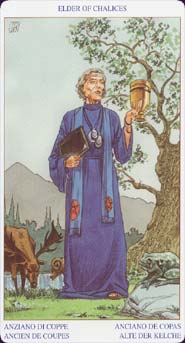
Elder: The Elder has achieved the highest levels of power that are possible along the given path. In order to continue growing, the Elder must pass on the knowledge and experience to someone coming up the path: no further accomplishment is possible without teaching or in some other way helping others. A new path may also be recommended. We can go no further without some form of change."
The Court cards are the "people" cards in the deck. They can represent something within ourselves, or they can represent other people in our lives. There is no indication in the LWB how these cards are to be read - only the energy that they carry. A reader attempting to read with this deck would more than likely attribute the traditional meanings to these cards, and that does not appear to be what is intended here. Something else that compounds this issue is that the Court cards for Fire/Wands and Air/Swords are male, while the Court cards for Water/Chalices and Earth/Pentacles are female. This may provide balance within the deck, but it does not provide balance within the suit (although it does follow esoteric thought on the male/female nature of the individual elements). Each Elemental is represented by its nature spirit: Fire by Salamanders; Water by Undines; Air by Sylphs; and Earth by Gnomes.
I also have a problem with the Elemental designation. The definition sounds very similar to that traditionally attributed to the Aces. From the LWB:
"Ace: Aces represent new beginnings, something that is literally, physically new entering our lives and waking us up to a new decision, path or challenge we can take. An energy that gives us something to work with, where a piece of the puzzle might have been missing previously."
In the LWB that accompanies the deck, the suits are listed as Fire, Water, Air and Earth. On the cards, the suits are listed as Wands, Chalices, Swords and Pentacles. There seems to be some sort of discrepancy here.
The cards and LWB come packaged in a traditional box that opens from the top. The LWB gives basic information on the deck in five languages: English, Italian, French, Spanish and German (approximately 12 pages each). It gives a short paragraph for each of the Major Arcana, Court cards, and suits, but nothing for the Pips, other than a general meaning for each number.
The cards themselves are approximately 2 5/8" by 4 3/4", on good quality, glossy cardstock. The size of the deck makes it easy for smaller hands to handle. The backs have a white border surrounding a wider green and white border, with a picture in the middle of a man (in a dark robe) and a woman (in a light robe) standing in a body of water with the Elemental spirits (Salamander, Undine, Sylph and Gnome) circling them. The mans hands seem to be supporting the woman's arms, which are raised up at waist level, with the palms up. It would be evident if these cards were to be dealt in the reversed position.
The face of the cards shows a white border, with the card title (in English) in black lettering on the top of the card, with the card number in the right and left hand corners. The card title is written across the bottom of the card in each of the other four languages (Italian, French, Spanish and German). For the Pips, the suit name (Wands, Chalices, Swords, Pentacles) takes the place of the card title. For the court cards, title and suit are listed in English across the top of the card, and across the bottom in the other four languages.
Several things are immediately noticeable about this deck. It is intended to be a modern update to the traditional Tarot deck, and the imagery does this very well by taking one main character, a female, and placing her in different situations, often surrounded by computer technology. The more esoteric symbolism of the Tarot is absent, for the most part, in this deck, while is does make use of Pagan symbolism. Look closely, and there are some neat surprises.
The Fool shows a robed female figure with a cat as her companion; the High Priestess shows the intuitive self as a shadow face in the upper half of the card; Strength sits in the woods surrounded by animals - bear, fox, mouse, rabbit, dog, and what appears to be a skunk; the Hermit shows a young woman sitting at her desk, writing by candlelight but appearing to be talking on a cell phone, with a pitcher of something and a knife on her desk, with a pentacle atop what appears to be a coaster or weight sitting atop a stack of books; the World shows all four spirit energies - there are many more, just waiting to be found!
The coloring in the cards is inconsistent, with a tendency towards browns, blues, yellows and greens. More intense color, with the addition of some reds, would certainly help. The dullest coloring seemed to be in cards like the Magician (grays and browns), the Hermit (browns and yellows), the Devil (browns and grays), the Elemental of Chalices (a dull blue), the Ace through the Four of Pentacles (browns), and the Nine of Swords (gray and white). More intense coloring appears in the Chariot, Strength, the Wheel and intermittently in the suits.
One of my favorite cards would be the Fool, which shows a robed female figure, walking in the dark, with a cat at her feet.
The Hierophant is a somewhat disturbing card, showing a bonfire in the middle of a courtyard, with books being tossed in. The figure of the Hierophant looks on from the side, standing at an elevated level in front of what appears to be a church.
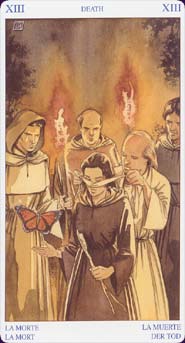
The Hanged Man is also somewhat of a confusing card. We see a black robed female, standing, blindfolded, with her hands tied behind her back. Two females in white robes are behind her - one standing with her hands at the neck of the blindfolded woman's robe, the other seated, doing something with the bindings on the hands. It is not clear if all three are meant to be aspects of the same person, or if they are three distinct people. In the distance we see a crowd of people, backlit by an orange light, as if from a bonfire.
The Ace of Chalices is certainly a card of peace and joy, showing a large gold Chalice sitting on a stone bench, with a blue towel thrown over the end of the bench. In the water in the background we see two dolphins flying through the air.
The Seven of Chalices is quite an interesting card, showing a young woman seated in the middle of a black and white tiled floor (resembling a chess board), meditating with seven lit candles surrounding her, a pentacle and sword to one side, and seven Chalices arched over her head.
The Eight of Pentacles is a wonderfully modern card, with a businesswoman sitting at her desk, talking on the phone. There is a bookshelf behind her, and a computer on her desk. A quite interesting effect is the light coming through t he window behind her, forming an "X" with a circle around it.
I cannot resist showing one of the Elementals - the Elemental of Pentacles. Here we have a little Gnome with a brown shirt and pants, a green hat, and white hair and beard, smoking a long pipe and carrying a walking stick. He is turned to face us, and you can feel the power that he represents. Not someone to be messed with!
In spite of the inconsistencies in this deck, I feel that it has worth. The Pagan symbolism is clear, and the artwork is very realistic. There is minimal nudity, so the deck could be used for a wide audience. The modern structure and symbolism will appeal to the younger generation, and the structure of the Court cards, while not traditional for Tarot, is traditional for the Pagan initiatory process. The deck could be readily used by non-Pagans, and would be very supportive of the path of a Pagan Seeker.
What is really needed to make this deck more readily understood is a companion book, and I believe that in this case the author, Pagan High Priestess Gina Pace, does intend to do a companion book.
While I have some reservations about this deck (mainly because of the coloring), I advise people to go look at it. It is a very up to date, interesting deck that could be used with most clients, and certainly can be used to help someone understand the Pagan path. I feel that there is something here - and that the book will make the deck easier to understand.
Complete Details of Pagan Tarot
Creators: Gina M. PacePublisher: Lo Scarabeo 2005
Deck Type: Tarot Deck
Cards: 78
Major Arcana: 22
Minor Arcana: 56
Deck Tradition: Modern
Minor Arcana Style: Unique Scenes Without Suit Symbols
Suits: Chalices, Swords, Wands, Pentacles
Court Cards: Elemental, Novice, Initiate, Elder
The Fool is 0
Strength is 8
Justice is 11
Card Size: 2.60 x 4.72 in. = 6.60cm x 12.00cm
Card Language: English
Card Back: Reversible
Rating: 16/20 or
 stars out of five
Similar Decks to Pagan Tarot
Theme: Modern, Pagan & WiccanCreator: Medieval Cat Tarot, Pagan Lenormand Oracle, Pagan Tarot Mini by Gina M. Pace

< Previous Deck · Back to Top · Next Deck >
Home > Tarot Reviews > Pagan Tarot Review