
Sakki-Sakki Tarot Deck Review
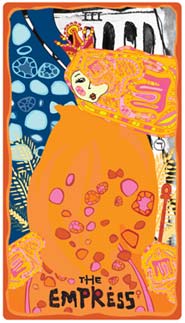
The Sakki-Sakki Tarot incorporates the structure and divinatory meanings of the traditional Rider-Waite-Smith deck, together with Astrology, the Kabbalah and personal symbolism. The deck has an extra card, The Artist, for our individual and collective creative journeys.
Deck Type: Tarot Deck Cards: 79
Creators: Sakki-Sakki Artist
Publisher: Self Published
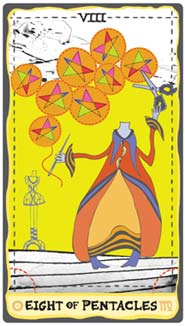
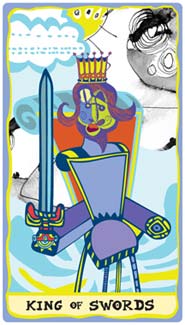
Retailers
See Price at sakki-sakki.comSakki-Sakki Tarot Review by ferrous
I adored the Sakki-Sakki Tarot from the minute I saw it online. The bright colours, the unique artwork, the sometimes headless characters; everything about this deck called out to me, telling me that it would be my new favourite deck.
It was right. Now that I've been able to look through it and read with it, it's been on my mind every minute of the day that I haven't been able to touch it and flick through the cards.
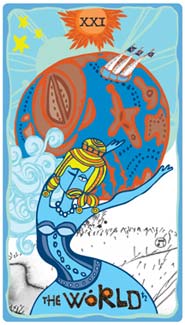
The Sakki-Sakki comes in its own beautiful box (apparently it uses no glue to be held together, just clever folding and tucking) the top of which is decorated with the character from The World card. It has a lovely smooth, laminated finish which has been wearing quite well while being carried around daily in my backpack for the past couple of weeks. I'll be making a special cloth bag for this deck, but the box provides adequate protection for the cards and I'll be keeping the cards within the box inside the bag, simply because it's such a nice box.
When the top flap of the box is opened you find the deck and the little white book are wrapped with a cardboard band printed with the words, "Good Karma". I've found this inch or so wide band, which is made from the same cardboard as the box, to be quite convenient for lifting the deck out of the box without having to tip it upside down.
The cards themselves are a little longer and skinner than most (approximately 2˝ by 4˝ inches), giving me the impression of lovely long piano playing fingers. I found them easy to shuffle with my small hands by holding them on the long sides and shuffling with the short edge rather than the long edge of the cards. They're finished with a light and satiny lamination, smooth and silky, but not slippery and very nice to the touch.
The colours used in the artwork are bright, most cards presenting a wide array of colours, yet they manage to not be gaudy. Many cards also feature some black and white art in them, often used as part of the background, created by using what is referred to as sensitive inks. (I'm not exactly sure what this is, but it sounds interesting.) The artwork is contained within a narrow outline, which is in turn contained within another border which goes to the edge of the card, each card's border and outline a different colour to the next. There doesn't seem to be a pattern to the choice of border or outline colour aside from matching it to the artwork inside it. This could make for a very messy, unmatched looking deck, but it doesn't have this effect at all. With the bright colours throughout the deck it works very well.
The Sakki-Sakki Artist sticks fairly closely with the traditional imagery and symbolism, all of which is instantly recognisable, but it is put together using her own stock of images and presented in her own unique and colourful way. Some examples:
- Many of the characters are headless. This works better than you might think it would.
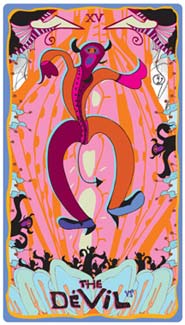
- The Devil is not scary at all. In fact, I think he's rather cute. He seems to be surrounded by lots of little minions.
- Strength is a beautiful young woman with the lion curled up on her lap like a large cat. He looks fierce, but content.
- The Lovers could be in a scene from Romeo and Juliet.
- The person in the Nine of Swords has left the bed.
- The man in the Seven of Rods looks a lot more relaxed than in the traditional RWS pose. In fact, dressed in his funky clothing, he looks almost as though he's about to head out for a night on the town. Perhaps he's going to defend himself against the onslaught of single women (or men, if he's inclined that way instead).
- Justice looks like a very snobby judge.
- The Moon is positively psychedelic.
- The man in The Chariot is lead by a couple of colourful dragons with long eyelashes.
- The Magician has an assistant consisting of just a pair of knee-high boots.
- The Fool, his cliff and his dog, appear to be on a stage.
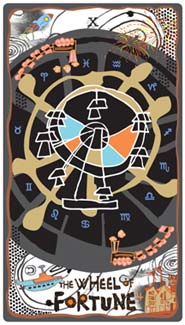
Some of the meanings given in the little white book have also been given her own slant. For instance, most traditional meanings for the Wheel of Fortune only indicate possible good fortune. The Sakki-Sakki Artist's reflections in the LWB state, in part, "We can't change the way the Wheel spins, but the choices we make can change the course of our lives. Remember that whether good or bad, nothing ever stays the same. Hop on for the ride, and expect the unexpected!"
The text for the Devil states, "The Devil invites us to meet our hidden desires and the ugliest image of ourselves. When we confront our dark side and either work to deny it or worry about it excessively, we only dig ourselves in deeper in mind games. The only way out of his darkness is through it - by becoming aware of all our inhibitions, suppressed urges and excesses. Accept and channel those energies in a positive fashion."
Some other small differences of note are that wands are called rods, pentacles are coins and the Judgement card is renamed The Angel. Also, where many of the traditional characters are male, the Sakki-Sakki Tarot features a more equal mix of males and females.
There is a seventy-ninth card included with the deck. This card is called the Artist. It can be used as a part of the deck or as a significator. From the LWB, this card "establishes the Sakki-Sakki deck as a Tarot for the Artist in each of us, for our individual and collective creative journeys."
This deck could easily be used by a beginner, such as myself, but there is plenty of meaning and symbology included for the more advanced or serious reader, including Hebrew letters, numerology, planets and the Zodiac signs. These are all given a brief outline in the LWB. For newcomers to these systems, the information included will be a good start, for those already familiar with them, they could be a handy quick reference.
Taken only at face value the Sakki-Sakki Tarot could be a light and amusing deck, but there is certainly a depth to the cards which can be found as one looks deeper and spends more time with the deck. At the very least, the deck is fun. At the most, it could be your new all-time favourite.
Sakki-Sakki Tarot Review by Bonnie Cehovet
I consider myself very blessed to have made the decision to join the Aeclectic Tarot Forum when I did, as it gave me the opportunity to watch the Sakki-Sakki Tarot being birthed. Even my mailman was impressed as he handed me the package posted from Israel! And what a wondrous package it was!
The box itself is an intricate little toy - with little glue anywhere, but folded very securely. Best use has indeed been made of every single inch of this box. For starters, it opens up the long way, making the cards very easy to access. The flap that runs the long way on the top carries the words: "Come on, Let's play ...". That certainly earned a smile from me, as did the colorful band around the cards, which bore the words "Good Karma". A sturdy band, it can be put on and taken off the cards with ease. The bottom of the box has a folded in page with a short bio of the artist, and a statement of her intent for the deck. From the box:
About Sakki-Sakki Art:
The Sakki-Sakki philosophy embraces the human spirit, transcending boundaries and cultures. Sakki-Sakki™ images introduce an authentic visual language that can be applied to a wide variety of products.
As the glyphs for planets and signs are included on each card, there is an Astrological Reference Card included with the deck that shows the glyph and the planet or sign that it represents. The deck also includes an extra card, called the Artists Card. This card is meant to serve as a significator, if the reader or Seeker chooses it to. It puts the Artist, the Seeker, at center stage in their life and in their reading. From the LWB, re the Artist Card:
The special addition of "The Artist" card establishes the Sakki-Sakki deck as a Tarot for the Artist in each of us, and for our individual and collective creative journeys.
A 48 page booklet (LWB) accompanies the deck. It introduces the artist, gives short explanations of Tarot in general and the Artist card in particular. In discussing a Tarot reading, the artist states: "Color, archetypes, numerology, Astrology, the Kabbalistic Tree of Life and personal symbolism are like the many threads in a tapestry, rewoven with each exploration of the Sakki-Sakki Tarot." She is serious about this, and includes introductory material on Hebrew Letters and the Tree of Life; Numbers; Planets/Astrological Elements; Zodiac Signs/Astrological Elements; and Astrology and the Court Cards.
She presents quite an intriguing section on Tarot spreads, covering the one card reading, three card readings (with multiple definitions for what the three cards can be defined as), and a 10 card Artists Path spread. This last spread really jumped out at me - especially position number 8, termed The Price. The Price is what we need to give up in order to follow our Artists Path. That hit me in the gut - because there is a steep price to pay for every single path that is followed. (I say that from personal experience.) I should say here that Monicka is referring to the Artist in each of us - as our choices and actions are what gives form to our lives.
The Minor Arcana - Pips and Court Cards, are listed with multiple upright keywords only. The Major Arcana are listed with Zodiac attribution, Hebrew letter, upright keywords and a short descriptive paragraph. From the LWB:
1. The Magician
Mercury, Beit
Creative Initiative * Multiple Talents * Willpower * Ego * Mastery * Synthesis * Concentration * Magnetism * Trickster
The Magician represents the creative principle. He is a multi-talented master with a diplomatic, persuasive manner, able to get things going. We can now achieve anything that we set our minds on. Desire and intention, together with the unbeatable combination of intellect, emotions, intuition and practicality, will create a magickal reality! Make it happen!
The cards themselves are 2 3/8" by 4 1/2" , of good quality, non-glossy card stock - narrower than most Tarot cards, and easy to handle for smaller hands. The backs are a yellowish color, with a blue-green floral pattern. A reversed card drawn would not be apparent. The faces carry a small border mimicking a primary color from the illustration. For the Majors and the Pips, the card number is at the top in black lettering, with the card title along the bottom, also in black lettering. The Pips also carry Planet and Astrological Sign glyphs, while the Major Arcana carry Planet and Hebrew letter glyphs. The Court Cards carry the card title and suit along the bottom of the card in black lettering.
I am not trained in art, so the following description concerning the artwork in this deck is what I see, in my own words. IOW - the correct technical terms may not have been used here. ;-) There is abundant use of color, but it is flat, rather than an intense, in your face riot. The artwork has been assembled from a collage of pre-existing drawings, icons and "sensitive inks" (the artists own words) to add layers of meaning and feeling. Traditional archetypes have been presented in a new and vibrant manner. There are floating heads, floating symbols, and artwork that takes its own form - some of which to me is akin to primitive forms.
The Artist is one of my favorite cards - one for which I shall have to find a use, as I do not use significators. I think "she" may sit up above my cards as I do a reading, whispering her own "take" on the situation. A printed rose colored background acts as stage curtains, surrounding a black stage. Remember - the Artist (Seeker) is always on center stage!
The Magician is adorable, with his blue floating head with an orange-yellow lemnescate above it. His tools are on his table, and he is ready to rock!
I always look for the Hermit, as that is one of my birth cards. The Sakki-Sakki Hermit is dressed in an orange robe, facing away from us, carrying a black lantern in his right hand.
The Angel (the traditional card of Judgment) shows the head of a red haired angel blowing a trumpet, with two small trumpets above her head. Below her two headless bodies dance.
The Ten of Rods (Wands) shows a person carrying the traditional bundle of ten wands, except that in this card the person is facing us, and the look on their face is not one of frustration, but more one of "How the heck did I get here!"
The Ace of Cups is a lovely card, showing a rose colored cup with five streams of water flowing from it.
Last, but not least, The Knight of Coins (Pentacles) is an interesting fellow, sitting atop his purple horse, waiting for action!
The Sakki-Sakki Tarot is a non-traditional deck that follows very traditional lines. It is a fun deck to read with, and would be a deck that I could offer my in person clients as a choice of decks. It is a good deck to use when feeling "stuck", as it takes you out of your normal way of viewing Tarot (much as the Voyager Tarot deck does).
© Bonnie Cehovet
Complete Details of Sakki-Sakki Tarot
Also known as For The Artist in Each of Us
Creators: Sakki-Sakki ArtistPublisher: Self Published
Deck Type: Tarot Deck
Cards: 79
Major Arcana: 23
Minor Arcana: 56
Deck Tradition: Rider-Waite-Smith
Minor Arcana Style: Unique Scenes With Suit Symbols
Card Back: Unknown
Rating: 14/20 or
 stars out of five
Similar Decks to Sakki-Sakki Tarot
Theme: Astrology, Fantasy, Modern, SurrealCategory: Tarot Decks With Extra Major Arcana

< Previous Deck · Back to Top · Next Deck >
Home > Tarot Reviews > Sakki-Sakki Tarot Review