Transparent Tarot Deck Review
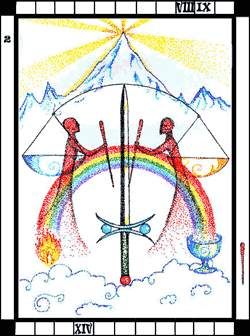
A stunning innovation in the world of Tarot, the Transparent Tarot uses clear sheets with symbolic elements that can be combined in layers, to make combined pictures and meanings. The full deck of 78 transparent cards is now out from Schiffer Books.
Deck Type: Tarot Deck Cards: 78
Creators: Emily Carding
Publisher: Schiffer Books 2008
Retailers
See Price at Amazon.comSee Price at Amazon.co.uk
See Price at Amazon.ca
Transparent Tarot Review by Kathleen Meadows
This was another deck I looked at many times online before purchasing it. I admit it, I was resistant to this new concept! Naturally suspicious (yes I’m a Scorpio and today is my birthday) by nature of anything that feels “trendy”, or “contrived”. But I do love innovation and this deck proved to be just that. Innovative, imaginative and now holds a permanent position at my reading table.
When it first arrived, it took me about a week to open it. That’s how resistant I was! I pulled out the cards and thought, “but there is only one aspect of a card on each one of transparencies!” I am definitely not going to like this deck and I felt validated in my hesitation to purchase it in the first place. I put the cards aside and opened Emily’s accompanying book, which is a good size I might say.
That was the trigger to turn my thinking around. Emily is an excellent writer and what she has to say is well worth reading. She knows the Tarot! She met the mustard so to speak in her knowledge of the Tarot classics (which I’m also rather fussy about) and distilled all that she understood about the Tarot to one central image. But she doesn’t just stop there! Throughout this book she gives many, many examples of readings done with this deck and I delighted in reading every one of them. By page 56 (the book is a hefty 280 pages) I couldn’t wait to work with this deck. Reading with this deck really is as Emily states, “An evolutionary shift in tarot reading”. You don’t lay out the cards one by one, rather you layer them one atop the other to build a card which represents final outcome.
Each card has one single image on the transparency but Emily has placed these images in different positions on the deck to facilitate this layering affect. Sometimes the central symbols fall one atop the other which creates a whole new symbol, but often the symbols at different positions on the card will create a whole new scene. It’s addictive!
When reading for clients I always save these cards for the end of the session, when a client will often ask, “Do you have any last thoughts Kathleen? Any last words of wisdom before I go?” That’s when I pull out the Transparent Tarot and say, “Let’s see what the Tarot’s parting comment is!” Inevitably it’s perfect. One woman asked about whether I thought she would need an operation due to a dropped uterus and the first card up was the “Hanged One” depicting a chrysalis suspended from a branch. My client burst out laughing when she saw the image! “Oh my God!”, she gasped, “Is that for REAL?!” We giggled together and I said, “Yes I do think an operation will be in order. It stands now suspended but being in a chrysalis stage it’s very likely to go through a change that will make it uncomfortable indeed!
If you have not purchased a copy of this deck I
highly recommend you do so. It was published in 2008 so
there may not be many left. It’s fun, informative and a
great learning tool. I’ve recommended it highly to new
and virtuoso tarotists alike.
Transparent Tarot Review by Kim Huggens
It’s a rare thing to find a deck that is original, truly unique, yet which remains functional and accessible. Too often deck creators sacrifice a deck’s ease of use for a novelty factor in the hopes of filling a niche in the market. Therefore it is a happy circumstance that Emily Carding has broken the mould with the Transparent Tarot yet not broken Tarot itself – this deck is one of those rare decks that combines novelty with function, simplicity with depth, and beauty with innovation. In fact, the Transparent Tarot is innovation at its best in the Tarot world – it’s the first deck of its kind, and (as we will see below) leads to an entirely new process of reading.
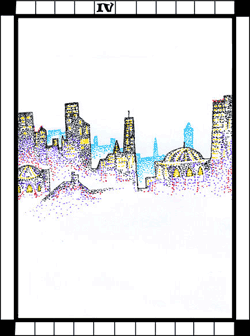
As the name of the deck suggests, every card of the Transparent Tarot is… transparent. The card images are made up of simple and colourful symbols that have been created with hundreds of minuscule points of colour – similar to the style of pointillism as practised by artists such as Seurat. This allows each image to remain translucent yet still bold and easy on the eye. The images are almost abstract – the Major Arcana rarely show scenes with figures interacting in them, but instead archetypal images (such as a city for the Emperor, a white butterfly for the Fool, and horses of opposing colours for the Chariot). The Minor Arcana show figures interacting, but without scenery. This makes for uncluttered cards that are easy of the eye, allowing the reader to immediately identify the symbols and therefore the meaning of the card.
On its own, each card of the Transparent Tarot is a joy to behold: evocative, yet uncluttered, free of overly-occult symbolism and instead represented by a few symbols that are more easily understood by beginners as well as advanced readers; symbols that speak to human experience rather than a particular school of thought, occult order, or religion. Some people may feel that trying to encapsulate every possible meaning of the High Priestess in a single symbol is a reductionist and pointless exercise. However, I had the joy of witnessing a young child pick up this deck and start telling me what the cards meant… The images spoke to her in such a palpable way that I’d quite readily have asked her for a full reading there and then (had we not been in the middle of eating rather yummy chocolate fudge cake!) As such, I believe the Transparent Tarot’s use of simple, evocative images speaks readily to beginners. Any advanced readers who see the images should have other knowledge already to supplement these images, and in this way they act as flash cards, prompts, or jumping off points.
However, the Transparent Tarot is not designed for reading each card separately. It is designed for layering the cards on top of each other, overlapping each other, and more! Their transparent nature forms a conglomerate image, in which the simple symbols quickly create a diverse, detailed, and meaningful scene. This is where the magic of the Transparent Tarot lies: not only has Emily Carding innovated the symbols and images like most new decks do, but she’s also innovated the way we interact with the cards, the very mechanics of the reading process and the process of interpretation! When we lay the Empress over the Emperor and create a conglomerate image, we refrain from interpreting the cards separately and jump straight to the goal of any good reading: to weave the card meanings together to form a more holistic view of the querent’s situation. This process also removes the necessity to call up from the depths of ones mind the knowledge we may have painstakingly memorized, encouraging us instead to intuitively respond to the images in front of us. And perhaps I’m just easily pleased, but for me there’s something really magical and fascinating about watching an image form between two or three cards, like seeing something come into focus. There are some gorgeous pairings and triplicates in the cards, particularly in the Major Arcana, and I could sit for hours creating new pictures!
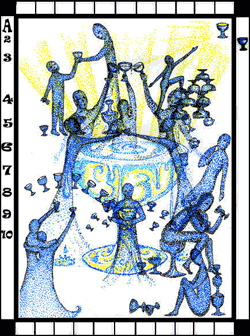
Comparing the different cards to each other, we quickly see that the Major Arcana bear large, stark, multicoloured symbols, the Court Cards bear medium-sized figures, and the Minor Arcana smaller figures in a single colour. The suits each bear a single colour that can be associated with the four elements. This becomes much more interesting later when we put the cards together, as you begin to notice the subtle nuances of the deck that display a great deal of technical skill on behalf of the artist! There’s not a single card in the deck that melds with any other card poorly. Somehow Emily has managed to create each card so that they meld together almost seamlessly, whilst remaining centred, uncluttered, and colourful. The Minor Arcana are a great example of this: comparing the four Aces, we notice that the images are all positioned dead centre of the card, and that when the four Aces are put together they form a beautiful image of the four elemental symbols interacting with each other. The Twos of each suit have figures that also meld together into an image just shy of the centre of the card – and this image evokes the nature of the Twos, whilst each separate Two card manages to also evoke the single meaning of a specific Two. Going onwards, the Threes are slightly further from the centre, the Fours even further, and finally the Tens are position at each separate corner of the card. This is a marvellous means of displaying not only the evolution of the energies of the suit, but also the progression of the numerological value of each set of cards, an aspect sadly missing from many modern Tarot decks.
Similarly, each suit Court has a cohesive family illustrated between the Pages, Knights, Queens and Kings. It is easy to understand that they represent different levels or applications of that element or suit. Very obviously Emily has not sat down with some clear plastic and simply sketched some pretty doodles – she has planned this deck carefully and as an holistic, cohesive representation. It’s rare that I find I want to praise a Tarot deck’s technical beauty, but it’s one aspect of the Transparent Tarot that I still marvel at. In the age of so many slapdash, haphazard decks, this is an absolute joy to behold.
There are a couple of downsides to the deck, however. Firstly, the Court Cards might be a little difficult to read for beginners, since they are not as expressive as the other cards in the deck. All the Queens are in the same pose, but in a different colour, and the same is true for all the Knights, etc. This reminds me of the Witches Tarot by Ellen Cannon-Reed, and for a set of cards that I believe are sometimes the hardest to interpret in a reading, more expression is needed. The other criticisms of the deck are from a mundane perspective: I found the plastic used for the cards quickly accumulated unsightly and (in the sunlight) very noticeable fingerprints that didn’t come off easily; similarly, the plastic made for a very heavy deck (even though each card is quite thin) and due to its weight I found the relatively sharp edges of the cards made shuffling with any vigour almost painful. Finally, the black corners of the cards made for huge black blemishes upon otherwise beautiful images, especially when laying the cards not directly over each other, but overlapping in a line.
The entire deck comes in a set including the book and a white spreadcloth (which will need ironing before first use, since the folds will get in the way otherwise!) The book is a brilliant guide to the deck, split into three sections. The first section introduces the deck, introduces Tarot, and gives some good beginning advice. The second section is the largest, with explanations of each card; and the third section gives from excellent ideas and suggestions for using the deck and interacting with the cards.
One of the best features of section two are the example readings given for each Major Arcana card, in which that Major Arcana is depicted in a conglomerate image with two other cards from the deck and interpreted. This not only demonstrates how the Transparent Tarot is designed to work, but shows how interpretations of each card depend on the other cards and the intuition.
I highly recommend that even the most seasoned readers take a look at the third section of the book, if only to get them to think outside the box and break their old die-hard reading habits! In this section, Emily demonstrates the versatility any dynamism of reading with the Transparent Tarot, including some suggestions for spreads, some new takes on old spreads, and some new ideas for positioning the cards.
Overall, the Transparent Tarot won’t charm the readers who prefer their decks to be dripping in occult symbolism, and it probably won’t please readers who prefer their decks dark and heavy – this deck is very much sunlight and stars, simplicity and beauty. But it is an intelligent, innovative, and beautiful deck that is more than just a novelty. It’s a deck I’d highly recommend to beginners, and a deck that will inspire an advanced reader to new heights and techniques. It’s a new approach to Tarot that makes the reader aware of the panorama of possibilities available to us when we pick up a Tarot deck.
Transparent Tarot Review by Bonnie Cehovet
“The Transparent Tarot” is much more than the new deck on the block – it takes Tarot out of its comfort zone, and “evolves it” into something new and different. The basic structure remains the same – 78 cards, 22 Major Arcana, 56 Minor Arcana. The traditional titles are used (with the exception of the Hanged Man, which becomes the Hanged One, and the Wheel of Fortune, which becomes The Wheel). The suit names are Wands, Cups, Swords, and Pentacles, with the Court Cards titled King, Queen, Knight, and Page.
To understand the evolution of this deck, we have to look at Carding’s background. She is a visionary artist, priestess, and Reiki Master, practices Celtic Shamanism, has studied with John and Caitlin Matthews, and is working her way (with her partner) through the Merlin’s Wisdom series of initiatory gateways. She also holds a BA in Theater Arts from Bretton Hall College. vIn her foreword Naomi Ozaniec speaks of Carding paying homage to tradition, while taking familiar images into a new realm. She notes that this deck would not have been possible without Carding’s considerable design and graphic skills – skills in not only creating each individual card, but skill in creating the cards in such a manner that they interact readily with one another.
In her introduction, Carding makes it very evident that the companion book to this deck is not meant to be definitive, nor is it even meant to act as an outline within which the reader places their own definitions. It is meant to act as a foundation upon which the reader will build their understanding of the cards, and how the cards interact with one another.
She makes a point of noting that the cards are best read on a white background – that a colored or patterned background could lead to cards becoming “lost” (literally and figuratively). I should probably say here that one of the evolutions of this deck is that it is transparent! Simple images are placed on plastic, which can then be read by themselves, or together, which build up a complex picture. I did try using a dark background, but white does work best!
Throughout the book Carding makes an effort to inform the reader that the cards are theirs – a tool for them to use, in whatever manner they see fit. It is a tool for unlocking intuition. The information in the companion book is meant to simply support the reader on their journey. Another point that she makes, when discussing Tarot history, is that where Tarot came from is of far less interest (to her) than where Tarot is going.
What Carding has done with this deck is to take the energy of each card and simplify the imagery so that it can be read in layers. For instance, the Fool is represented by a red rose at the bottom of the card, and a butterfly in flight in the middle of the card. The High Priestess is represented by a crescent moon and an open book. The Moon is represented by a full moon with the face of a female, spirals on her cheeks, and an eye in her third eye area. The figures in the Major Arcana show no faces, allowing them to appear as anthropomorphic archetypes. (Note: The figures in the Minor Arcana – Pip and Court Cards – do show faces.)
In her introduction to the Major Arcana, Carding suggests that the reader ask themselves the following questions:
- How does the energy of this card effect a reading?
- What cards seem to combine particularly well with this card?
- Which cards work less well together? What could this mean?
- What do I think of when I see this card?
- How does this card make me feel?
- What smells/tastes/sounds do I associate with this card?
- If the card could speak, what would it say?
Each Major Arcana card is presented with a full page black and white scan, a discussion of the card and its imagery, divinatory meanings (upright and reversed), and a sample three card combination with interpretation.
In her introduction to the Minor Arcana, Carding lists the following associations:
- Wands/Red/Fire/ What drives us, our energy, passion and will.
- Cups/Blue/Water/What moves us, deep emotions and intuition.
- Swords/Dark Purple/Air/The realm of intellect, logic, and ideas.
- Pentacles/Green/Earth/They show us the physical realm, and speak of matters of health, work, and finances.
In dealing with the Minor Arcana, Carding suggests that the reader ask themselves the following questions:
- Regardless of what the book suggests, what is MY first impression of what is happening in this card?
- What do I think might have happened just before?
- What do I think will happen next?
- What are my feelings towards the figure in the card?
- Does this image resonate with any event or person in my life?
- What do I think may be happening beyond the scene on the card?
- What smells/tastes/sounds do I associate with this card?
- How does this card interact with others in a combination?
- How does this image change when reversed or flipped?
- If the figures in this card could speak, what would they say?
Carding notes that with Court Cards, she feels that it is more appropriate to associate them with age and gender, than with status. The questions that she suggests the reader ask themselves about the Court Cards are:
• What sort of person do I think this card shows?
• Do I like this person or not
• What traits do I share with this person?
• Who do I know that is like this person?
• What can I learn from this person?
• What does this person have to say to me?
• Which card or combination of cards would I choose to represent myself at this time?
The Pips and Court cards of the Minor Arcana are presented with a black and white scan, a discussion of the card, its imagery and symbolism, and divinatory meaning (upright and reversed).
In her chapter on how to use the cards, Carding talks about divination, meditation, magick and brainstorming. Templates are presented for card(s) of the day, three position readings, the traditional ten card Celtic Cross spread, a Celtic Cross spread using three cards in each position, and a unique twenty-five card spread entitled Ripples of Consequence/Wheel of the Year spread. The reader is encouraged to play with the deck – that there are infinite possibilities for bringing out information using the cards.
I am going to add a couple of my own thoughts here. The first would be to take the Major Arcana and lay it out in a 3X7 format – three rows of seven cards each (first line = I-VII, second line =VIII-XIV, third line =XV-XXI), with the rows placed under each other. In this manner you can read the story that is the Tarot through the lines, and read the three card combinations (i.e. I/VIII/ XV, II/IX/XVI etc.). Pick the cards up and place them one on top of another, and look at the pictures that they form. Since the Fool represents the Seeker who is taking the journey, I would also add this card to any group of cards that I was reading. Read the cards with and without the Fool, and note how things change.
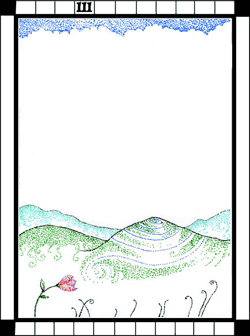
Cards I/VIII/XV are really stunning, in that the dragon tails appear to be wound around the sword of Justice, which comes out in the center of a circle made by the dragons, the arm that bears the scales of Justice, and the circle from the Devil. Cards II/IX/XVI show the lightening bolt seeming to come from the top of the mountain that represents the Hermit, ending in the open book that represents the High Priestess. Cards III/X/XVII show rolling hills and a red rose on the bottom, with a complex middle figure of the septagram from the Star and the medicine wheel from the Wheel.
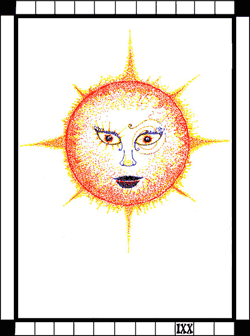
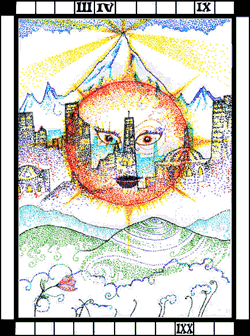
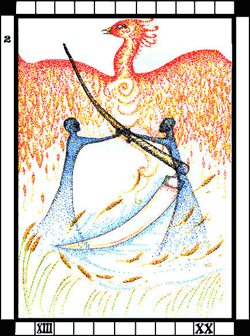
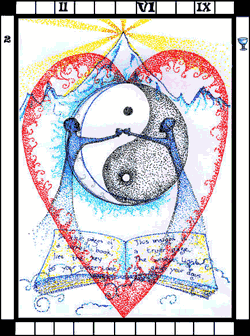
Cards V/XII/XXI show the oak tree that is the Hierophant, with the cocoon from the Hanged One and the round face of the Sun superimposed over it. Cards VI/XIII/XX show the heart outline and yin/yang symbol of the Lovers, with the wheat from Death under it and the Phoenix of Judgment behind it. Cards VII/XIV/XXI show the two horse heads from the Chariot, with a spiral (the World) between them and a rainbow (Temperance) under them.
The Minor Arcana also lend themselves to play: placing the Court Cards from each suit together melds into a complete family picture. You can also place the numbered cards in a straight row, to read the story for each suit, or place the same number from each suit together. When you do this with the Aces, the result is the Pentacle in the center, the Cup in the center, and slightly below it, the Wand and Sword crossed in the middle.
From a counseling perspective, the cards could be used in many ways. The Seeker could choose to deliberately go through the deck and create a picture that represents who they are at a given point in time (past, present or future), or they could choose to build a picture of someone in their life, or of an issue that they are facing, or decision that they have to make. They could also choose to build a picture of the energy that they need to move themselves forward, based on information they received in a reading.
Working with this deck transports the reader, and the Seeker, into a truly magickal world, where anything is possible. There is one thing that applies to this deck that does not apply to other decks – it is temperature sensitive. The plastic in the cards will not do well in extremes of either heat or cold. I deeply appreciate my friend Carolyn Giles for bringing this up in a conversation that we had about this deck. (Of course, Carding also makes a point of mentioning this in her companion book.)
This deck could be used by people of any age (children included) or background. It will be read at the level that the Seeker understands, which is a true gift. This is more than a collectors deck – it is indeed a point of evolution in the world of Tarot.
© Bonnie Cehovet
Complete Details of Transparent Tarot
Creators: Emily CardingPublisher: Schiffer Books 2008
Deck Type: Tarot Deck
Cards: 78
Major Arcana: 22
Minor Arcana: 56
Deck Tradition: Unique
Minor Arcana Style: Unique Scenes With Suit Symbols
Suits: Wands, Cups, Swords, Pentacles
Court Cards: Page, Knight, Queen, King
Major Titles: 0 - Fool, I - Magician, II - High Priestess, III - Empress, IV - Emperor, V - Hieorphant, VI - Lover, VII - Chariot, VIII - Strength, IX - Hermit, X - Wheel, XI - Justice, XII - Hanged Man, XIII - Death, XIV - Temperance, XV - Devil, XVI - Tower, XVII - Star, XVIII - Moon, XIX - Sun, XX - Judgment, XXI - World
The Fool is 0
Strength is 8
Justice is 11
Card Size: 4.53 x 4.96 in. = 11.50cm x 12.60cm
Card Language: English
Card Back: N/A
Back Design: Transparent cards so they don't have a back design.
Companion Material: A considerable, accessible soft-cover book.
Rating: 16/20 or
 stars out of five
Similar Decks to Transparent Tarot
Theme: NoveltyCreator: Simple Wisdom of the Household Dog, Tarot of the Black Mountain, Tarot of the Sidhe, Transparent Oracle by Emily Carding

< Previous Deck · Back to Top · Next Deck >
Home > Tarot Reviews > Transparent Tarot Review