Vikings Tarot Deck Review
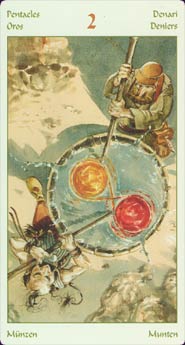
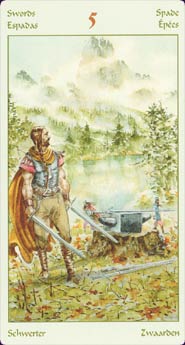
A Tarot of the mythology and culture of the Scandinavian invaders, the Vikings. The card art of the Vikings Tarot features natural-looking watercolours, and the symbology is based on the Rider-Waite.
Deck Type: Tarot Deck Cards: 78
Creators: Manfredi Toraldo, Sergio Tisselli
Publisher: Lo Scarabeo 2003
Retailers
See Price at Amazon.comSee Price at Amazon.co.uk
See Price at Amazon.ca
Vikings Tarot Review by Kate Hill
"The traditional iconography of the Tarot united with the epic deeds of Odin, Thor, the Aesir, and the Vanir. A world of poetry and legend, courage and spirit, death and rebirth."
The concept for Viking Tarot deck is from Manfredi Toraldo, who also created the Olympus Tarot and Durer Tarot (also published by Lo Scarabeo). The artwork is by Sergio Tisselli, new to the world of Tarot art. The deck is based on the culture and legends of the 'Vikings', a loose term for the groups of Scandinavian raiders who invaded and settled parts of Europe, Britain, and even North America in the ninth to eleventh centuries. They have a reputation for being barbarians, heroic and bloodthirsty warriors, but they also had a complex and diverse culture that included merchants, craftsmen, traders and farmers.
The two distinct groups of gods in Norse mythology, the Aesir and the Vanir are both represented in the cards. The Aesir are the 'supreme' gods, like Loki, Frigg, Thor and Odin, and have been associated with the major arcana. The Vanir are the indigenous gods of agriculture & domestic life, and these have been linked with the suit of Chalices. Wands are represented by Giants, Pentacles by Dwarves & Elves (with blue skin and pointed ears). Men, as intelligent beings and the 'instruments of destiny' represent the Swords suit. The Vikings were a male-oriented culture, so the Vikings Tarot does reflect this. Women are by no means omitted, but the majority of cards do depict men or male entities in action.
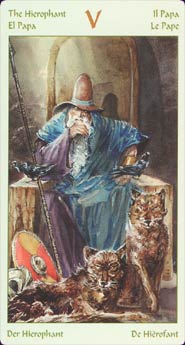
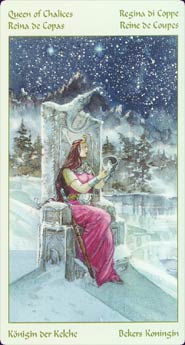
The art appears to be watercolour, and has a misty, slightly dreamy effect. The colours are muted and occasionally dull - lots of browns and greys - but that is natural. The art style is consistent across the whole deck, but the cards have an individuality rather than a sameness. I like the effective use of sky, lighting and background in these cards. The background matches the story of the card and is an extra visual clue. Happy scenes like the Ten of Cups have a clear blue sky, the Eight of Chalices has a sunset, and mixed cards like the Ten of Wands or the Moon have a partially clouded sky. Clear light plays around the Magician, the Hierophant is illuminated in his dark chamber by a single shaft of light, while the Devil has a background of rocks and snow. Out of all the cards, my favourite card is the Queen of Chalices. She is purple-clad and with a diadem on her brow, cup in both hands. She sits on the snowy shores of a reflective lake, and above her the sky blazes with a thousand stars.
The Vikings Tarot brings alive the mystery and magic of this bloodthirsty yet poetic Nordic culture, while its symbology retains recognisable links with traditional tarot. The Viking Tarot deck is one that could be easily picked and up and read with by anyone with some Tarot experience.
Vikings Tarot Review by Joan Taillon
The Vikings Tarot, based on Norse mythology, is an artistically appealing watercolour deck. Many of the mythological references predate the Viking era, however, so more aptly I’d call it a Norse Tarot except that Clive Barrett’s fine deck already bears that name.
The Major Arcana depicts the Aesir. These great gods are only marginally brought to life in the multilingual little white booklet accompanying the cards.
The suits are Pentacles, Swords, Wands and Chalices, representing races of Dwarves and Elves; Men; Giants; and the Vanir, respectively. Vanir, another race of gods, were displaced by the Aesir.
Chalices is assigned to the season of winter and element of water; Pentacles to spring and earth; Wands to summer and fire; and Swords to autumn and air. Pentacles and Wands are both associated with nature, with little distinction made between them. Outside of the briefest of keywords in the booklet (none on the cards), interpretation of the Minor Arcana is left to the reader.
The cards are standard-weight, easy to shuffle, with Roman numerals on the Majors and Arabic numerals on the Minors. Unnumbered Court cards are identified as Knave, Knight, Queen or King.
You have the option of using reversed cards, but the size and muted tones make this a deck to read visually. The Sun is female; the central figure on the Moon is male. The booklet accurately states that Vikings viewed “masculine aspect in the Moon and feminine aspect in the Sun.” The brightly rendered three of Chalices is beautiful, idyllic and celebratory, and provides colourful relief from some starker stories depicted.
Justice, number 8 in this deck, is believable. The god Forseti, son of Balder, dispenses justice as in the ancient lore. The Hermit also is consistent with usual Tarot card meanings. Heimdall, The Hermit, has a reputation for aloofness, lack of humour and for being a great teacher. As we expect from this Tarot archetype, many-faceted Heimdall keeps his knowledge close to his heart. The mystical, introspective connotations are all there. The only variance with the Heimdall myth is Heimdall’s appearance. In the lore he is fair-featured, with golden teeth; the card depicts him as bearded and swarthy in appearance. Inevitably, there are irritations.
I don’t care for the contrived, calendar-style poses of the male figures in the nine of Chalices and Knave of Swords. If Swords are autumn and Chalices are winter, the amount of bare skin they’re flaunting is foolish and does not fit the power they’re intended to convey.
The card that irritates me most is the nine of Swords. A naked female communing with the gods in a gray and decidedly wintry landscape also apparently is unfazed by the weather. The Queen of Swords looks autumnal; the card is beautiful, but likewise the figure is underdressed.
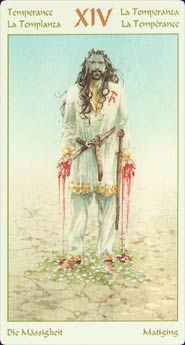
Temperance is jarring and disconcerting. There’s nothing temperate about this card. Instead of the more familiar angel Michael, the god Balder is depicted. But not the radiant, fair-haired Balder I know. Instead we get a Jesus Christ-like parody in white, whose stigmata-like hands drip blood. The booklet’s description of Balder’s death and resurrection reads biblical. It’s way over the top to represent an ability to adapt or change. The Tower shows a huge stone edifice beginning to destruct by fire at Ragnarok when the world ends and the giants fight the gods. Atypically, the image in The Tower is not nearly as disruptive or disturbing as Temperance.
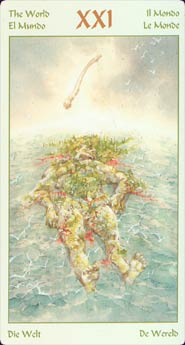
It is a shame the art is rendered small, because minute detail is lost — especially in The Wheel, The World and 10 of Pentacles. The subtleties cannot be fully appreciated in 2.25 x 3.75 inches (excluding a grey, narrow border) that is typical of Lo Scarabeo’s decks.
Strengths: The strengths of this deck are the detailed drawings and the inclusion of many myths. To anyone familiar with Norse lore, it presents a unique aid to meditation, pathworking, writing exercises and divination. Placed in the hands of a bard, or any imaginative storyteller, the action adventure exploits of the Vikings will enhance Tarot reading.
Weaknesses: The Viking Tarot’s weaknesses are small-scale pictures and insufficient text. Readers are left at sea without a compass and with very little in the way of a map. The bare bosoms of a few of the Viking women strike me as ridiculous in a setting of snow and ice. Real Viking women would have had the good sense to cover up in the cold latitude.
Recommendation to publisher: Re-issue this deck with larger pictures. Create a substantial book explaining the legends. Re-draw the nine of Swords, take the Jesus out of Temperance, and add some clothes to a few of the Folk before they freeze to death!
Complete Details of Vikings Tarot
Creators: Manfredi Toraldo, Sergio TisselliPublisher: Lo Scarabeo 2003
Deck Type: Tarot Deck
Cards: 78
Major Arcana: 22
Minor Arcana: 56
Deck Tradition: Mixed
Minor Arcana Style: Unique Scenes With Suit Symbols
Suits: Chalices, Swords, Wands, Pentacles
Court Cards: Knave, Knight, Queen, King
The Fool is 0
Strength is 8
Justice is 11
Card Size: 2.60 x 4.72 in. = 6.60cm x 12.00cm
Card Language: English
Card Back: Reversible
Rating: 18/20 or
 stars out of five
Similar Decks to Vikings Tarot
Theme: NorseCreator: Native American Tarot by Sergio Tisselli Dragons Tarot, Dragons Tarot Mini, Olympus Tarot by Manfredi Toraldo
< Previous Deck · Back to Top · Next Deck >
Home > Tarot Reviews > Vikings Tarot Review