
Da Vinci Tarot Deck Review
An art tarot in homage to the great Renaissance painter and inventor, Leonardo da Vinci. The images in the Da Vinci Tarot are mostly inspired by Leonardo's art, but do feature some of his well-known pieces. First published as the Leonardo aa Vinci Tarot a stand-alone deck, it's now available as the Da Vinci Tarot kit with a book by Mark McElroy.
Deck Type: Tarot Deck Cards: 78
Creators: A. Atanassov, Iassen Ghiuselev
Publisher: Lo Scarabeo 2004
Publisher: Lo Scarabeo 2005
Retailers
See Price at Amazon.com (Set)See Price at Amazon.com
See Price at Amazon.co.uk (Set)
See Price at Amazon.ca
Da Vinci Tarot Review by Kate Hill
A brand new deck from Lo Scarabeo, created in honour of one of the greatest minds of the Italian Renaissance, Leonardo da Vinci. Perhaps most famous for painting the Mona Lisa and the Last Supper, he was also an inventor, scientist and military strategist.
The stretch to make a connection between Leonardo and tarot is not too great a leap, as Leonardo may have had contact with tarot cards in his own lifetime. According to the booklet, he had visited the Milanese court of Ludovico da Sforza - famous in the tarot world for commissioning tarot designs that have survived to this day.
A standard tarot in its suits of Chalices, Pentacles, Wands and Swords and 78 cards, it is more unusual in it that two separate artists, both Bulgarians, completed the major and minor arcana. Iassen Ghiuselev originally completed the trumps in 1992, while in 2002 Atanas Atanassov (artist for other tarots like the Bosch Tarots, Golden Tarot of the Tsar, and Visconti Tarot) created the 56 remaining minor arcana cards. Despite the two artists and the ten-year gap, the illustrative style is maintained consistently at a high level.
Leonardo's art was remarkable at the time for its carefully drawn sense of perspective and realism. He was a keenly observant artist and scientist, and drawings of the human body are incredibly well proportioned and lifelike (so much so that they helped doctors to better understand muscle arrangements and bone structure). The card art for the Leonardo da Vinci has been created in the spirit of Leonardo's illustrations and paintings, sometimes directly copying his works, but mostly using them as a source.
Colours are muted olives, khaki, mud brown, greyish blues, reminiscent of Leonardo's sketches. The drawings are spare and super-sharp, almost hyper-real and have a static, posed feel, even in action cards. People's facial features, musculature, and folds of clothing are all very well defined. These cards are very human- people are young, old, infants, naked, fully or partially clothed in either period costume or togas, and always the centre focus of the card. (Unfortunately, the range of human expression and emotion is also very small - most people look dour or impassive and are rarely smiling, even on the Sun card!)
The majors feature Leonardo's masterpieces or scenes inspired by such. They also have the title of the card in Italian script written backwards in the background of the card, just as Leonardo made notes in his own journal. The minor arcana cards are illustrated scenes appropriate to the period, but they also have a pip-like layout of the suit elements in the top right of the card.
These cards can easily be used for reversals. The image on the back of the cards is the woman from the Queen of Wands, cleverly placed so it is upright from both ends. Reversal meanings are also given for the cards in the WB, though they are typically short for Lo Scarabeo. For example, the majors have: "I. Magician. Willingness. Skill. Diplomacy. Autonomy. Negative: Lie. Social Climbing. Tricks." The minors have even less text, eg: "Wands - 3. Ambush. Conspiracy. Hidden danger. Enemy plotting unseen." The meanings are printed in Italian, Spanish, French and German as well as English.
An art tarot in the truest sense, this is an essential addition to the collection of lovers of the Renaissance and fine art and suitable for the experienced reader.
Da Vinci Tarot Review by Cerulean
I found this a rather winning team of artists and writers for a 78 card art deck with multi-lingual pamphlet. Separately, I was quite pleased when Berti's commentary and Atanassov's art were showcased in the Visconti Gold Tarot kit. I found Ghiuselev's humor and art rather challenging in Tarot of the Third Millennium. I was puzzled by Atannossov's art in the Bosch Tarot because there was humor and interesting artistry, but I do not appreciate most of H. Bosch's symbolic art. I actually think people who want to use this deck for reading for themselves will find the self- study valuable if they like allegorical art from the Middle Ages and High Renaissance period.
But if you are used to modern decks from the 1900s on with Rider Waite Smith or Thoth style descriptions or imagery, this will be a learning curve. Also, in reading for others, here's some things that I have found: some people may find the limited colors confusing, the allegorical pictures cold and plain or simply not too their taste. If you prefer all your characters with pleasant features and costumed, this is not a deck that you would enjoy. In this deck, I find myself using it to work more with both tarot meanings and familiarity with Leonardo Da Vinci's work. As an art student, I find this very pleasing. I'm absorbing this deck slowly. I started gathering texts and am starting to identify all the majors. I haven't an online link to the Fool and Hanged Man, but have seen sketches of his flying machine in an art book that has a section of the Sforza family of Milan and Da Vinci. So the interested art student might find many little hidden treasures and gentle humor in the choices of Leonardo's original art and the tarot card that was matched to it for this deck. Here's a partial list of the majors posted by Michele Jackson in her review of the 22-card version, also by Lo Scarabeo:
- High Priestess from Mona Lisa
- Empress from Portrait of a Woman
- Hermit from St. Jerome
- Strength from Virgin and Child with St. Anne
- Temperance from Annunciation
Let me add two others:
- Hanged Man is from "Study of A Hanged Man" in 1479 of the assassin of Giuliano de Medici so it is from his time in Florence.
-World is "Leda and the Swan" --- note that this is I. Ghiuselev's 22 card version.
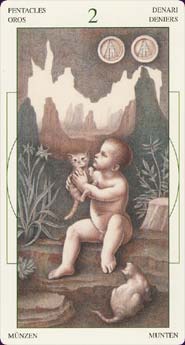
All the majors have Italian script written backwards writing that has the name of the major that you can see in a mirror. Also, little drawings or glyphs, as if Leonardo was making a new symbolic language for the majors. This might be likened to the backwards writing noted in Leonardo's journals and sketchbooks. The use of Italian names reminds me that Leonardo Da Vinci wasn't considered a man of letters based on the Renaissance standard of Latin and Greek scholars. His talents for observation and curiosity and his drive as a lifetime naturalist and student science and arts show a personal drive, not a classical education. I find him fascinating and modern in that respect. I've long been a fan of the Dover Editions of Leonardo's Sketchbooks and find them a wonderful resource. In keeping with the sketchbook feel, the color choices for majors and minors are a limited palette. I've noticed after some study that you can tell the difference in art style between the majors and minors. It's more a subtle difference for me. The majors seem like sculptural icons against a faded backdrop. The modeling seems to have a larger white area on the figures and the color differences seem to be a lighter olive gray, darker brownish black shading. There is a slightly flatter, lighter tint to the backgrounds of the majors. The minors are done in softer, smaller and narrower figures and the shading has a warmer and softer feel. The contrast is clear if you compare the Leda of the World by Ghiuselev with the Two of Chalices' Leda and the Swan by Atanassov. I find Atanassov's court choices rather fun. The King of Swords is similar to Head of a Warrior and Queen of Wands is based on Lady with an Ermine. The tarot version has just enough difference in coloring and slight change of perspective, plus the symbol of the suit to make it look different. So far I've been able to recognize from different art resources which Leonardo depiction was used. If no one else, I think art fans might be pleased. In one pleasant discovery when I compared majors and minors, I found that not only Strength was a woman from Virgin and Child from St. Anne, but the Six of Cups was also a detail from the same picture. The Six of Cups is a child playing with a lamb-- perhaps the iconographic Baby Jesus. Since the woman is taming a lion and the child is playing with a lamb, the Biblical metaphor about the 'lion and the lamb' and 'child shall lead them' makes for a sweet link between these two cards.
The sample Pentacles spread references the Ace of Pentacles, modeled after the famous Leonardo Vetruvian Man. I enjoyed looking at the instructions, major and minor descriptions and the spread. For 12 pages of text, there's quite a bit of information. However what might be a drawback in terms of divinatory meanings for there lacks keywords for reversals in the minors. The majors do have two suggested keywords for reversals. I do recommend this deck to others as a second deck if you like the Italian combination of High Renaissance art and tarot meanings. The ordering of the majors is Marseilles-style with Justice being Card Eight of the trumps and Strength being Card Eleven. The meanings remind me more of Lo Scarabeo's standard traditional meanings rather than the more modern Thoth or Waite- style depictions. I just made another pleasant discovery while researching Leonardo Da Vinci and his designs. He sketched fabulous costumes and effects for celebrations with allegorical references for at least three court productions of the Sforza--one which also included the marriage of Beatrice D'Este of Ferarra and Ludovico Sforza. If you are a fan of Renaissance historical trivia, this might also be the deck for you. In terms of a quick reading with the cards, here's a three card pick:
1) Five of Chalices - a picture of a naked youth contemplating five cups. Meanings: Meditation. Analysis. Careful observation. The search for the 'naked truth.'
2) Justice - a picture of woman with an upraised sword in her left hand and an upraised mirror in her left, facing the artist, which looks like an elderly Leonardo Da Vinci. Meanings: Level-headed. Law. Agreement. Hierarchy. N: Injustice. Legal Problems.
3) King of Chalices - a picture of an elderly man holding one hand over an upraised cup He is clad in a rich collar and hat, seemingly wealthy and masterful. Meanings: Intellectual. Mature man who offers decisive and conclusive help.
To me, this means for meditation and art study, the examples of Leonardo Da Vinci's sketchbooks and this tarot will be a valuable companion. If these seem appealing, you might also enjoy doing online google, used bookstore and library searches for Leonardo Da Vinci resources. It might be a beginning of another beautiful tarot-inspired lifetime study.
Da Vinci Tarot Review by Bonnie Cehovet
Interesting when life morphs from art, to book, to movie, to Tarot! This is exactly what happened with the work of Leonardo Da Vinci. I am excited to be working with this deck, partially because I admire the artist, partially because I found the book so surreal, and partially because I think that a work like this can be incredibly educational.
The LWB that accompanies this deck is one that I find to be quite interesting - it is "small book" size (5" by 7 3/4", 63 pages), and ever so much easier to read that the typical "minuscule print" format of the LWB's that accompany most decks. The nature of this LWB is also unique, in that it not only addresses the Tarot, but the life of the artist, Leonardo Da Vinci.
Da Vinci is known primarily as an artist, but he was also an engineer, inventor, and mathematician. He came into this world with many gifts - the undeniable gift of a thirst for knowledge, the gift of physical beauty, and the gift of being able to communicate through many different venues. Coming from a humble beginning, he was apprenticed at the age of fifteen to master artist Andrea del Verrocchio (who taught Botticelli and influenced Michelangelo). Under del Verrocchio, Da Vinci was exposed to a wide range of artistic venues, including painting, metal work, and sculpture.
An interesting note in the LWB is that Da Vinci more than once did not finish a commission. It is not stated, but my impression here is that Da Vinci's mind worked at warp speed, and it was hard to hold his attention for lengthy spans of time. Another interesting note is his appointment as personal engineer and architect to Ludovico Sforza, duke of Milan. Sketches in his notebooks from this time include everything from churches to submarines (it is a bit scary to see the best and the worst of life in one person). It is possible that Da Vinci did encounter the Tarot during the eighteen years that he held this appointment.
The aim of the artists connected with this deck was to adapt selected elements from the Master's work with the archetypes, themes and divinatory meaning associated with modern Tarot. This is one way of rediscovering the genius that was (and still is) Da Vinci.
The LWB presents the cards without scans of any kind. Each card is broken down into: Encourages (basically the upright meaning of the card), Cautions against (the reversed, or ill-dignified nature of the card), Illustration notes (notes on the background of the card, where the images were adapted from), Commentary (a short discussion of the nature of the card), and Exploration Questions (questions that can be asked to focus the energy of the card, and how it is appearing in your life).
There is a short section on working with the cards that includes two spreads specific to this deck: The Pentacle Spread, a five card spread inspired by Da Vinci's "Vitruvian Man"; and the Da Vinci inspired Insight and Inspiration Spread, a five card linear spread that focuses on a specific problem or challenge.
The cards themselves are approximately 2 5/8" by 4 3/4", of good quality card stock, but would need to be handled with care. The card back shows a depiction of the figure from the Queen of Wands, placed at the right hand corner of the card (on both ends) so that it would not be possible to tell if the card was drawn upright or reversed. The card titles are placed in the four corners, in English, Italian, Spanish, French, German and Dutch. Looking closely at the Major Arcana, you will see (in the background) the card title written backwards (in Italian script). The numbers for the Major Arcana and the Pips appear across the middle of the top of the card.
The colors for this deck are very sepia toned - muted olives, browns, and gray/blues. The style is very reminiscent of Da Vinci's style of painting (we have all at least seen the Mona Lisa!): attention to detail (especially the muscular and skeletal detail of his subjects), with clean lines and, at times, a surreal quality. The Da Vinci Tarot is also unique in that separate artists did the Major Arcana and the Minor Arcana: Lassen Ghiuselev completed the Major Arcana in 1992, while Atanas Atanassov completed the Minor Arcana in 2002. While the differences between the Major and Minor Arcana are discernible, the quality is good throughout, and the cards do flow together.
I am not well versed in art appreciation, but I will say that I felt the drawings were lifelike, even though the faces showed universally stoic expressions. The clothing was of the period, and the lines overall are crisp and clear. The Major Arcana feature Da Vinci's masterpieces (or scenes inspired by them), while the Minor Arcana show scenes appropriate to the period, with the suit symbol in the upper right hand corner.
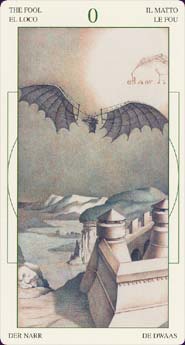
The Fool shows Da Vinci's bat winged flying machine soaring above a castle. Of all the depiction's of the Fool that I have seen, this is the most eerie. Even putting out the idea that man could fly in the time of Da Vinci was a risk - it was just not done! The High Priestess is a take off on the Mona Lisa, showing her wearing a crown (following the thought of the Papesse being a female Pope). The Hierophant shows a side view of a Pope sitting next to a window, and is based on Raphael's portrait of Julius II. In the window we see a glyph taken from Da Vinci's plans for an unfinished basilica (representing the "squaring of the circle", or perfection expressed through geometric form).
The Hermit gives an initial impression of a very skeletal person, i.e. perhaps someone who has been a prisoner of war. It is based on Da Vinci's "St. Jerome", who chose to go into the desert in order to translate Scriptures. In an interesting aside, the image has been reversed from the original. The Hanged Man in this deck is interesting, as he is hanging from the neck, with his hands behind his back, and his legs straight down, feet pointing towards the floor. The image comes from Da Vinci's study of the Bernardo di Bandino Baroncelli.
I love the image of death in this deck! According to the LWB, it is an allegorical sketch of Envy, raising her arm to block the gaze of heaven. What I found so interesting is that she is kneeling atop one of Da Vinci's inventions - a multi-bladed battle wagon. In her right hand she hold aloft a skull based on one of Da Vinci's anatomical studies. Temperance has been adapted from Da Vinci's "Annunciation". The image here has been reversed from the original, as was that of the Hermit.
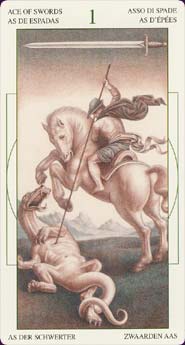
The Aces in many deck can be incredibly boring - but that is not the case here. The Ace of Wands shows an image of an unborn child, taken from one of Da Vinci's sketches, seated in a valley, above a town. The Ace of Chalices shows the image of a mother and child, adapted from the "Litta Madona", which, according to the LWB, is questionably attributed to Da Vinci. The Ace of Swords is based on the legend of St. George, and shows a rider, cape flying, seated on a rearing horse with is lance through the dragon. The Ace of Pentacles will be familiar to everyone, as it is based on Da Vinci's "Vitruvian Man".
The Five of Chalices is based on one of Da Vinci's male nude studies, and resembles what "The Thinker" might look like in a standing pose. I found this to be a very strong card. The Four of Swords is adapted from Da Vinci's "St. John The Baptist". His right hand points upward, towards the four swords int he right hand corner of the card. The Seven of Swords is another stunning card. At the bottom of the card we see a horse, with rider, drawing a "weaponized" chariot. In the background we see another chariot that has overturned, with bodies lying on the ground next to it. In the upper right hand corner are seven swords. In essence, this card naturally divides itself into three pictures.
While I generally find Tarot decks that fall into the category of "art" (as this deck does) interesting but a bit "standoffish", I was drawn to this deck. For someone who is interested in the Renaissance period, or someone who is a collector, this is a must have deck. It is a deck that requires some knowledge of Tarot basics to work with, so it would be more appropriate for an experienced reader than for a Tarot novice. While the nudity is appropriate when it appears, this deck would not be acceptable for all audiences. Used with discretion, the Da Vinci Tarot brings with it the great gift of wisdom, and a wonderful opportunity to peek into another time.
© Bonnie Cehovet
Complete Details of Da Vinci Tarot
Also known as Leonardo da Vinci Tarot
Creators: A. Atanassov, Iassen GhiuselevPublisher: Lo Scarabeo 2004
Publisher: Lo Scarabeo 2005
Deck Type: Tarot Deck
Cards: 78
Major Arcana: 22
Minor Arcana: 56
Deck Tradition: Mixed
Minor Arcana Style: Unique Scenes With Suit Symbols
Suits: Chalices, Swords, Wands, Pentacles
Court Cards: Knave, Knight, Queen, King
Major Titles: The Fool, The Magician, The High Priestess, The Empress, The Emperor, The Hierophant, The Lovers, The Chariot, Justice, The Hermit, The Wheel, Strength, The Hanged Man, Death, Temperance, The Devil, The Tower, The Stars, The Moon, The Sun, Judgement, The World
The Fool is 0
Strength is 11
Justice is 8
Card Size: 2.60 x 4.72 in. = 6.60cm x 12.00cm
Card Language: Spanish, Italian, German, French, English, Dutch
Card Back: Reversible
Back Design: Mirrored image in sepia of the Queen of Wands.
Companion Material: 64-page stapled book (much larger than a regular companion booklet) written by Mark McElroy.
Rating: 16/20 or
 stars out of five
Similar Decks to Da Vinci Tarot
Theme: Art StyledCreator: Tarocchi di Pinocchio, Tarot of the III Millennium by Iassen Ghiuselev Bosch Tarots, Golden Botticelli Tarot, Golden Tarot of Klimt, Golden Tarot of the Tsar, Karma Angels Oracle, Mantegna Tarot, Tarot of Visconti Grand Trumps, Visconti Tarot, Visconti Tarot Mini by A. Atanassov

< Previous Deck · Back to Top · Next Deck >
Home > Tarot Reviews > Da Vinci Tarot Review