
Wildwood Tarot Deck Review
The Wildwood Tarot is a complete reconception and redesign of the popular Greenwood Tarot. This time author Mark Ryan is working with John Matthews, and illustrator Will Worthington of the DruidCraft Tarot, to the create this deck based on the seasonal rhythms and festivals of the ancient year.
Deck Type: Tarot Deck Cards: 78
Creators: John Matthews, Mark Ryan, Will Worthington
Publisher: Sterling 2011
Card Images from the Wildwood Tarot
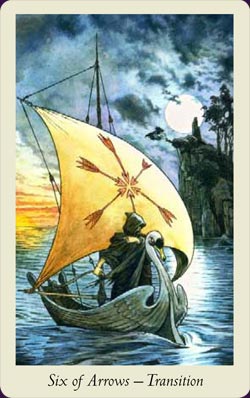
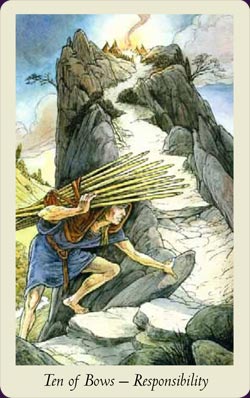
Wildwood Tarot Sample Images Cards copyright Will Worthington 2010, reproduced from THE WILDWOOD TAROT by Mark Ryan and John Matthews with permission from Eddison Sadd Editions, London. Further reproduction is prohibited.
Retailers
See Price at Amazon.comSee Price at Amazon.co.uk
See Price at Amazon.ca
Wildwood Tarot Review by Bonnie Cehovet
In his preface, “Return To The Green”, Mark Ryan refers to the “Greenwood Tarot”, the predecessor to the “Wildwood Tarot”. He notes that the insights from the Greenwood “otherworld” have been nurtured and applied by thousands of people. They have come to know the esoteric archetypes that inhabit the Wildwood, and the Wheel of the Year system. Unavailable for some years now, the “Wildwood Tarot” takes its place alongside it predecessor. The focus and emphasis for the “Wildwood Tarot” is on ecology, and he older conception of forest lore from a European perspective.
Everyone that I know that has worked with either of these decks has been drawn into them, and moved beyond belief. They are not to be taken lightly. The box that the book and deck come in is heavy duty, with a lift-off top. The figure on the top of the box is that of the Ancestor (Hierophant), a very imposing figure clad in reindeer skins and evergreen leaves. This figure alone tells of the seriousness of intent in this deck. There are two compartment within the box for the cards, with finger-hole to make easy to get the cards out
I am a little bobblehead reading the companion book. (Yes, I read companion books from first word to last. I am not of the school that throws the book away and just takes the cards out to play.) The figure on the cover of the companion book is that of the Hooded Man (The Hermit). This is a favorite card for me in most decks, as it is one of my birth cards, and a card that I strongly identify with.
Note: Having said this, Mark Ryan says in “Part One – Into The Green” that the best advice he was ever given was to “Read the book, meditate with the cards, then put the book away and do your own thing.”
I am impressed with many things in the companion book. From an esoteric perspective, I love the fact that green type has been used, and that the pages that divide the sections are green, with white print. It follows the theme of the book, without making a mockery of it. The companion book is divided into three parts: Part One – Into The Green (Introduction), Part Two – The Cards And Their Meanings, and Part Three – Finding Your Way (working with the cards).
The deck is a traditional 78 card deck, with the Major Arcana renamed as follows:
0 The Wanderer (The Fool)
1 The Shaman (The Magician)
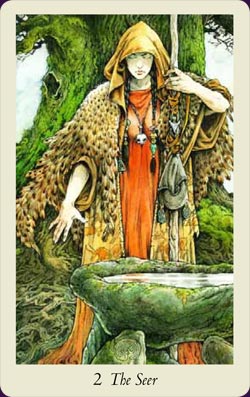
2 The Seer (The High Priestess)
3 The Green Woman (The Empress)
4 The Green Man (Emperor)
5 The Ancestor (The Hierophant)
6 The Forest Lovers (The Lovers)
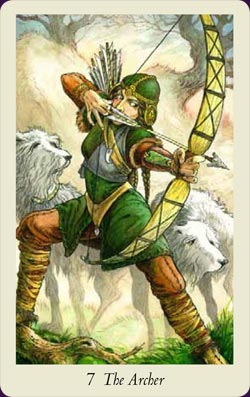
7 The Archer (The Chariot)
8 The Stag (Strength)
9 The Hooded Man (The Hermit)
10 The Wheel (The Wheel of Fortune)
11 The Woodward (Justice)
12 The Mirror (The Hanged Man)
13 The Journey (Death)
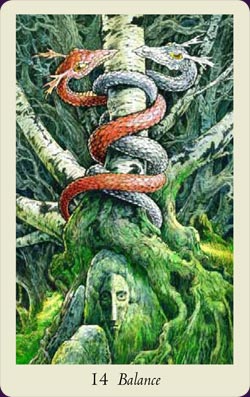
14 Balance (Temperance)
15 The Guardian (The Devil)
16 The Blasted Oak (The Tower)
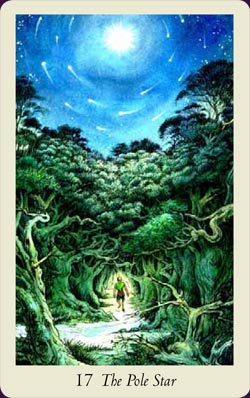
17 The Pole Star (The Star)
18 The Moon On Water (The Moon)
19 The Sun of Life (The Sun)
20 The Great Bear (Judgment)
21 The World Tree (The World)
The suits are Arrows (Swords/Air/Spring), Bows (Wands/Fire/Summer), Stones (Pentacles/Earth/Winter) and Vessels (Cups/Water/Autumn). The Court Cards are King, Queen, Knight and Page.
In his introduction, Mark Ryan addresses the subject of gender in the deck. First and foremost, each of us carries both male and female qualities. Where the concept of the archetype was largely masculine or feminine, that is what the creators worked with. In other instances, choices were made – such as the Moon being portrayed as feminine and the Sun as masculine. Ryan also addresses such things as asking questions (which he breaks down into the formulation of the question, the impartial layout of the cards, and the interpretation of the layout), fate and the Tarot, and the foundation for the Wheel of the Year. He takes us through the four seasons, the four corresponding suits, and each card in turn. The text is complimented with an excellent schematic of the Wheel of the Year and the four suits.
The cards are presented with a black and white scan, a short synopsis of their position on the wheel, a description of the card, a discussion of the meaning of the card, reading points, and a highlighted section called “Roots and Branches”, where the keywords are listed. Note: The Court Cards do not contain descriptions, and the Pips (numbered cards) do not contain keywords. The intro page to each suit includes a quote, the position on the wheel, the elemental association and associations (keywords/qualities applicable to each suit).
The chapter on working with the deck includes a three-card spread (The Pathway), a seven card spread (The Bow), and an eight card spread (The World Tree). After the spreads the authors have included a visualization (The Hermit’s Cave). At the end of the book are blank pages for making notes.
I was especially pleased to see a visualization presented, and presented so well. The reason given for including this was that answers do not come easily in any divination system, or in a form that is easily understandable. The visualization is meant to help the Seeker focus on their question, and to get to know the archetypes and what they represent.
The cards themselves are 3” by 4 ¾”. The backs are black, with a fine white border ¼” in. At each corner is a white flower. Along the border on the right and left hand sides is a copyright notice. The backs are reversible. The card faces have a ¼” white border. The titles are across the bottom, in black mettering: the Major Arcana show the card number and title, the Pips show the card number and suit, in text, with the keyword for the card. The Court Cards show the card title and suit, in text, along with the keyword for the card.
The artwork is color intense, with a sense of fantasy, along with a strong acknowledgement of the natural world, and stands consistent from card to card. The artwork, by Will Worthington, is very different from that of the “Greenwood Tarot”, which was illustrated by Chesca Potter. Both decks stand on their own as far as the artwork goes. There is an intensity of both color and form in these cards – they carry great power, to the point that at times one does have to step back and regroup.
With the sense of earthiness and care for the planet at the foundation of this deck, it would appeal to all forms of nature (green) spirituality, as well as to those that follow other religious orientations. The stories flow in this deck – it would be easy to read from for and level of Tarot reader/student, and is applicable for all ages and all backgrounds.
© Bonnie Cehovet
Wildwood Tarot Review by Raya P.
I'd been wanting to get my own deck for quite some time. The one that I have from before was given to me by a friend and it took a couple of years for me to get accustomed to it. So it never felt like my own.
That's why it felt like such a bliss when I found this deck! I've been looking through all the decks that have a 3.5 and up rating, and even though I liked a bunch of them, I felt like I needed more proof they they are good decks than just looking at the sample cards. But when I saw Wildwood, it instantly felt familiar (plus I was mesmerized by the artwork).
I ordered it from Amazon and it came pretty quickly. When I opened the box and started looking through the cards I've realized that I actually love each and every card in the deck. Apart from the art being stunning, this deck is all about regeneration (rebirth) and the cycle of life interpreted through the seasons of the year, all tied in the Celtic mythology. I must add that even though this deck has a lot of Celtic influences, it is not the typical stereotyped runes and druids stuff. A lot of the cards in the deck are animals commonly found in European woods (which is also why it felt like home to me I guess). The whole deck is the embodiment of Wildwood and each card represents some aspect of the forest as you're walking through it.
It is a traditional 78 card deck, although some of the meanings of the cards are slightly changed to suit the overall theme. There are 22 Major Arcana cards in this deck. They are:
0 The Wanderer (The
Fool)
1 The Shaman (The Magician)
2 The Seer (The High
Priestess)
3 The Green Woman (The Empress)
4 The Green Man
(Emperor)
5 The Ancestor (The Hierophant)
6 The Forest Lovers
(The Lovers)
7 The Archer (The Chariot)
8 The Stag
(Strength)
9 The Hooded Man (The Hermit)
10 The Wheel (The
Wheel of Fortune)
11 The Woodward (Justice)
12 The
Mirror (aspects of The Hanged Man, although I feel that
if in the case of the Hanged Man he changes his
perception by looking at the world from a different
perspective, the Mirror is more intimate, inviting you to look
at yourself and maybe accepting parts of yourself to
change your views)
13 The Journey (Death)
14 Balance
(Temperance)
15 The Guardian (The Devil)
16 The Blasted Oak (The
Tower and The Hanged Man)
17 The Pole Star (The Star)
18
The Moon On Water (The Moon)
19 The Sun of Life (The
Sun)
20 The Great Bear (Judgment)
21 The World Tree (The
World)
The 4 (four) suits are Arrows (Swords), Bows (Wands), Stones (Pentacles) and Vessels (Cups). In this deck they each also represent a season of the year and an element associated with that season.
The companion book provides a beautiful interpretation of how all the cards fit into the Wheel of the Year. I would also recommend reading all the introductions as they provide a history and inspiration behind this deck. The book has 2-page detailed descriptions for the major Arcana cards, and a 1-page description for the suits. It also proposes three spreads and a visualization at the end.
I found the readings from this deck to be very accurate not only for myself but for other people, too. The people who I did readings to felt inspired and ready for whatever may come after their readings, which is very flattering. I do believe that it is partially because of my bond with this deck. One person picked it up once and tried to shuffle it to ask a simple question, and after 30 seconds or so he gave it to me saying that he can't do it, that the deck is bound to me. That's why I think that no matter how good and amazing one deck might be for one person it might not be the same for the other. You have to be emotionally connected to the deck from the first time you lay your eyes on it. For me, this deck is perfect in every single way.
Happy Readings!
Wildwood Tarot Review by John Matthews
Information on the Wildwood Tarot by Mark Ryan and John Matthews illustrated by Will Worthington
The following 6 cards represent a selection from both Major and Minor cards in the deck. We have chosen them to illustrate the wonderful depths and magical quality of the Wildwood.
2: THE SEER
The Seer is wrapped in the owl's cloak of wisdom decorated with totem animals of power and shamanic spirits. She stands before the World Tree, drawing wisdom from the roots that are deeply embedded in the earth. Close around her are the symbols of the four elements that she mediates: the cup, staff, arrowhead and stone. From the head of her staff hang the crane bag and a set of runes. Her face may only be glimpsed or seen in half-light. Her voice may be hushed and she may speak in riddles, but if you listen, she can point you to new, wiser beginnings. With her inherent ability to balance emotion, intellect and will power, she spurs us to create change in our material world and is a skilled mediator of all the elemental forces found within the Wildwood. She fosters the positive exercise of will, manifested by emotion and commitment and resulting in outer material effect. This is one of the purest and most blessed forms of Earth magic.
7: THE ARCHER
The Archer holds the broad longbow poised in the act of release. The bow is of an ancient design, the fletchings are of goose feather, taken from the right wing, and the arrowhead is flint. The Archer's gaze is focused and steady as she looks beyond the arrow into the sky, holding the tension between the bow and the sinew bowstring with controlled and relaxed intent. She wears a simple amulet and appears serene and confident yet full of purpose. By her side stand two great hunting dogs, messengers of the power she holds within herself. Just as spells and curses were loosed through the air by hunters and shamans, so we must ourselves tune in to this ancient process and become archers with quivers full of ideas and desires, capable of forming and focusing our aim in the steady drawing of our will and then loosing our creative and intellectual drives in a controlled and effective way.
14: BALANCE
The polarised energies of the land interweave and intertwine around the staff of the heavens, generating the pulse of life. Red and white serpents coil around a great tree – the heart of the Wildwood. Red and white energies represent the basic colours of a primal world – red for blood, fire and iron; white for milk, ash and bone. These colours are particularly relevant to Beltane as it lies at the junction on the Wheel between Fire (red) and Air (white), and from this interaction come creative impulses. The ancient symbol of the caduceus echoes the double helix of human DNA, the building blocks of life, where each strand contains the information of the whole. The human face of the Wildwood has both a light and a dark side, shown here in the face of the wooden masked carved into the tree itself. Both are natural and necessary components of the human condition.
17: THE POLE STAR
The pure white light of The Pole Star illuminates the dark void of the universe and casts its radiance upon the earth. The stars represents the remotest power in the celestial sky and the interaction and fusion of particles that produce light and heat. Stars rise above the Earth, beckoning our searching minds to reach beyond our own solar system and grasp the vastness of space. The swirling clouds of stellar dust that formed the heart of the stars spiral outward into infinity and turn with the cycle of the universe. The blessing of The Pole Star radiates to the Earth across the abyss and reminds us that the same stuff of creation that fuels and binds these mighty sentinels of the night sky burns within us. Latest research shows that stars are initially formed as a sphere within a ring or circle of matter, echoing the cup and ring symbols found carved on the stones of prehistory that may represent the seed of manifestation and the source of creation itself. The blessing of the stellar world bathes the Earth and the human spirit with healing and regenerative energy.
SIX OF ARROWS
A stylised wooden boat with a swan prow floats on a still pool of water. A single white sail on which a six-pointed star is outlines by six arrows drives it. In the prow of the boat stands a lone, cloaked figure. The primal impulse is to move beyond old boundaries and personal thought processes and deploy new methods of reasoning to resolve important issues. Some obstacle may challenge older methods, and new, more dynamic responses are required to adapt to a new set of paradigms. This can be an exciting process. The journey may be scary, since letting go of old and previously effective processes can be unsettling, but the unseen tides that drive the need to evolve are already pulling you to new experiences and places. Trust in your own instincts and skills to absorb change is essential to overcome new situations.
TEN OF BOWS
A lone figure has gathered a large bundle of ten unfinished longbow staves and struggles stoically and determinedly with the heavy burden over his shoulder, toward a woodland encampment of hunters and warriors. Fires burn, welcoming beacons in the darkness and the figure toils up the dark, winding forest pathway towards the reassuring glow of security and companionship. The challenge of dealing with responsibility brings a need for inner fortitude, stamina and determination. The weight of the burden may be heavy and cumbersome but the task may be vital for the greater good, not just for the individual but also for the wellbeing of the family or chosen tribe.
Text copyright John Matthews and Mark Ryan, 2010; cards copyright Will Worthington 2010, reproduced from THE WILDWOOD TAROT by Mark Ryan and John Matthews with permission from Eddison Sadd Editions, London. Further reproduction is prohibited. THE WILDWOOD TAROT is currently in preparation for publication spring 2011 by Sterling Publishing (US) and Connections Book Publishing (UK).
Wildwood Tarot Review by Rosaleen D. Bellchamber
I have used the Greenwood Tarot for many years, and so naturally I became interested in the prospect of a re-release. The Wildwood Tarot however, is no mere re-packaging of the 'Greenwood', and while they certainly share themes and some of the text, the Wildwood is entirely its own beast! And this is a good thing.
First of all, the text has been expanded, and changes have been made within the overall context of the set which further deepens individual card meanings and enhances the relationship to the Wheel of the Year. There is a strong emphasis on ecological awareness and concern for our planet, as well as enchantment with old European forest lore and mystery. The Wildwood Tarot tarot will speak directly to those who embrace any form of green spirituality including (but not limited to) Wiccans, Druids and Pagans, as well as those who have a fondness for Northern European myth and legend. There is also more contemplative material added to aid in meditation and provide a more spiritually focused reading. I also enjoyed the fact, that while gender is occasionally referenced, the creators of this deck do not limit themselves to a strict binary view of gender, and many of the figures can be interpreted as male or female.
The book is organized in two ways so that you can experience the cards in the context of the 'Wheel of the Year' and/or the traditional tarot order. This is helpful for seasoned students of tarot, as you do not have to completely chuck out your tarot training in order to jive well with this system even though some of the Majors have been renamed: The Wanderer (the Fool), the Seer (High Priestess), the Hooded Man (the Hermit), ect. The suit of arrows pertains to spring/air; bows to fire/summer; vessels to water/autumn; and stones to earth/winter. As in the Greenwood Tarot, the court cards are represented as animals. Some changes have been made to the court cards to better correspond to each suit's element.
Then there's the art itself. Like many 'Greenwood' fans, I too enjoyed Chesca Potter's art, although I found it to be inconsistent in style. It would be futile to compare the art in both decks to each other, as the artist (Will Worthington, who also illustrated the Druid Animal Oracle, Druid Plant Oracle, and Druidcraft Tarot), has provided an entirely new vision, which stands on its own merits. While homage is paid to the original work by Potter, Worthington definitely revisions the deck in his own style. The art in the Wildwood Tarot is bold, crisp and evocative. The scans of some of the cards on the internet do not do justice to the beauty of this deck. You truly have to meet this deck in person to get the full impact! The cards are not too large (comparable in size to your standard tarot deck), the card stock is strong, yet flexible, with a nice smooth finish. The printing is excellent and showcases the art well, and the colours are rich. I was quite pleased with the packaging and presentation.
Most importantly, however, to any
tarot reader and collector who needs more than just
pretty cards to be satisfied: it reads beautifully! This
deck has a warm, conversational feel, coupled with that
uncanny feeling one gets while walking in the woods alone:
calm and relaxed, yet slightly dreamy with a tinge of
danger. Which brings to mind another point about the
Wildwood Tarot that I love: even though the card meanings
are quite positive and spiritually focused, it does
not shy away from conflict, challenge or death like
many softer decks do. It embraces challenge and death
as part of the life cycle overall, and as part of
one's growth and development. I heartily recommend this
deck to anyone who wishes for an earthy,
Pagan-friendly, organic feeling deck while keeping with
traditional tarot structure, as well as anyone who appreciates
an artfully beautiful deck.
Complete Details of Wildwood Tarot
Creators: John Matthews, Mark Ryan, Will WorthingtonPublisher: Sterling 2011
Deck Type: Tarot Deck
Cards: 78
Major Arcana: 22
Minor Arcana: 56
Rating: 16/20 or
 stars out of five
Similar Decks to Wildwood Tarot
Theme: Celtic, NatureCreator: Camelot Oracle, Celtic Lenormand, Druid Animal Oracle, Druid Plant Oracle, DruidCraft Tarot by Will Worthington Greenwood Tarot by Mark Ryan Arthurian Tarot, Byzantine Tarot, Camelot Oracle, Cathar Tarot, Celtic Oracle, Celtic Shaman's Pack, Grail Tarot, Lost Tarot of Nostradamus, Shaman's Oracle, Sherlock Holmes Tarot, Steampunk Tarot by John Matthews

< Previous Deck · Back to Top · Next Deck >
Home > Tarot Reviews > Wildwood Tarot Review